Department of Obstetrics and Gynecology, School of Medicine and Dentistry, University of Rochester, Rochester, New York 14642, USA.
Environ Health Perspect. 2011 Jul;119(7):958-63. doi: 10.1289/ehp.1103421. Epub 2011 Mar 4.
In male rodents, anogenital distance (AGD) provides a sensitive and continuous correlate of androgen exposure in the intrauterine environment and predicts later reproductive success. Some endocrine-disrupting chemicals can alter male reproductive tract development, including shortening AGD, in both rodents and humans. Whether AGD is related to semen quality in human is unknown.
We examined associations between AGD and semen parameters in adult males.
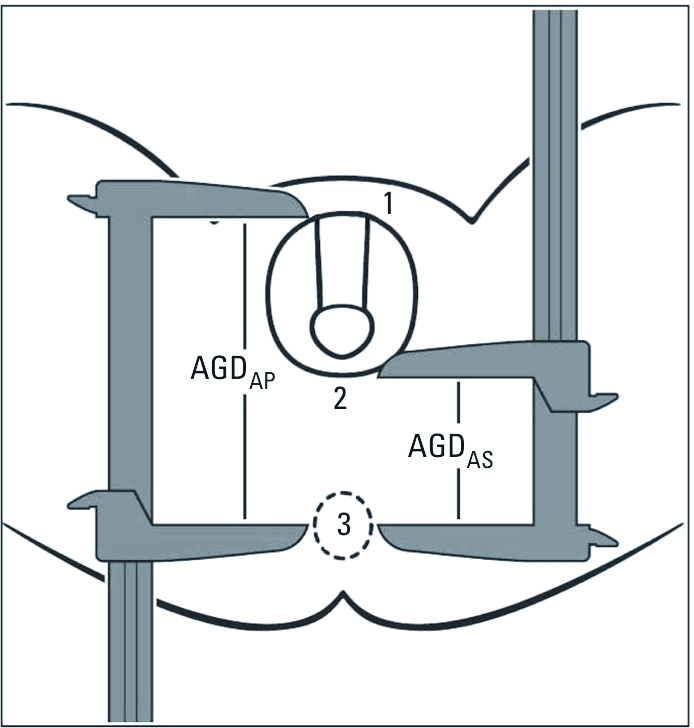
We used multiple regression analyses to model the relationships between sperm parameters and two alternative measures of AGD [from the anus to the posterior base of the scrotum (AGD(AS)) and to the cephalad insertion of the penis (AGD(AP))] in 126 volunteers in Rochester, New York.
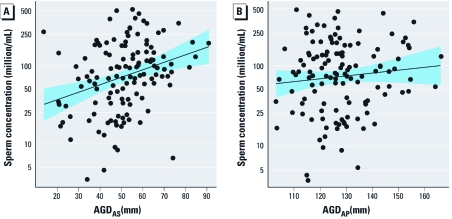
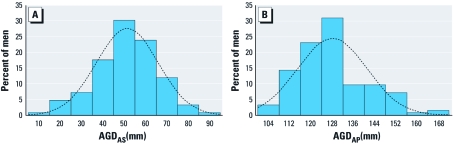
AGD(AS), but not AGD(AP), was associated with sperm concentration, motility, morphology, total sperm count, and total motile count (p-values, 0.002-0.048). Men with AGD(AS) below (vs. above) the median were 7.3 times more likely (95% confidence interval, 2.5-21.6) to have a low sperm concentration (< 20 × 10⁶/mL). For a typical study participant, sperm concentrations were 34.7 × 10⁶/mL and 51.6 × 10⁶/mL at the 25th and 75th percentiles of (adjusted) AGD(AS).
In our population, AGD(AS) was a strong correlate of all semen parameters and a predictor of low sperm concentration. In animals, male AGD at birth reflects androgen levels during the masculinization programming window and predicts adult AGD and reproductive function. Our results suggest, therefore, that the androgenic environment during early fetal life exerts a fundamental influence on both AGD and adult sperm counts in humans, as demonstrated in rodents.
在雄性啮齿动物中,肛门生殖器距离(AGD)提供了宫内环境中雄激素暴露的敏感和连续相关指标,并预测了后期的生殖成功。一些内分泌干扰化学物质可以改变雄性生殖道的发育,包括缩短 AGD,这在啮齿动物和人类中都有发现。AGD 是否与人类的精液质量有关尚不清楚。
我们研究了 AGD 与成年男性精液参数之间的关系。
我们使用多元回归分析模型,在纽约罗切斯特的 126 名志愿者中,研究了精子参数与 AGD 的两种替代测量方法[从肛门到阴囊的后基底(AGD(AS))和到阴茎的头侧插入(AGD(AP))]之间的关系。
AGD(AS),而不是 AGD(AP),与精子浓度、活力、形态、总精子数和总活动精子数相关(p 值为 0.002-0.048)。AGD(AS)低于(而非高于)中位数的男性,精子浓度低(<20×10⁶/ml)的可能性是 7.3 倍(95%置信区间,2.5-21.6)。对于典型的研究参与者,在(调整后的)AGD(AS)的 25%和 75%百分位数,精子浓度分别为 34.7×10⁶/ml 和 51.6×10⁶/ml。
在我们的人群中,AGD(AS)是所有精液参数的强相关指标,也是精子浓度低的预测指标。在动物中,出生时的雄性 AGD 反映了雄性化编程窗口期间的雄激素水平,并预测了成年的 AGD 和生殖功能。因此,我们的研究结果表明,在人类中,正如在啮齿动物中所证明的那样,早期胎儿生命中的雄激素环境对 AGD 和成年精子计数都有基本的影响。