Department of Chemistry, University of New Hampshire, Durham, New Hampshire 03824, USA.
Inorg Chem. 2011 Apr 4;50(7):3078-86. doi: 10.1021/ic200014w. Epub 2011 Mar 7.
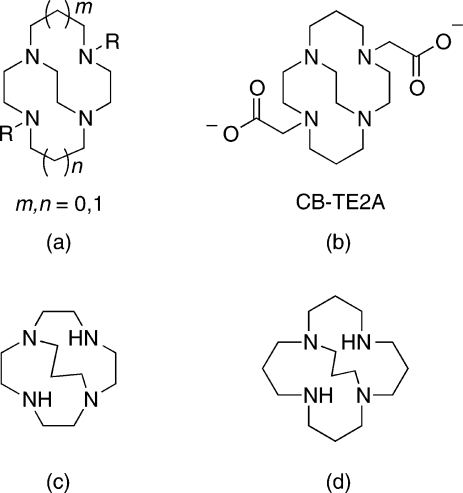
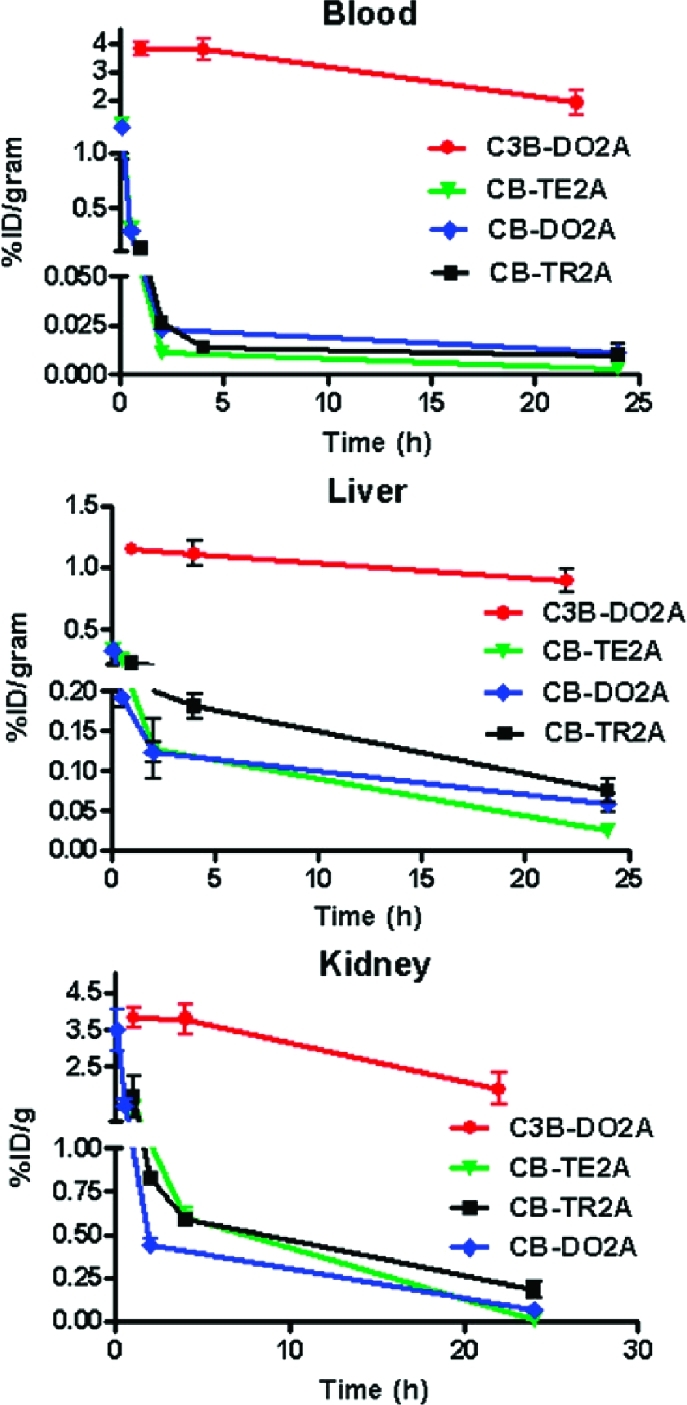
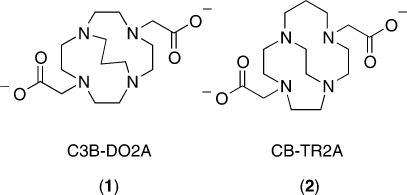
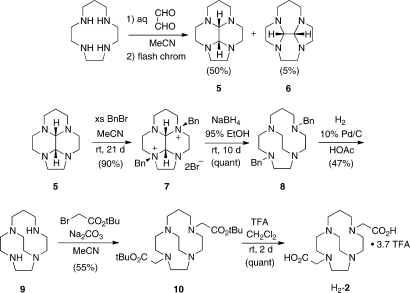
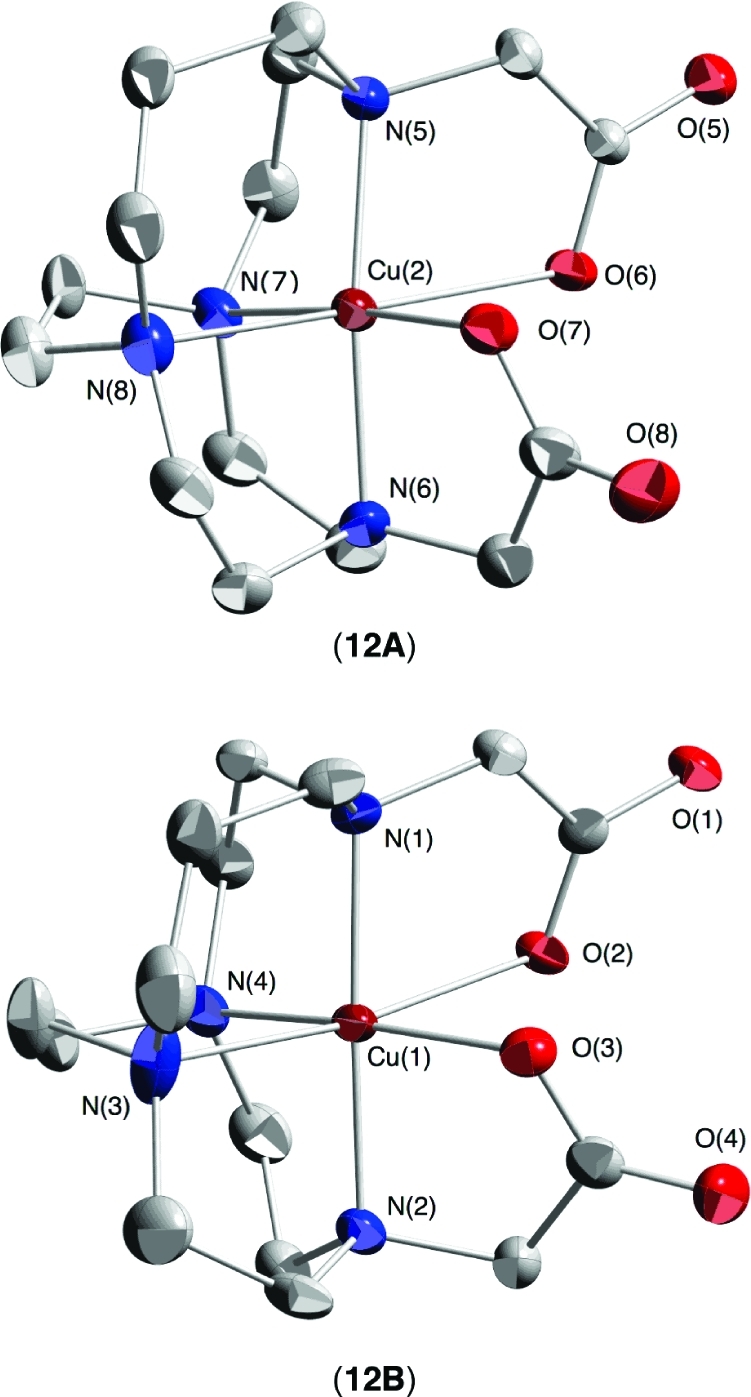
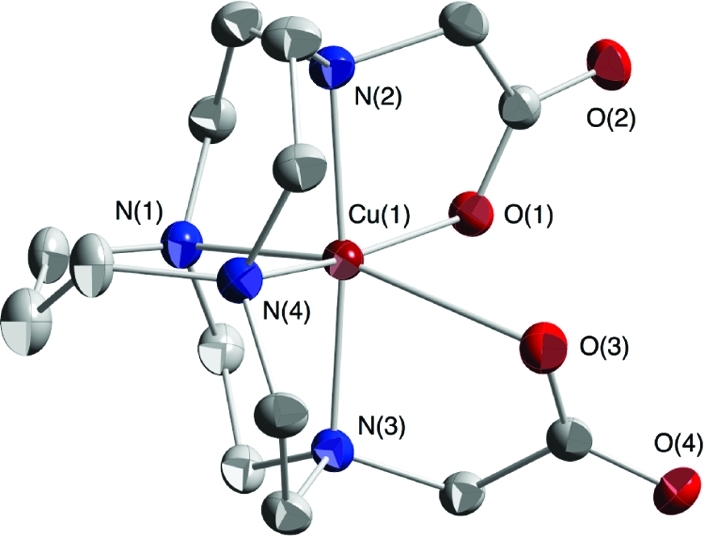
Ethylene cross-bridged tetraamine macrocycles are useful chelators in coordination, catalytic, medicinal, and radiopharmaceutical chemistry. Springborg and co-workers developed trimethylene cross-bridged analogues, although their pendant-armed derivatives received little attention. We report here the synthesis of a bis-carboxymethyl pendant-armed cyclen with a trimethylene cross-bridge (C3B-DO2A) and its isomeric ethylene-cross-bridged homocyclen ligand (CB-TR2A) as well as their copper(II) complexes. The in vitro and in vivo properties of these complexes are compared with respect to their potential application as (64)Cu-radiopharmaceuticals in positron emission tomography (PET imaging). The inertness of Cu-C3B-DO2A to decomplexation is remarkable, exceeding that of Cu-CB-TE2A. Electrochemical reduction of Cu-CB-TR2A is quasi-reversible, whereas that of Cu-C3B-DO2A is irreversible. The reaction conditions for preparing (64)Cu-C3B-DO2A (microwaving at high temperature) are relatively harsh compared to (64)Cu-CB-TR2A (basic ethanol). The in vivo behavior of the (64)Cu complexes was evaluated in normal rats. Rapid and continual clearance of (64)Cu-CB-TR2A through the blood, liver, and kidneys suggests relatively good in vivo stability, albeit inferior to (64)Cu-CB-TE2A. Although (64)Cu-C3B-DO2A clears continually, the initial uptake is high and only about half is excreted within 22 h, suggesting poor stability and transchelation of (64)Cu to proteins in the blood and/or liver. These data suggest that in vitro inertness of a chelator complex may not always be a good indicator of in vivo stability.
乙烯交叉桥连四胺大环配合物在配位、催化、药物和放射性药物化学中是有用的螯合剂。Springborg 及其同事开发了三亚甲基交叉桥连类似物,尽管它们的悬垂臂衍生物受到的关注较少。我们在此报告一种带有三亚甲基桥的双羧甲基悬垂臂环庚三烯(C3B-DO2A)及其异构的乙烯交叉桥连同环庚三烯配体(CB-TR2A)以及它们的铜(II)配合物的合成。比较了这些配合物的体外和体内性质,以评估它们作为正电子发射断层扫描(PET 成像)中(64)Cu 放射性药物的潜在应用。Cu-C3B-DO2A 对脱配合物的惰性非常显著,超过了 Cu-CB-TE2A。Cu-CB-TR2A 的电化学还原是准可逆的,而 Cu-C3B-DO2A 的电化学还原是不可逆的。与 Cu-CB-TR2A(碱性乙醇)相比,制备(64)Cu-C3B-DO2A(高温微波加热)的反应条件相对苛刻。(64)Cu 配合物的体内行为在正常大鼠中进行了评估。(64)Cu-CB-TR2A 通过血液、肝脏和肾脏的快速和持续清除表明其具有相对良好的体内稳定性,尽管不如(64)Cu-CB-TE2A。虽然(64)Cu-C3B-DO2A 持续清除,但初始摄取量较高,只有大约一半在 22 小时内排出,表明其在血液和/或肝脏中的稳定性差,并且发生了(64)Cu 向蛋白质的转金属化。这些数据表明,螯合剂配合物的体外惰性不一定总是体内稳定性的良好指标。