Malaria Drug Resistance and Chemotherapy Laboratory, Queensland Institute of Medical Research, Brisbane, Australia.
Malar J. 2011 Mar 8;10:56. doi: 10.1186/1475-2875-10-56.
Artemisinin-combination therapy is a highly effective treatment for uncomplicated falciparum malaria but parasite recrudescence has been commonly reported following artemisinin (ART) monotherapy. The dormancy recovery hypothesis has been proposed to explain this phenomenon, which is different from the slower parasite clearance times reported as the first evidence of the development of ART resistance.
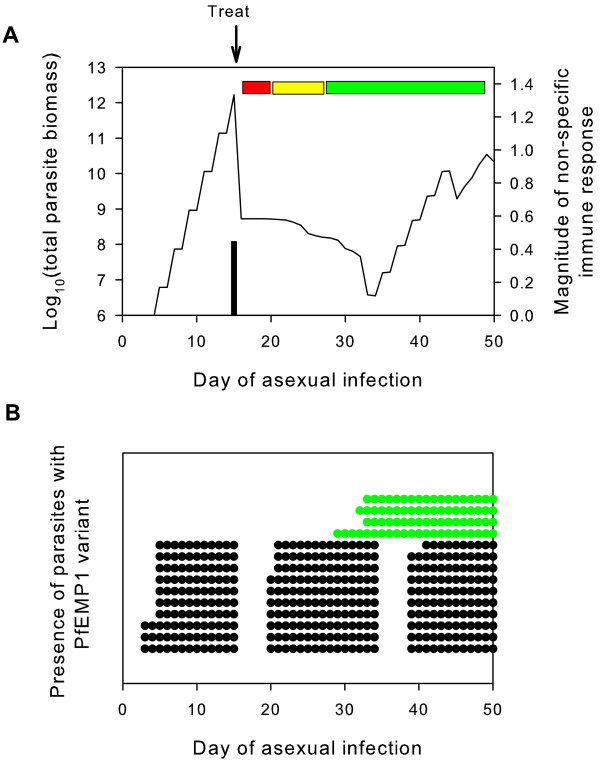
In this study, an existing P. falciparum infection model is modified to incorporate the hypothesis of dormancy. Published in vitro data describing the characteristics of dormant parasites is used to explore whether dormancy alone could be responsible for the high recrudescence rates observed in field studies using monotherapy. Several treatment regimens and dormancy rates were simulated to investigate the rate of clinical and parasitological failure following treatment.
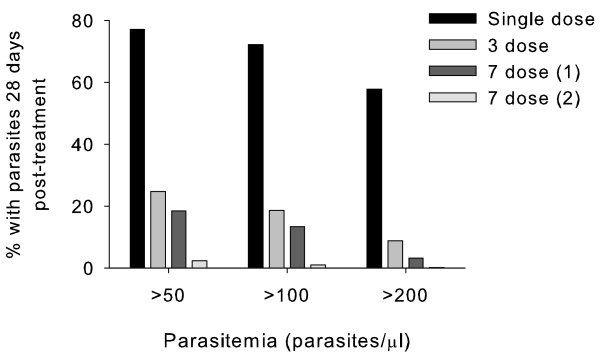
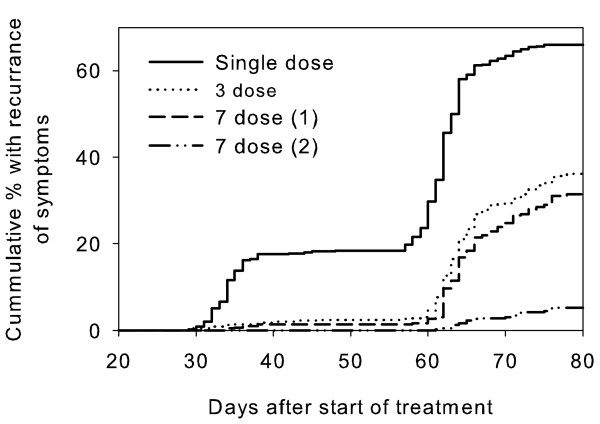
The model output indicates that following a single treatment with ART parasitological and clinical failures occur in up to 77% and 67% of simulations, respectively. These rates rapidly decline with repeated treatment and are sensitive to the assumed dormancy rate. The simulated parasitological and clinical treatment failure rates after 3 and 7 days of treatment are comparable to those reported from several field trials.
Although further studies are required to confirm dormancy in vivo, this theoretical study adds support for the hypothesis, highlighting the potential role of this parasite sub-population in treatment failure following monotherapy and reinforcing the importance of using ART in combination with other anti-malarials.
青蒿素联合疗法是治疗无并发症恶性疟的一种非常有效的方法,但在青蒿素(ART)单药治疗后,常报告寄生虫复发。已经提出休眠恢复假说来解释这种现象,这与报道的作为青蒿素耐药性发展的第一个证据的较慢寄生虫清除时间不同。
在这项研究中,对现有的恶性疟原虫感染模型进行了修改,纳入了休眠假说。使用描述休眠寄生虫特征的已发表的体外数据来探索仅休眠是否可能导致在单药治疗的现场研究中观察到的高复发率。模拟了几种治疗方案和休眠率,以研究治疗后临床和寄生虫学失败的发生率。
模型输出表明,在单次使用 ART 治疗后,寄生虫学和临床失败的发生率分别高达 77%和 67%。这些比率随着重复治疗迅速下降,并且对假定的休眠率敏感。模拟的寄生虫学和临床治疗失败率在治疗后 3 天和 7 天与来自几项现场试验的报告相当。
尽管需要进一步的研究来确认体内休眠,但这项理论研究为该假说提供了支持,突出了这种寄生虫亚群在单药治疗后治疗失败中的潜在作用,并强调了在联合使用其他抗疟药物的情况下使用青蒿素的重要性。