Institute of Endocrinology, Chaim Sheba Medical Center, Tel Hashomer, Israel.
Diabetes. 2011 Apr;60(4):1134-45. doi: 10.2337/db09-1323. Epub 2011 Mar 8.
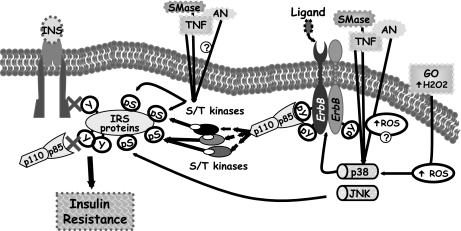
Stress stimuli such as tumor necrosis factor (TNF) have been shown to induce insulin receptor substrate (IRS)-1 serine phosphorylation and insulin resistance by transactivation of ErbB receptors. We aimed at elucidating the potential role of p38 mitogen-activated protein kinase (p38MAPK) in mediating stress-induced ErbB receptors activation.
p38MAPK effect on ErbBs transactivation and insulin signaling was assessed in Fao or HepG2 cells, exposed to stress stimuli, and on metabolic parameters in ob/ob and C57/BL6 mice.
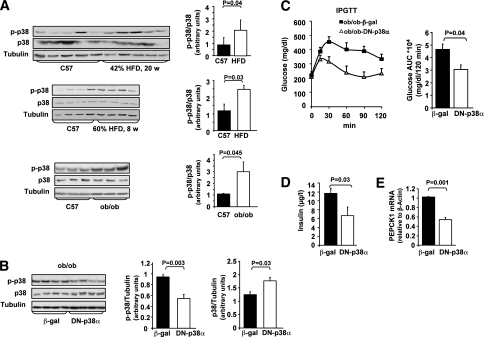
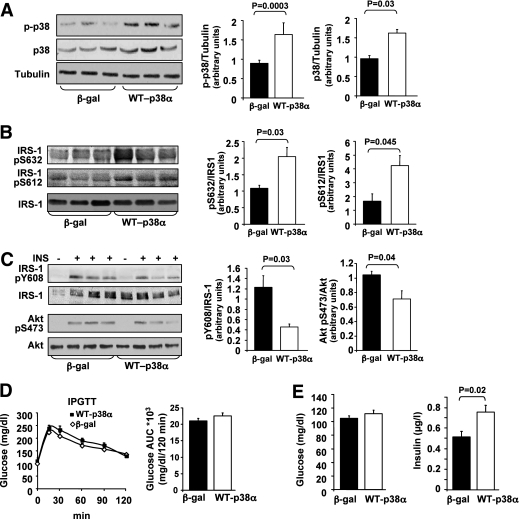
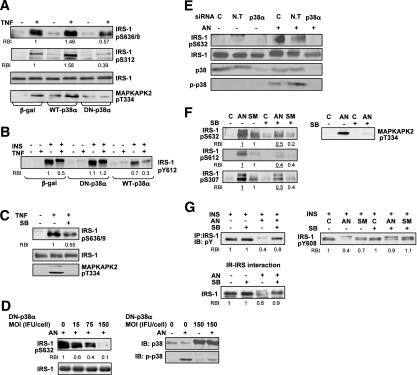
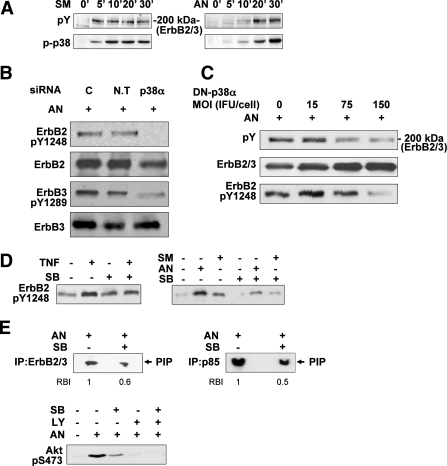
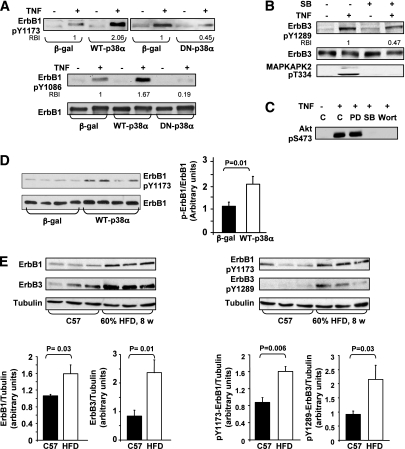
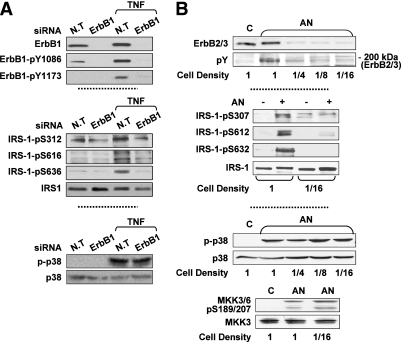
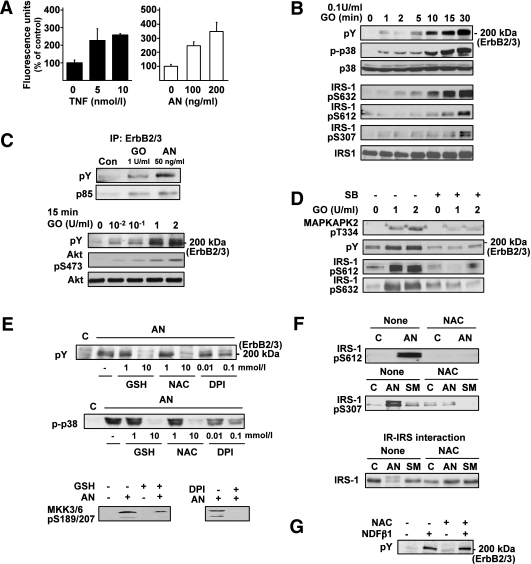
High-fat diet-fed mice and ob/ob mice exhibited elevated hepatic p38MAPK activation associated with glucose intolerance and hyperinsulinemia. Liver expression of dominant-negative (DN)-p38MAPKα in ob/ob mice reduced fasting insulin levels and improved glucose tolerance, whereas C57/BL6 mice overexpressing wild-type p38MAPKα exhibited enhanced IRS-1 serine phosphorylation and reduced insulin-stimulated IRS-1 tyrosine phosphorylation. Fao or HepG2 cells exposed to TNF, anisomycin, or sphingomyelinase demonstrated rapid transactivation of ErbB receptors leading to PI3-kinase/Akt activation and IRS-1 serine phosphorylation. p38MAPK inhibition either by SB203580, by small interfering RNA, or by DN-p38MAPKα decreased ErbB receptors transactivation and IRS-1 serine phosphorylation and partially restored insulin-stimulated IRS-1 tyrosine phosphorylation. When cells were incubated with specific ErbB receptors antagonists or in cells lacking ErbB receptors, anisomycin- and TNF-induced IRS-1 serine phosphorylation was attenuated, despite intact p38MAPK activation. The stress-induced p38MAPK activation leading to ErbB receptors transactivation was associated with intracellular reactive oxygen species generation and was attenuated by treatment with antioxidants.
Hepatic p38MAPK is activated following various stress stimuli. This event is upstream to ErbB receptors transactivation and plays an important role in stress-induced IRS-1 serine phosphorylation and insulin resistance.
肿瘤坏死因子(TNF)等应激刺激已被证明通过 ErbB 受体的转激活诱导胰岛素受体底物(IRS)-1丝氨酸磷酸化和胰岛素抵抗。我们旨在阐明 p38 丝裂原活化蛋白激酶(p38MAPK)在介导应激诱导的 ErbB 受体激活中的潜在作用。
在暴露于应激刺激的 Fao 或 HepG2 细胞中,评估 p38MAPK 对 ErbBs 转激活和胰岛素信号的影响,并在高脂肪饮食喂养的小鼠和 ob/ob 小鼠以及 C57/BL6 小鼠中评估代谢参数。
高脂肪饮食喂养的小鼠和 ob/ob 小鼠表现出肝 p38MAPK 激活升高,伴有葡萄糖不耐受和高胰岛素血症。ob/ob 小鼠肝脏表达显性失活(DN)-p38MAPKα 可降低空腹胰岛素水平并改善葡萄糖耐量,而 C57/BL6 小鼠过表达野生型 p38MAPKα 则表现出 IRS-1 丝氨酸磷酸化增强和胰岛素刺激的 IRS-1 酪氨酸磷酸化减少。TNF、放线菌酮或鞘磷脂酶处理的 Fao 或 HepG2 细胞迅速转激活 ErbB 受体,导致 PI3-激酶/Akt 激活和 IRS-1 丝氨酸磷酸化。p38MAPK 抑制(通过 SB203580、小干扰 RNA 或 DN-p38MAPKα)可减少 ErbB 受体转激活和 IRS-1 丝氨酸磷酸化,并部分恢复胰岛素刺激的 IRS-1 酪氨酸磷酸化。当细胞用特定的 ErbB 受体拮抗剂孵育或在缺乏 ErbB 受体的细胞中,尽管 p38MAPK 激活完整,放线菌酮和 TNF 诱导的 IRS-1 丝氨酸磷酸化减弱。应激诱导的 p38MAPK 激活导致 ErbB 受体转激活,与细胞内活性氧的产生有关,并可通过抗氧化剂治疗减轻。
肝 p38MAPK 在各种应激刺激后被激活。这一事件发生在 ErbB 受体转激活的上游,在应激诱导的 IRS-1 丝氨酸磷酸化和胰岛素抵抗中起重要作用。