Department of Neuroscience and Pediatrics, Neurogenetics Laboratory, Howard Hughes Medical Institute, University of California, San Diego, California, USA.
Curr Opin Neurol. 2011 Apr;24(2):98-105. doi: 10.1097/WCO.0b013e3283444d05.
Ciliopathies are genetic disorders caused by defects of primary ciliary structure and/or function and are characterized by pleiotropic clinical features. The ciliopathies include several partially overlapping syndromes such as Joubert syndrome, Bardet-Biedl syndrome and Meckel-Gruber syndrome, all of which have pronounced neurodevelopmental features. Here we focus on potential roles of cilia in central nervous system function, to explore how impairments may cause brain malformation and neurodevelopmental disease.
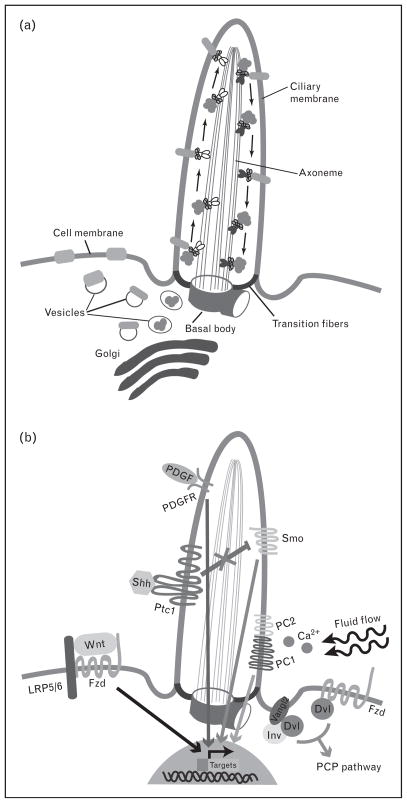
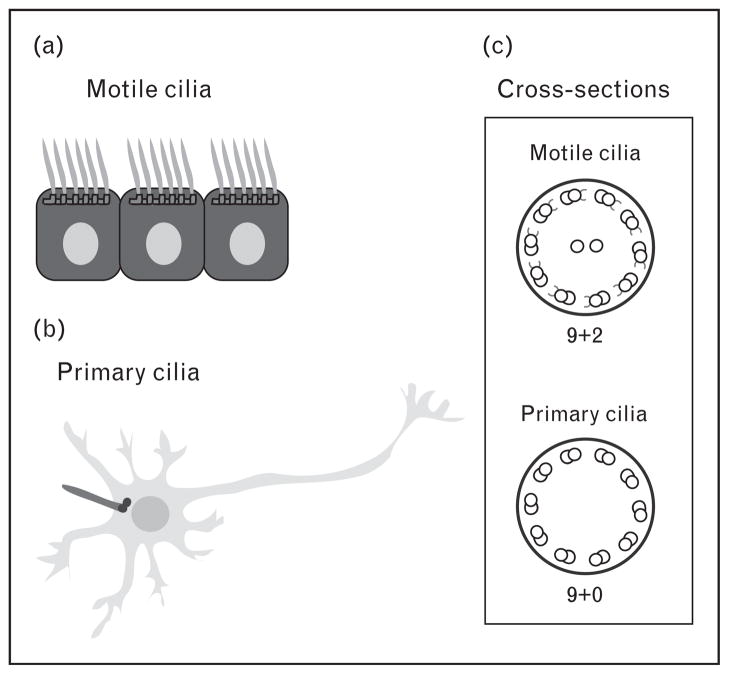
Cilia have long been considered as 'sensory cellular antennae', responding as chemo-sensors, mechano-sensors and thermo-sensors, although their roles in development were not well understood until recently. The surprising finding that disparate syndromes are all due to defects of the primary cilia, along with the recent advances in genetics, has helped elucidate further roles of primary cilia beyond sensory functions. Several molecules that are associated with key signaling pathways have been discovered in primary cilia. These include sonic hedgehog, wingless, planar cell polarity and fibroblast growth factor, which are essential for many cellular processes. Additionally, mutations in 'ciliome' genes have largely shown developmental defects such as abnormal body axis and brain malformation, implying disrupted cilia-related signaling pathways. Accordingly, the emerging theme is that primary cilia may play roles as modulators of signal transduction to help shape cellular responses within the environmental context during both development and homeostasis.
The link between cilia and signal pathways has become a framework for understanding the pathogenesis of ciliopathies. Despite recent progress in ciliary biology, fundamental questions remain about how cilia regulate neuronal function in the central nervous system. Therefore, investigation of ciliary function in the nervous system may reveal cilia-modulating mechanisms in neurodevelopmental processes, as well as suggest new treatments for disease.
纤毛病是由原发性纤毛结构和/或功能缺陷引起的遗传疾病,其特征是多系统临床表现。纤毛病包括几种部分重叠的综合征,如杰特综合征、巴德-比德尔综合征和梅克尔-格鲁伯综合征,所有这些综合征都有明显的神经发育特征。在这里,我们重点关注纤毛在中枢神经系统功能中的潜在作用,以探讨纤毛功能障碍如何导致脑畸形和神经发育疾病。
纤毛长期以来被认为是“细胞感觉天线”,作为化学传感器、机械传感器和热传感器发挥作用,尽管直到最近,其在发育中的作用才被人们所了解。令人惊讶的是,不同的综合征都是由于原发性纤毛缺陷引起的,加上遗传学的最新进展,有助于进一步阐明原发性纤毛在感觉功能之外的作用。几个与关键信号通路相关的分子已在原发性纤毛中被发现。这些分子包括 sonic hedgehog、wingless、平面细胞极性和成纤维细胞生长因子,它们对许多细胞过程都是必不可少的。此外,“纤毛组”基因的突变主要表现为发育缺陷,如异常的身体轴和脑畸形,这意味着纤毛相关信号通路被破坏。因此,新兴的主题是,原发性纤毛可能作为信号转导的调节剂发挥作用,有助于在发育和稳态过程中塑造细胞对环境的反应。
纤毛与信号通路的联系已成为理解纤毛病发病机制的框架。尽管纤毛生物学最近取得了进展,但关于纤毛如何调节中枢神经系统中的神经元功能,仍存在一些基本问题。因此,研究纤毛在神经系统中的功能可能揭示神经发育过程中纤毛调节机制,并为疾病提供新的治疗方法。