Section of Molecular Medicine, Department of Medicine, University of Oklahoma Health Sciences Center, Oklahoma City, Oklahoma, United States of America.
PLoS One. 2011 Feb 28;6(2):e17234. doi: 10.1371/journal.pone.0017234.
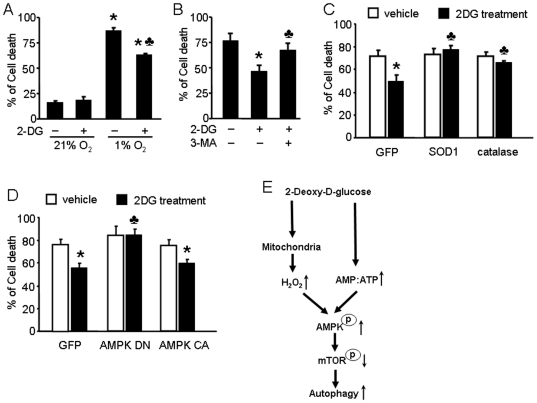
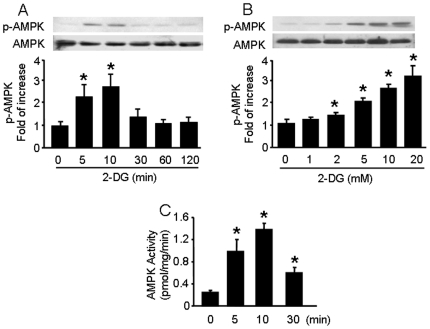
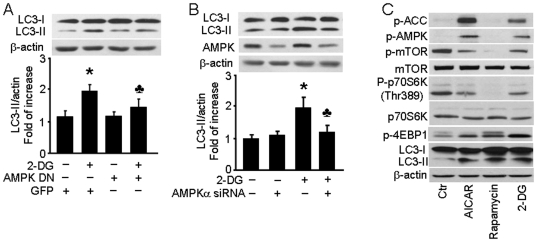
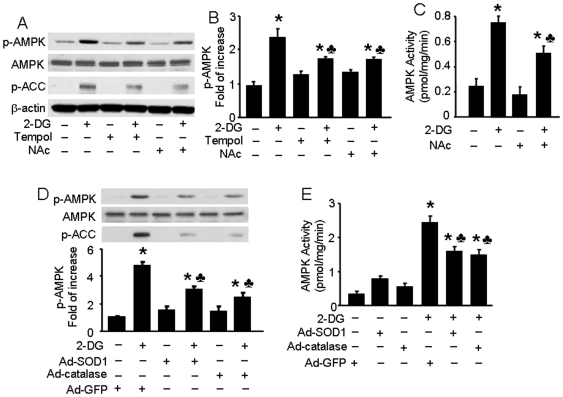
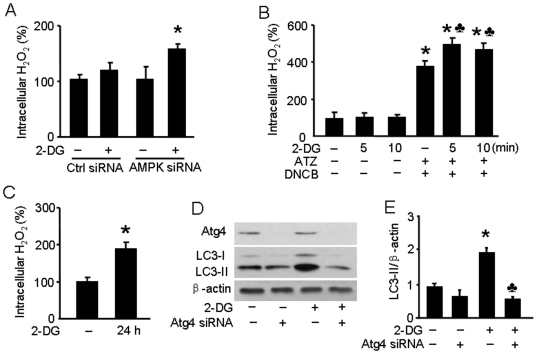
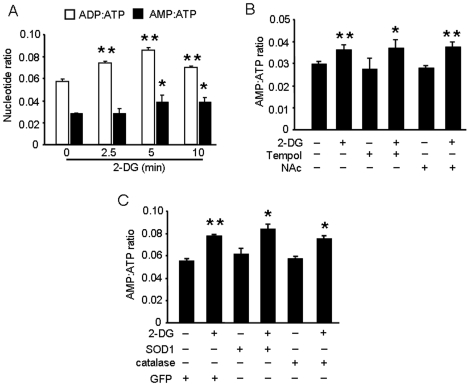
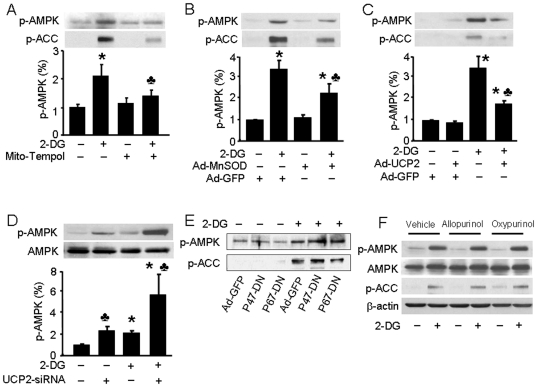
Autophagy is a cellular self-digestion process activated in response to stresses such as energy deprivation and oxidative stress. However, the mechanisms by which energy deprivation and oxidative stress trigger autophagy remain undefined. Here, we report that activation of AMP-activated protein kinase (AMPK) by mitochondria-derived reactive oxygen species (ROS) is required for autophagy in cultured endothelial cells. AMPK activity, ROS levels, and the markers of autophagy were monitored in confluent bovine aortic endothelial cells (BAEC) treated with the glycolysis blocker 2-deoxy-D-glucose (2-DG). Treatment of BAEC with 2-DG (5 mM) for 24 hours or with low concentrations of H(2)O(2) (100 µM) induced autophagy, including increased conversion of microtubule-associated protein light chain 3 (LC3)-I to LC3-II, accumulation of GFP-tagged LC3 positive intracellular vacuoles, and increased fusion of autophagosomes with lysosomes. 2-DG-treatment also induced AMPK phosphorylation, which was blocked by either co-administration of two potent anti-oxidants (Tempol and N-Acetyl-L-cysteine) or overexpression of superoxide dismutase 1 or catalase in BAEC. Further, 2-DG-induced autophagy in BAEC was blocked by overexpressing catalase or siRNA-mediated knockdown of AMPK. Finally, pretreatment of BAEC with 2-DG increased endothelial cell viability after exposure to hypoxic stress. Thus, AMPK is required for ROS-triggered autophagy in endothelial cells, which increases endothelial cell survival in response to cell stress.
自噬是一种细胞自我消化的过程,在能量匮乏和氧化应激等压力下被激活。然而,能量匮乏和氧化应激触发自噬的机制仍未被定义。在这里,我们报告称,线粒体来源的活性氧(ROS)激活的 AMP 激活蛋白激酶(AMPK)是培养的内皮细胞中自噬所必需的。在用糖酵解抑制剂 2-脱氧-D-葡萄糖(2-DG)处理的牛主动脉内皮细胞(BAEC)中监测 AMPK 活性、ROS 水平和自噬标志物。用 2-DG(5 mM)处理 BAEC 24 小时或用低浓度的 H₂O₂(100 µM)诱导自噬,包括微管相关蛋白轻链 3(LC3)-I 向 LC3-II 的转化率增加,GFP 标记的 LC3 阳性细胞内空泡的积累,以及自噬体与溶酶体的融合增加。2-DG 处理还诱导 AMPK 磷酸化,这可被两种强效抗氧化剂(Tempol 和 N-乙酰-L-半胱氨酸)的共同给药或 BAEC 中超氧化物歧化酶 1 或过氧化氢酶的过表达所阻断。此外,过表达过氧化氢酶或用 siRNA 介导的 AMPK 敲低可阻断 2-DG 诱导的 BAEC 自噬。最后,BAEC 用 2-DG 预处理可增加缺氧应激后内皮细胞的活力。因此,AMPK 是 ROS 触发内皮细胞自噬所必需的,这增加了内皮细胞对细胞应激的存活能力。