Department of Dermatology and Skin Science, Jack Bell Research Centre, Vancouver Coastal Health Research Institute, University of British Columbia, Vancouver, British Columbia, Canada.
PLoS One. 2011 Feb 28;6(2):e17578. doi: 10.1371/journal.pone.0017578.
S-phase kinase protein 2 (Skp2), an F-box protein, targets cell cycle regulators via ubiquitin-mediated degradation. Skp2 is frequently overexpressed in a variety of cancers and associated with patient survival. In melanoma, however, the prognostic significance of subcellular Skp2 expression remains controversial.
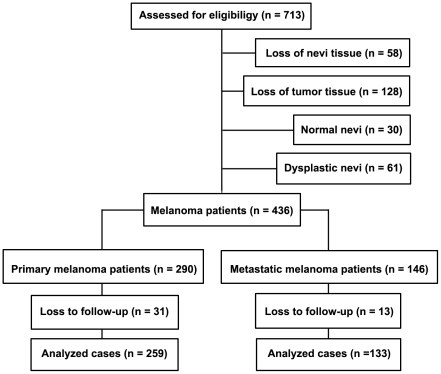
To investigate the role of Skp2 in melanoma development, we constructed tissue microarrays and examined Skp2 expression in melanocytic lesions at different stages, including 30 normal nevi, 61 dysplastic nevi, 290 primary melanomas and 146 metastatic melanomas. The TMA was assessed for cytoplasmic and nuclear Skp2 expression by immunohistochemistry. The Kaplan-Meier method was used to evaluate the patient survival. The univariate and multivariate Cox regression models were performed to estimate the hazard ratios (HR) at five-year follow-up.
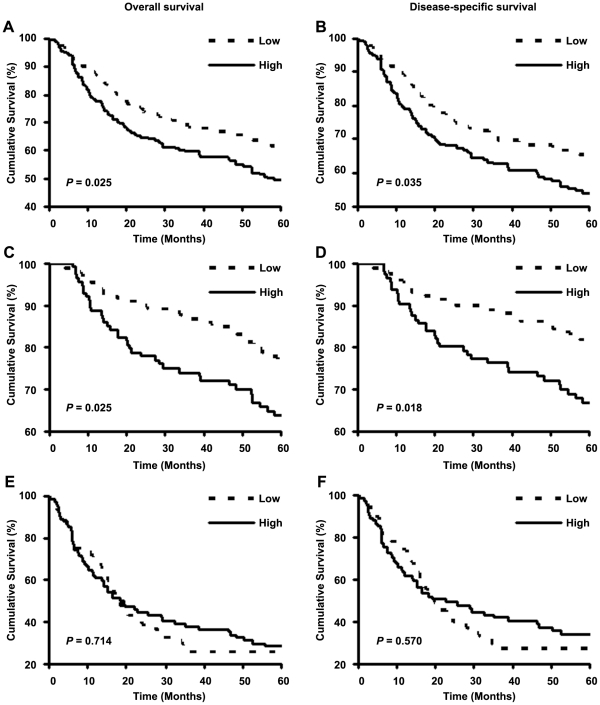
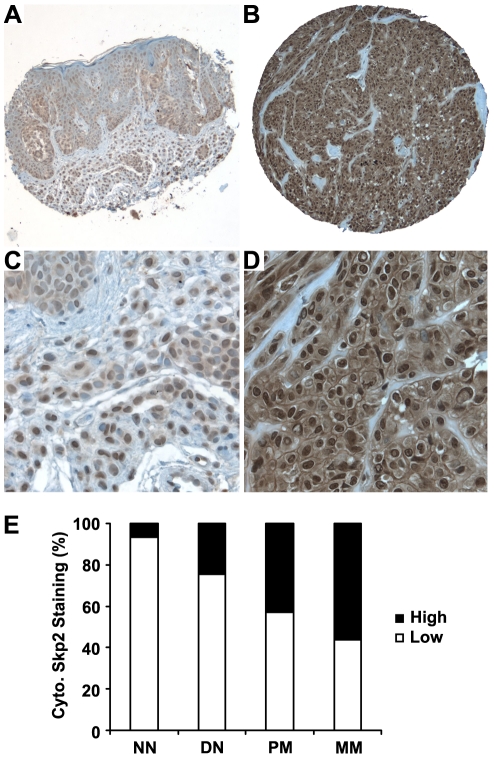
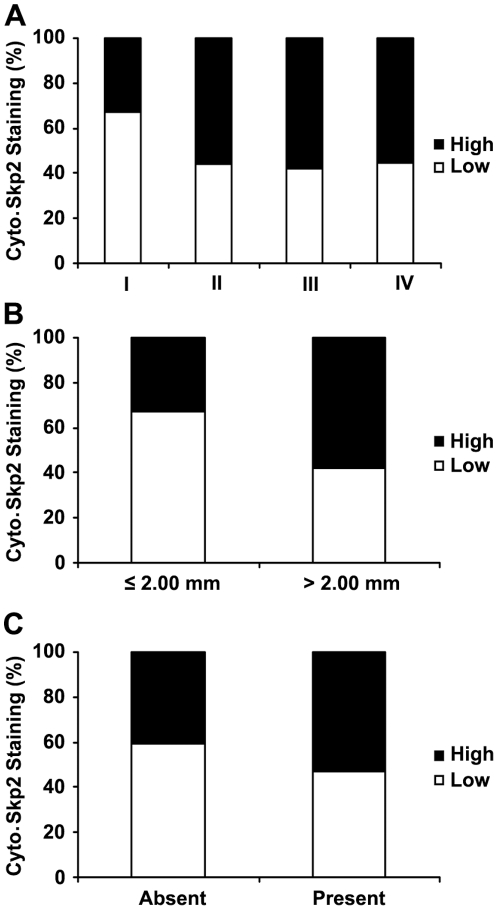
Cytoplasmic but not nuclear Skp2 expression was gradually increased from normal nevi, dysplastic nevi, primary melanomas to metastatic melanomas. Cytoplasmic Skp2 expression correlated with AJCC stages (I vs II-IV, P<0.001), tumor thickness (≤2.00 vs >2.00 mm, P<0.001) and ulceration (P = 0.005). Increased cytoplasmic Skp2 expression was associated with a poor five-year disease-specific survival of patients with primary melanoma (P = 0.018) but not metastatic melanoma (P>0.05).
This study demonstrates that cytoplasmic Skp2 plays an important role in melanoma pathogenesis and its expression correlates with patient survival. Our data indicate that cytoplasmic Skp2 may serve as a potential biomarker for melanoma progression and a therapeutic target for this disease.
S 期激酶蛋白 2(Skp2)是一种 F -box 蛋白,通过泛素介导的降解来靶向细胞周期调节剂。Skp2 在多种癌症中经常过表达,并与患者的生存相关。然而,在黑色素瘤中,亚细胞 Skp2 表达的预后意义仍存在争议。
为了研究 Skp2 在黑色素瘤发展中的作用,我们构建了组织微阵列,并检查了不同阶段黑色素细胞病变中 Skp2 的表达,包括 30 个正常痣、61 个发育不良痣、290 个原发性黑色素瘤和 146 个转移性黑色素瘤。通过免疫组织化学评估 TMA 中 Skp2 的细胞质和核表达。Kaplan-Meier 法用于评估患者的生存。单变量和多变量 Cox 回归模型用于估计 5 年随访时的危险比(HR)。
细胞质而非核 Skp2 的表达从正常痣、发育不良痣、原发性黑色素瘤到转移性黑色素瘤逐渐增加。细胞质 Skp2 的表达与 AJCC 分期(I 期与 II-IV 期,P<0.001)、肿瘤厚度(≤2.00 与>2.00 mm,P<0.001)和溃疡(P=0.005)相关。细胞质 Skp2 表达增加与原发性黑色素瘤患者的 5 年疾病特异性生存率降低相关(P=0.018),但与转移性黑色素瘤无关(P>0.05)。
本研究表明细胞质 Skp2 在黑色素瘤发病机制中起重要作用,其表达与患者的生存相关。我们的数据表明,细胞质 Skp2 可能作为黑色素瘤进展的潜在生物标志物,并成为该疾病的治疗靶点。