Aaron Diamond AIDS Research Center, The Rockefeller University, New York, New York, United States of America.
PLoS One. 2011 Mar 1;6(3):e17485. doi: 10.1371/journal.pone.0017485.
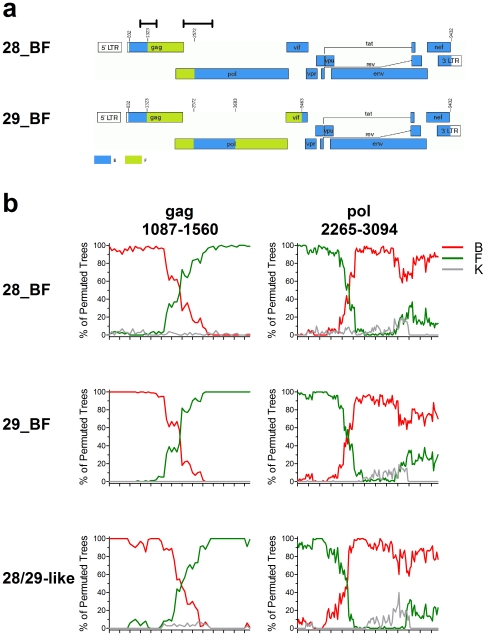
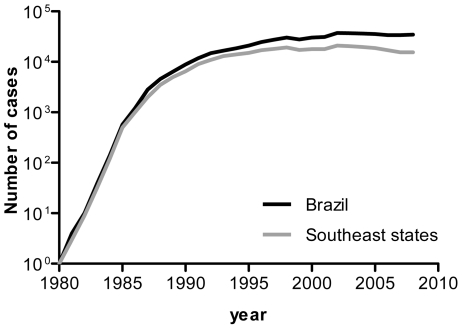
HIV-1 subtype B and subtype F are prevalent in the AIDS epidemic of Brazil. Recombinations between these subtypes have generated at least four BF circulating recombinant forms (CRFs). CRF28_BF and CRF29_BF are among the first two BF recombinants being identified in Brazil and they contributed significantly to the epidemic. However, the evolution and demographic histories of the CRFs are unclear.
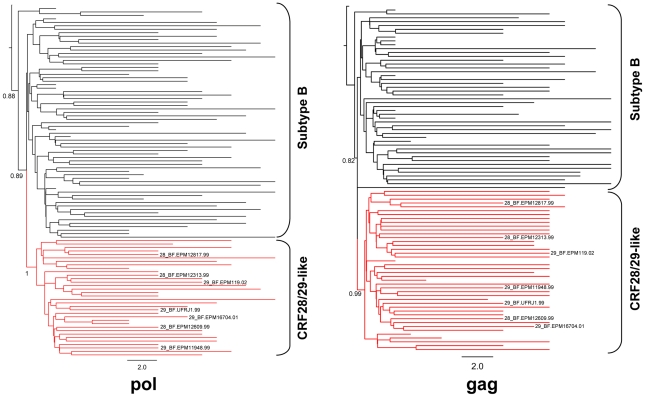
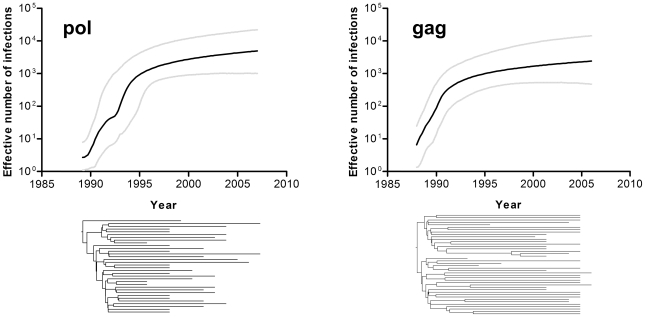
METHODOLOGY/PRINCIPAL FINDINGS: A collection of gag and pol sequences sampled within Brazil was screened for CRF28_BF-like and CRF29_BF-like recombination patterns. A Bayesian coalescent framework was employed to delineate the phylogenetic, divergence time and population dynamics of the virus having CRF28_BF-like and CRF29_BF-like genotype. These recombinants were phylogenetically related to each other and formed a well-supported monophyletic clade dated to 1988-1989. The effective number of infections by these recombinants grew exponentially over a five-year period after their emergence, but then decreased toward the present following a logistic model of population growth. The demographic pattern of both recombinants closely resembles those previously reported for CRF31_BC.
We revealed that HIV-1 recombinants of the CRF28_BF/CRF29_BF clade are still circulating in the Brazilian population. These recombinants did not exhibit a strong founder effect and showed a decreasing prevalence in the AIDS epidemic of Brazil. Our data suggested that multiple URFs may also play a role in shaping the epidemic of recombinant BF HIV-1 in the region.
HIV-1 亚型 B 和亚型 F 在巴西的艾滋病流行中较为常见。这些亚型之间的重组产生了至少四种 BF 循环重组形式(CRF)。CRF28_BF 和 CRF29_BF 是巴西最早发现的两种 BF 重组体之一,它们对该流行病的贡献显著。然而,CRF 的进化和人口历史尚不清楚。
方法/主要发现:对在巴西采集的 gag 和 pol 序列进行了筛选,以寻找 CRF28_BF 样和 CRF29_BF 样重组模式。采用贝叶斯合并框架来描绘具有 CRF28_BF 样和 CRF29_BF 样基因型的病毒的系统发育、分化时间和种群动态。这些重组体在系统发育上彼此相关,并形成了一个支持良好的单系分支,其日期可追溯到 1988-1989 年。这些重组体的有效感染人数在出现后的五年内呈指数级增长,但随后根据人口增长的逻辑模型下降到目前水平。这两种重组体的人口模式与之前报道的 CRF31_BC 非常相似。
我们揭示了 CRF28_BF/CRF29_BF 分支的 HIV-1 重组体仍在巴西人群中传播。这些重组体没有表现出强烈的创始效应,并且在巴西艾滋病流行中流行率下降。我们的数据表明,多个 URF 也可能在塑造该地区 BF HIV-1 重组体的流行中发挥作用。