National Institute of Public Health, Cuernavaca, Morelos, México.
BMC Public Health. 2011 Mar 15;11:164. doi: 10.1186/1471-2458-11-164.
Health system strengthening is critical to ensure the integration and scaling-up of priority health promotion, disease prevention and control programs. Normative guidelines are available to address health system function imbalances while strategic and analytical frameworks address critical functions in complex systems. Tacit knowledge-based health system constructs can help identify actors' perspectives, contributing to improve strengthening strategies. Using maternal health as an example, this paper maps and analyses the health system functions that critical actors charged with formulating and delivering priority health programs consider important for their success.
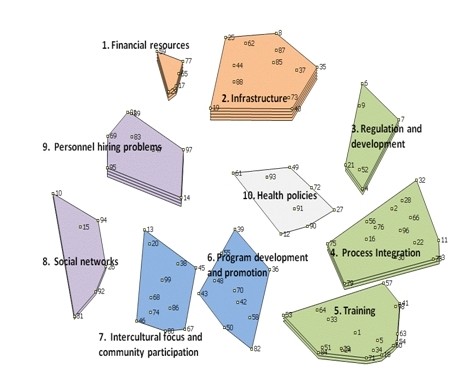
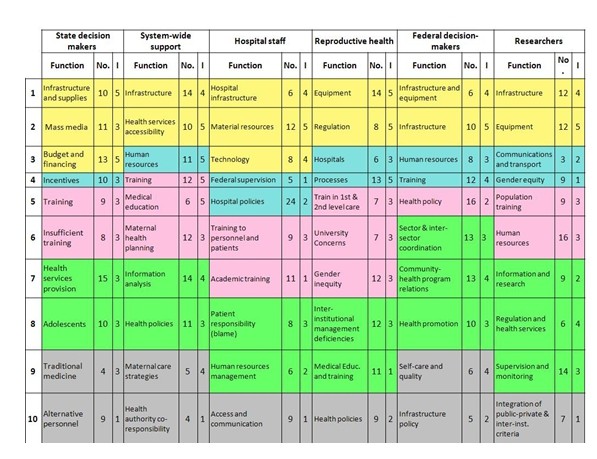
Using concept mapping qualitative and statistical methods, health system functions were mapped for different categories of actors in high maternal mortality states of Mexico and at the federal level. Functions within and across maps were analyzed for degree of classification, importance, feasibility and coding.
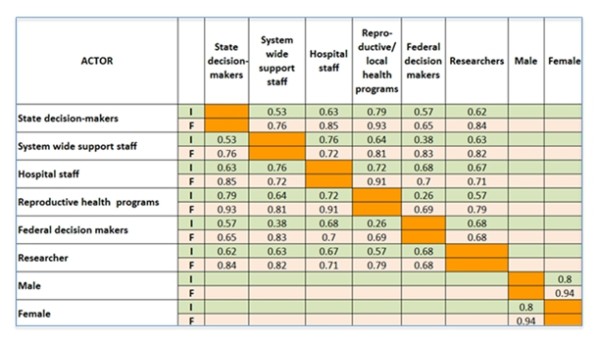
Hospital infrastructure and human resource training are the most prominent functions in the maternal health system, associated to federal efforts to support emergency obstetric care. Health policy is a highly diffuse function while program development, intercultural and community participation and social networks are clearly stated although less focused and with lower perceived importance. The importance of functions is less correlated between federal and state decision makers, between federal decision makers and reproductive health/local health area program officers and between state decision makers and system-wide support officers. Two sets of oppositions can be observed in coding across functions: health sector vs. social context; and given structures vs. manageable processes.
Concept mapping enabled the identification of critical functions constituting adaptive maternal health systems, including aspects of actor perspectives that are seldom included in normative and analytical frameworks. Important areas of divergence across actors' perceptions were identified to target capacity strengthening efforts towards better integrated, performing health systems.
加强卫生系统对于确保优先卫生促进、疾病预防和控制规划的整合和扩大至关重要。规范性准则可用于解决卫生系统功能失衡问题,而战略和分析框架则针对复杂系统中的关键功能。基于隐性知识的卫生系统结构可以帮助确定行为者的观点,有助于改善加强战略。本文以孕产妇健康为例,绘制和分析了负责制定和提供优先卫生方案的关键行为者认为对其成功至关重要的卫生系统功能。
使用概念映射定性和统计方法,对墨西哥高孕产妇死亡率州和联邦一级的不同类别行为者的卫生系统功能进行了映射。对地图内和跨地图的功能进行了分类程度、重要性、可行性和编码分析。
医院基础设施和人力资源培训是孕产妇卫生系统中最突出的功能,与联邦支持紧急产科护理的努力相关。卫生政策是一个高度分散的功能,而方案制定、跨文化和社区参与以及社会网络则明确规定,尽管重点较少,感知重要性较低。联邦和州决策者、联邦决策者和生殖健康/地方卫生区域方案官员以及州决策者和全系统支持官员之间的功能重要性相关性较低。可以观察到功能编码上存在两组对立:卫生部门与社会背景;以及既定结构与可管理流程。
概念映射使我们能够确定构成适应性孕产妇卫生系统的关键功能,包括行为者观点中很少包含在规范性和分析性框架中的方面。确定了行为者观点之间存在重要分歧领域,以便有针对性地加强能力,建设更好地整合、绩效更高的卫生系统。