Agriculture and Agri-Food Canada, 5403-1st Avenue South, Lethbridge, AB T1J 4B1, Canada.
BMC Microbiol. 2011 Mar 15;11:53. doi: 10.1186/1471-2180-11-53.
Campylobacter concisus is an emerging enteric pathogen, yet it is commonly isolated from feces and the oral cavities of healthy individuals. This genetically complex species is comprised of several distinct genomospecies which may vary in pathogenic potential.
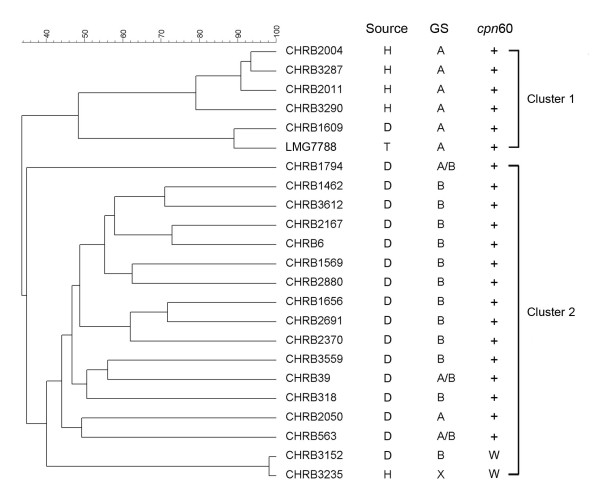
We compared pathogenic and genotypic properties of C. concisus fecal isolates from diarrheic and healthy humans residing in the same geographic region. Analysis of amplified fragment length polymorphism (AFLP) profiles delineated two main clusters. Isolates assigned to AFLP cluster 1 belonged to genomospecies A (based on genomospecies-specific differences in the 23S rRNA gene) and were predominantly isolated from healthy individuals. This cluster also contained a reference oral strain. Isolates assigned to this cluster induced greater expression of epithelial IL-8 mRNA and more frequently contained genes coding for the zonnula occludins toxin and the S-layer RTX. Furthermore, isolates from healthy individuals induced greater apoptotic DNA fragmentation and increased metabolic activity than those from diarrheic individuals, and isolates assigned to genomospecies A (of which the majority were from healthy individuals) exhibited higher haemolytic activity compared to genomospecies B isolates. In contrast, AFLP cluster 2 was predominated by isolates belonging to genomospecies B and those from diarrheic individuals. Isolates from this cluster displayed greater mean epithelial invasion and translocation than cluster 1 isolates.
Two main genetically distinct clusters (i.e., genomospecies) were identified among C. concisus fecal isolates from healthy and diarrheic individuals. Strains within these clusters differed with respect to clinical presentation and pathogenic properties, supporting the hypothesis that pathogenic potential varies between genomospecies. ALFP cluster 2 isolates were predominantly from diarrheic patients, and exhibited higher levels of epithelial invasion and translocation, consistent with known roles for these factors in diarrhoeal disease. Conversely, isolates from healthy humans and AFLP cluster 1 or genomospecies A (which were predominantly isolated from healthy humans) exhibited increased haemolytic ability, apoptotic DNA fragmentation, IL-8 induction, and/or carriage of toxin genes. Given that this cluster contains an oral reference strain, it is possible that some of the AFLP cluster 1 isolates are periodontal pathogens and may cause disease, albeit via a different mechanism than those from AFLP cluster 2.
弯曲菌属是一种新兴的肠道病原体,但它通常从健康个体的粪便和口腔中分离出来。这个遗传复杂的物种由几个不同的基因组种组成,其致病潜力可能有所不同。
我们比较了来自同一地理区域的腹泻和健康人群的粪便弯曲菌属分离株的致病性和基因型特征。扩增片段长度多态性(AFLP)分析的图谱将它们分为两个主要的聚类。被归类为 AFLP 聚类 1 的分离株属于基因组种 A(基于 23S rRNA 基因的基因组种特异性差异),主要从健康个体中分离出来。这个聚类还包含一个参考口腔株。属于这个聚类的分离株诱导上皮细胞 IL-8 mRNA 的表达更高,并且更频繁地包含编码 zonula occludens 毒素和 S 层 RTX 的基因。此外,来自健康个体的分离株比来自腹泻个体的分离株诱导更大的凋亡 DNA 片段化和更高的代谢活性,并且属于基因组种 A(其中大多数来自健康个体)的分离株比属于基因组种 B 的分离株表现出更高的溶血活性。相比之下,AFLP 聚类 2 主要由属于基因组种 B 的分离株和来自腹泻个体的分离株组成。这个聚类的分离株显示出比聚类 1 分离株更高的平均上皮细胞侵袭和易位。
在来自健康和腹泻个体的弯曲菌属粪便分离株中,确定了两个主要的遗传上不同的聚类(即基因组种)。这些聚类中的菌株在临床表现和致病特性方面存在差异,支持了基因组种之间的致病潜力存在差异的假说。AFLP 聚类 2 分离株主要来自腹泻患者,表现出更高的上皮细胞侵袭和易位水平,这与这些因素在腹泻疾病中的已知作用一致。相反,来自健康人群和 AFLP 聚类 1 或基因组种 A(主要从健康人群中分离出来)的分离株表现出更高的溶血能力、凋亡 DNA 片段化、IL-8 诱导和/或携带毒素基因。鉴于这个聚类包含一个口腔参考株,有可能一些 AFLP 聚类 1 分离株是牙周病原体,可能会引起疾病,尽管其机制与 AFLP 聚类 2 分离株不同。