Department of Biological Sciences, Inflammation Research Network, University of Calgary, Calgary, AB, Canada.
Gut Pathog. 2009 Feb 3;1(1):2. doi: 10.1186/1757-4749-1-2.
Campylobacter enteritis represents a risk factor for the development of inflammatory bowel disease (IBD) via unknown mechanisms. As IBD patients exhibit inflammatory responses to their commensal intestinal microflora, factors that induce translocation of commensal bacteria across the intestinal epithelium may contribute to IBD pathogenesis. This study sought to determine whether Campylobacter induces translocation of non-invasive intestinal bacteria, and characterize underlying mechanisms.
Mice were infected with C. jejuni and translocation of intestinal bacteria was assessed by quantitative bacterial culture of mesenteric lymph nodes (MLNs), liver, and spleen. To examine mechanisms of Campylobacter-induced bacterial translocation, transwell-grown T84 monolayers were inoculated with non-invasive Escherichia coli HB101 +/- wild-type Campylobacter or invasion-defective mutants, and bacterial internalization and translocation were measured. Epithelial permeability was assessed by measuring flux of a 3 kDa dextran probe. The role of lipid rafts was assessed by cholesterol depletion and caveolin co-localization.
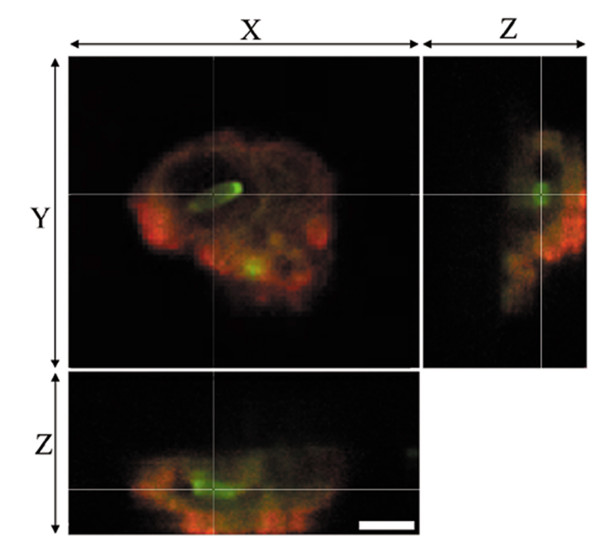
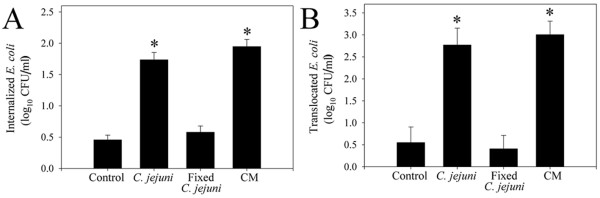
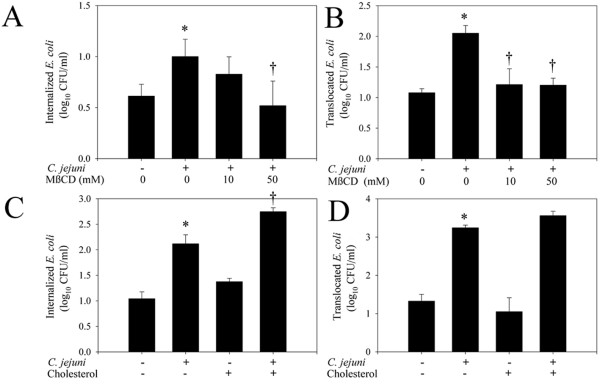
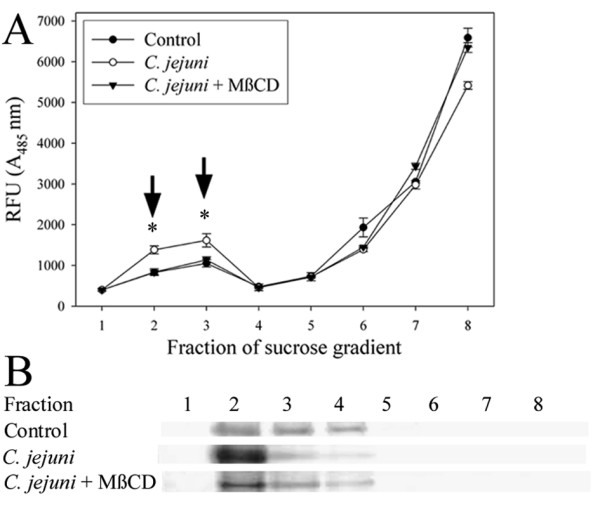
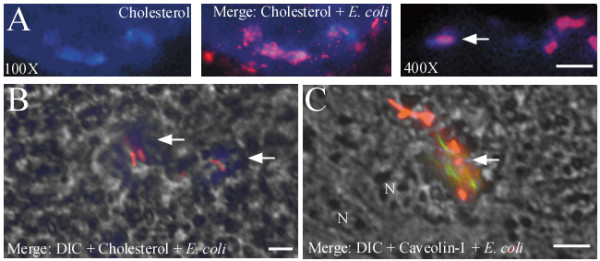
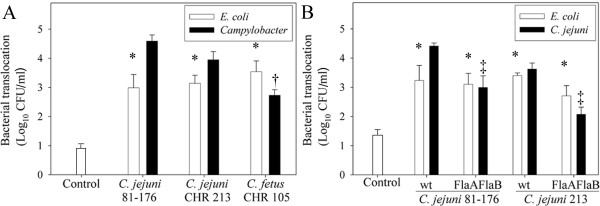
C. jejuni 81-176 induced translocation of commensal intestinal bacteria to the MLNs, liver, and spleen of infected mice. In T84 monolayers, Campylobacter-induced internalization and translocation of E. coli occurred via a transcellular pathway, without increasing epithelial permeability, and was blocked by depletion of epithelial plasma membrane cholesterol. Invasion-defective mutants and Campylobacter-conditioned cell culture medium also induced E. coli translocation, indicating that C. jejuni does not directly 'shuttle' bacteria into enterocytes. In C. jejuni-treated monolayers, translocating E. coli associated with lipid rafts, and this phenomenon was blocked by cholesterol depletion.
Campylobacter, regardless of its own invasiveness, promotes the translocation of non-invasive bacteria across the intestinal epithelium via a lipid raft-mediated transcellular process.
空肠弯曲菌肠炎通过未知机制成为炎症性肠病(IBD)的一个风险因素。由于 IBD 患者对其共生肠道微生物群表现出炎症反应,因此诱导共生细菌穿过肠上皮细胞易位的因素可能有助于 IBD 的发病机制。本研究旨在确定空肠弯曲菌是否诱导非侵入性肠道细菌易位,并探讨其潜在机制。
用空肠弯曲菌感染小鼠,通过肠系膜淋巴结(MLN)、肝脏和脾脏中肠道细菌的定量细菌培养来评估细菌易位。为了研究空肠弯曲菌诱导细菌易位的机制,用非侵袭性大肠杆菌 HB101 +/-野生型空肠弯曲菌或侵袭缺陷突变体接种 Transwell 培养的 T84 单层细胞,并测量细菌内化和易位。通过测量 3 kDa 葡聚糖探针的通量来评估上皮通透性。通过胆固醇耗竭和 caveolin 共定位评估脂筏的作用。
空肠弯曲菌 81-176 诱导感染小鼠的 MLN、肝脏和脾脏中共生肠道细菌易位。在 T84 单层细胞中,空肠弯曲菌诱导的大肠杆菌内化和易位是通过细胞内途径发生的,而不增加上皮通透性,并且通过上皮质膜胆固醇耗竭可阻断。侵袭缺陷突变体和空肠弯曲菌条件培养基也诱导大肠杆菌易位,表明空肠弯曲菌不会直接将细菌“穿梭”进入肠细胞。在空肠弯曲菌处理的单层细胞中,易位的大肠杆菌与脂筏相关,而胆固醇耗竭可阻断这一现象。
无论自身侵袭性如何,空肠弯曲菌均可通过脂筏介导的细胞内途径促进非侵袭性细菌穿过肠上皮细胞易位。