Biochemistry Department, National Research Centre, Dokki, Giza, Egypt 12622.
J Nutr Biochem. 2012 Jan;23(1):39-50. doi: 10.1016/j.jnutbio.2010.11.003. Epub 2011 Mar 16.
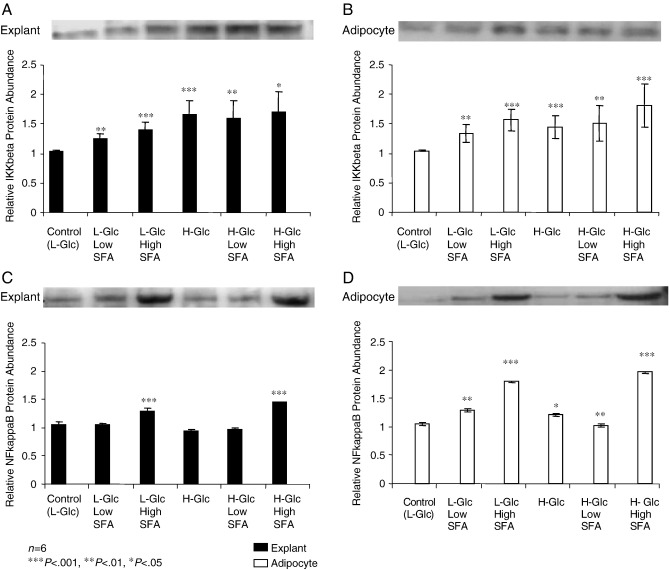
A post-prandial increase in saturated fatty acids (SFAs) and glucose (Glc) activates an inflammatory response, which may be prolonged following restoration of physiological SFAs and Glc levels--a finding referred to as 'metabolic memory'. This study examined chronic and oscillating SFAs and Glc on the inflammatory signalling pathway in human adipose tissue (AT) and adipocytes (Ads) and determined whether Ads are subject to "metabolic memory." Abdominal (Abd) subcutaneous (Sc) explants and Ads were treated with chronic low glucose (L-Glc): 5.6 mM and high glucose (H-Glc): 17.5 mM, with low (0.2 mM) and high (2 mM) SFA for 48 h. Abd Sc explants and Ads were also exposed to the aforementioned treatment regimen for 12-h periods, with alternating rest periods of 12 h in L-Glc. Chronic treatment with L-Glc and high SFAs, H-Glc and high SFAs up-regulated key factors of the nuclear factor-κB (NFκB) pathway in Abd Sc AT and Ads (TLR4, NFκB; P<.05), whilst down-regulating MyD88. Oscillating Glc and SFA concentrations increased TLR4, NFκB, IKKβ (P<.05) in explants and Ads and up-regulated MyD88 expression (P<.05). Both tumor necrosis factor α and interleukin 6 (P<.05) secretion were markedly increased in chronically treated Abd Sc explants and Ads whilst, with oscillating treatments, a sustained inflammatory effect was noted in absence of treatment. Therefore, SFAs may act as key instigators of the inflammatory response in human AT via NFκB activation, which suggests that short-term exposure of cells to uncontrolled levels of SFAs and Glc leads to a longer-term inflammatory insult within the Ad, which may have important implications for patients with obesity and Type 2 diabetes.
进食后饱和脂肪酸(SFAs)和葡萄糖(Glc)的增加会激活炎症反应,而在生理 SFAs 和 Glc 水平恢复后,这种炎症反应可能会持续延长——这种现象被称为“代谢记忆”。本研究探讨了慢性和波动的 SFAs 和 Glc 对人脂肪组织(AT)和脂肪细胞(Ads)中炎症信号通路的影响,并确定了 Ads 是否存在“代谢记忆”。采用慢性低糖(L-Glc):5.6 mM 和高糖(H-Glc):17.5 mM 以及低(0.2 mM)和高(2 mM)SFA 处理腹部(Abd)皮下(Sc)外植体和 Ads 48 h。Abd Sc 外植体和 Ads 还暴露于上述处理方案中 12 h 周期,并在 L-Glc 中交替休息 12 h。慢性 L-Glc 和高 SFAs、H-Glc 和高 SFAs 处理上调了 Abd Sc AT 和 Ads 中核因子-κB(NFκB)通路的关键因子(TLR4、NFκB;P<.05),同时下调了 MyD88。波动的 Glc 和 SFA 浓度增加了 TLR4、NFκB、IKKβ(P<.05)在外植体和 Ads 中的表达,并上调了 MyD88 的表达(P<.05)。慢性处理的 Abd Sc 外植体和 Ads 中肿瘤坏死因子-α(TNF-α)和白细胞介素 6(IL-6)(P<.05)的分泌明显增加,而在波动处理中,在没有处理的情况下观察到持续的炎症效应。因此,SFAs 可能通过 NFκB 激活成为人 AT 中炎症反应的关键启动子,这表明细胞短期暴露于不受控制的 SFAs 和 Glc 水平会导致 Ad 中更长期的炎症损伤,这对肥胖和 2 型糖尿病患者可能具有重要意义。