Department of Nuclear Medicine, Erasmus MC, Rotterdam, The Netherlands.
Eur J Nucl Med Mol Imaging. 2011 Jul;38(7):1257-66. doi: 10.1007/s00259-011-1775-3. Epub 2011 Mar 23.
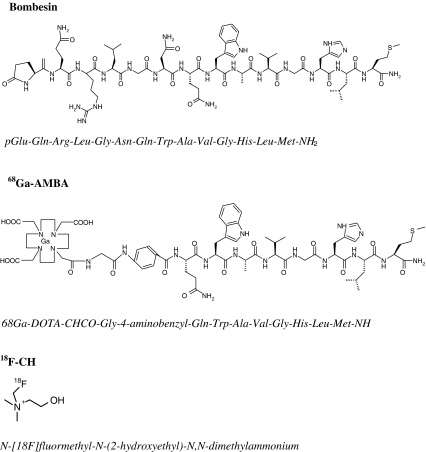
Prostate cancer (PC) is a major health problem. Overexpression of the gastrin-releasing peptide receptor (GRPR) in PC, but not in the hyperplastic prostate, provides a promising target for staging and monitoring of PC. Based on the assumption that cancer cells have increased metabolic activity, metabolism-based tracers are also being used for PC imaging. We compared GRPR-based targeting using the (68)Ga-labelled bombesin analogue AMBA with metabolism-based targeting using (18)F-methylcholine ((18)F-FCH) in nude mice bearing human prostate VCaP xenografts.
PET and biodistribution studies were performed with both (68)Ga-AMBA and (18)F-FCH in all VCaP tumour-bearing mice, with PC-3 tumour-bearing mice as reference. Scanning started immediately after injection. Dynamic PET scans were reconstructed and analysed quantitatively. Biodistribution of tracers and tissue uptake was expressed as percent of injected dose per gram tissue (%ID/g).
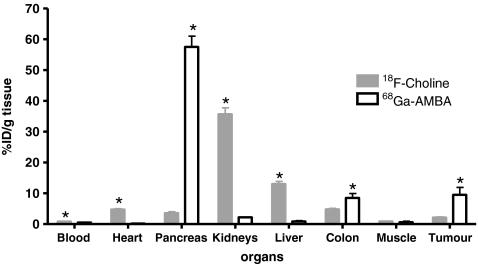
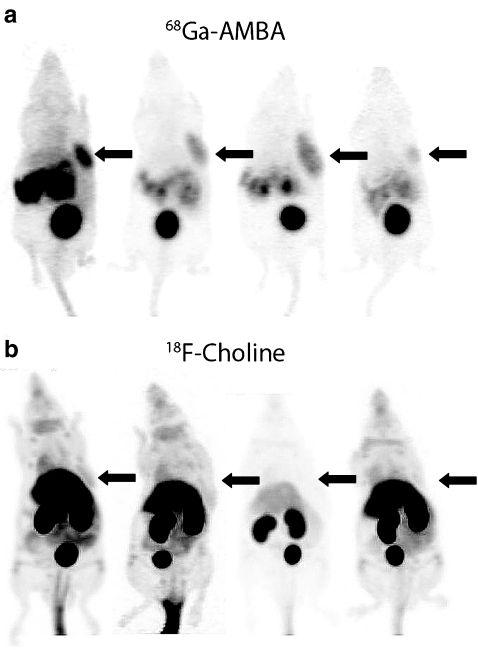
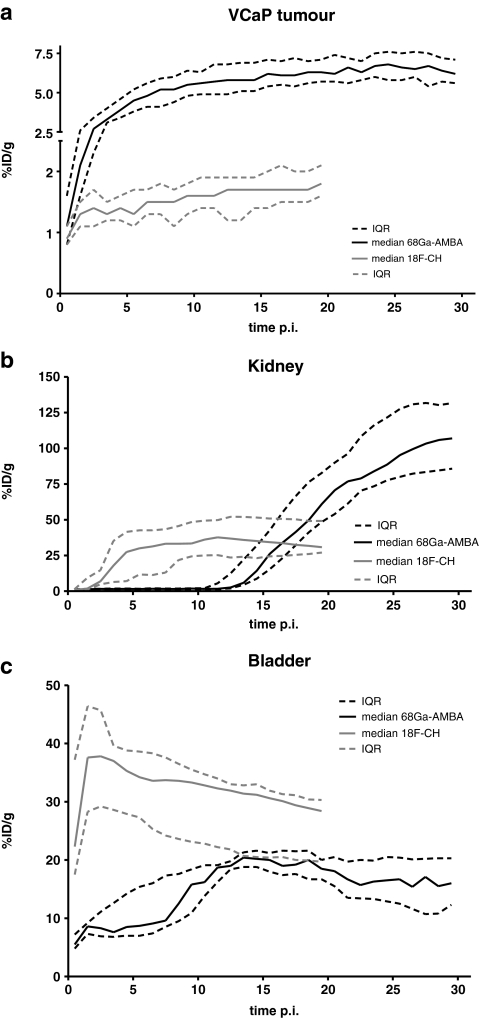
All tumours were clearly visualized using (68)Ga-AMBA. (18)F-FCH showed significantly less contrast due to poor tumour-to-background ratios. Quantitative PET analyses showed fast tumour uptake and high retention for both tracers. VCaP tumour uptake values determined from PET at steady-state were 6.7 ± 1.4%ID/g (20-30 min after injection, N = 8) for (68)Ga-AMBA and 1.6 ± 0.5%ID/g (10-20 min after injection, N = 8) for (18)F-FCH, which were significantly different (p <0.001). The results in PC-3 tumour-bearing mice were comparable. Biodistribution data were in accordance with the PET results showing VCaP tumour uptake values of 9.5 ± 4.8%ID/g (N = 8) for (68)Ga-AMBA and 2.1 ± 0.4%ID/g (N = 8) for (18)F-FCH. Apart from the GRPR-expressing organs, uptake in all organs was lower for (68)Ga-AMBA than for (18)F-FCH.
Tumour uptake of (68)Ga-AMBA was higher while overall background activity was lower than observed for (18)F-FCH in the same PC-bearing mice. These results suggest that peptide receptor-based targeting using the bombesin analogue AMBA is superior to metabolism-based targeting using choline for scintigraphy of PC.
前列腺癌(PC)是一个主要的健康问题。胃泌素释放肽受体(GRPR)在 PC 中的过度表达,但在增生性前列腺中没有,为 PC 的分期和监测提供了一个有希望的靶点。基于癌细胞代谢活性增加的假设,也正在使用基于代谢的示踪剂进行 PC 成像。我们比较了使用(68)Ga 标记的蛙皮素类似物 AMBA 进行基于 GRPR 的靶向与使用(18)F-甲基胆碱((18)F-FCH)进行基于代谢的靶向在携带人前列腺 VCaP 异种移植物的裸鼠中的效果。
在所有 VCaP 肿瘤荷瘤小鼠中进行了(68)Ga-AMBA 和(18)F-FCH 的 PET 和生物分布研究,并以 PC-3 肿瘤荷瘤小鼠作为参考。注射后立即开始扫描。重建和分析动态 PET 扫描。示踪剂和组织摄取的生物分布表示为每克组织的注射剂量百分比(%ID/g)。
所有肿瘤均使用(68)Ga-AMBA 清晰显示。(18)F-FCH 由于肿瘤与背景的对比度差,显示出明显较少的对比。定量 PET 分析显示,两种示踪剂均具有快速的肿瘤摄取和高保留。从平衡状态 PET 确定的 VCaP 肿瘤摄取值分别为(68)Ga-AMBA 的 6.7±1.4%ID/g(注射后 20-30 分钟,N=8)和(18)F-FCH 的 1.6±0.5%ID/g(注射后 10-20 分钟,N=8),差异有统计学意义(p<0.001)。PC-3 肿瘤荷瘤小鼠的结果相似。生物分布数据与 PET 结果一致,(68)Ga-AMBA 的 VCaP 肿瘤摄取值为 9.5±4.8%ID/g(N=8),(18)F-FCH 的摄取值为 2.1±0.4%ID/g(N=8)。除了表达 GRPR 的器官外,所有器官对(68)Ga-AMBA 的摄取均低于(18)F-FCH。
在同一 PC 荷瘤小鼠中,(68)Ga-AMBA 的肿瘤摄取率高于(18)F-FCH,而整体背景活性较低。这些结果表明,使用蛙皮素类似物 AMBA 进行基于肽受体的靶向比使用胆碱进行基于代谢的靶向在 PC 的闪烁成像中更具优势。