Department of Physics, Arizona State University, Tempe, Arizona 85287, USA.
ACS Nano. 2011 Apr 26;5(4):3113-9. doi: 10.1021/nn200251z. Epub 2011 Mar 31.
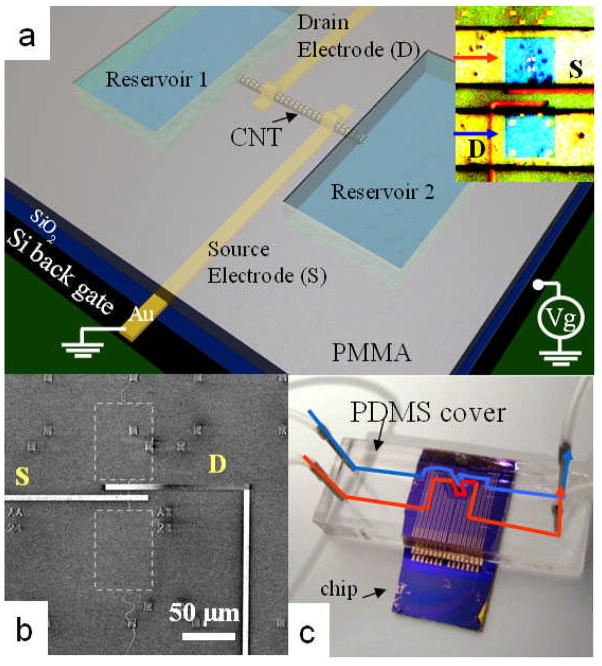
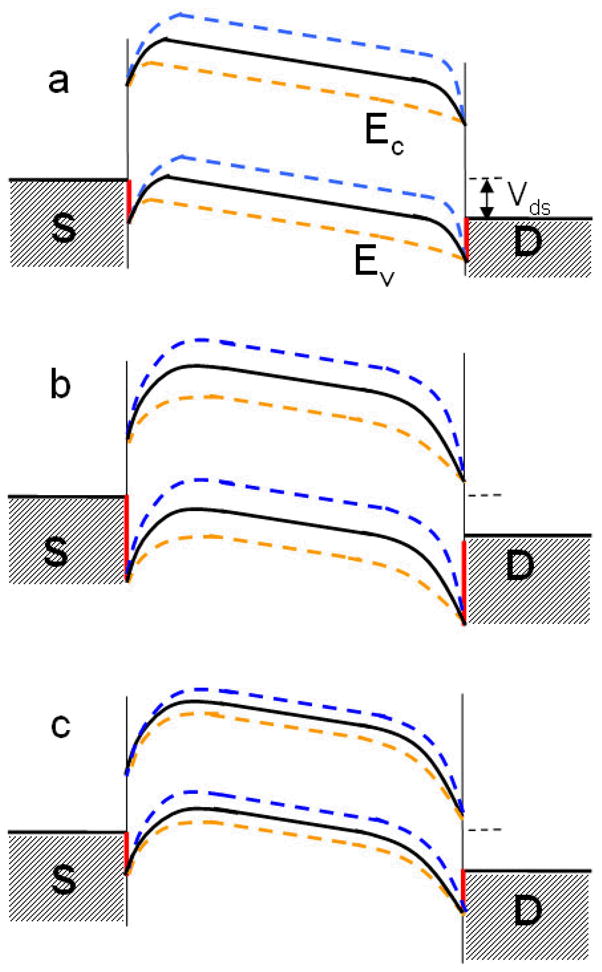
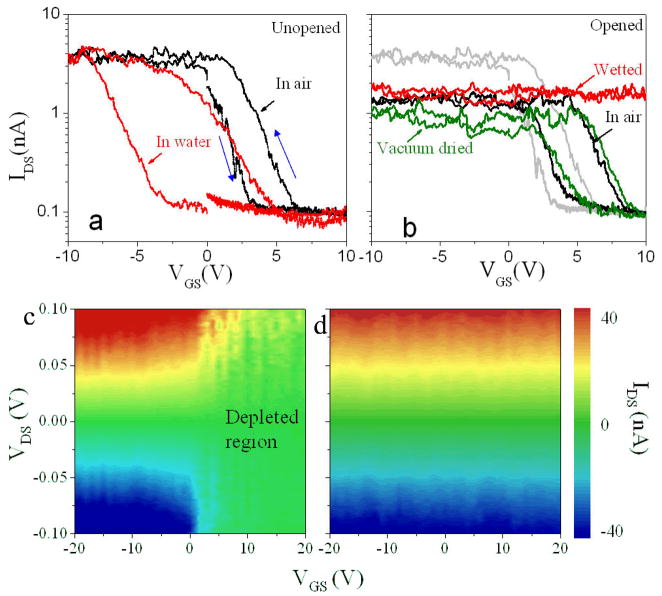
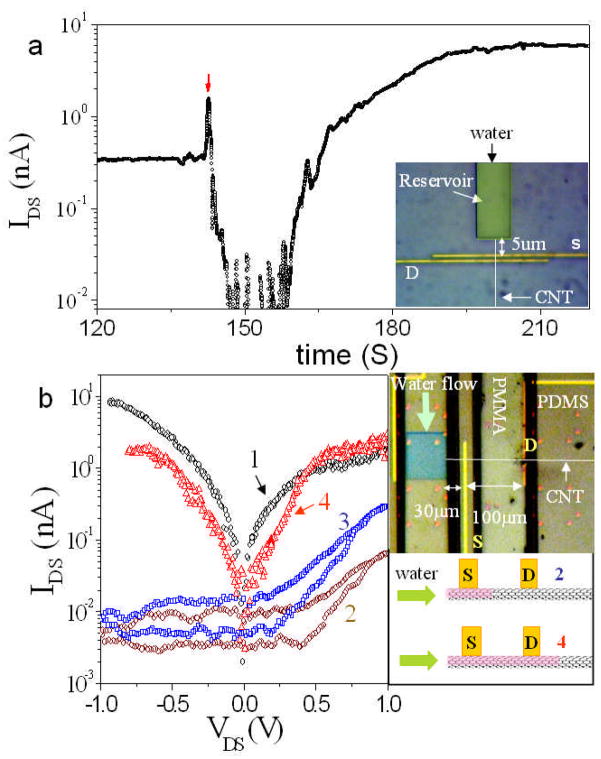
We have constructed devices in which the interior of a single-walled carbon nanotube (SWCNT) field-effect transistor acts as a nanofluidic channel that connects two fluid reservoirs, permitting measurement of the electronic properties of the SWCNT as it is wetted by an analyte. Wetting of the inside of the SWCNT by water turns the transistor on, while wetting of the outside has little effect. These observations are consistent with theoretical simulations that show that internal water both generates a large dipole electric field, causing charge polarization of the tube and metal electrodes, and shifts the valence band of the SWCNT, while external water has little effect. This finding may provide a new method to investigate water behavior at nanoscale. This also opens a new avenue for building sensors in which the SWCNT simultaneously functions as a concentrator, nanopore, and extremely sensitive electronic detector, exploiting the enhanced sensitivity of the interior surface.
我们构建了一些设备,其中单壁碳纳米管(SWCNT)场效应晶体管的内部充当纳米流道,将两个流体储液器连接起来,允许在被分析物润湿时测量 SWCNT 的电子特性。SWCNT 内部被水润湿会使晶体管导通,而外部润湿则几乎没有影响。这些观察结果与理论模拟一致,表明内部水既会产生大的偶极电场,导致管和金属电极的电荷极化,又会使 SWCNT 的价带发生位移,而外部水几乎没有影响。这一发现可能为研究纳米尺度下水的行为提供了一种新方法。这也为构建传感器开辟了新途径,其中 SWCNT 同时充当浓缩器、纳米孔和极其灵敏的电子探测器,利用内部表面的增强灵敏度。