School of Public Health and Preventive Medicine, Monash University, Melbourne, Australia.
BMC Med Res Methodol. 2011 Mar 31;11:35. doi: 10.1186/1471-2288-11-35.
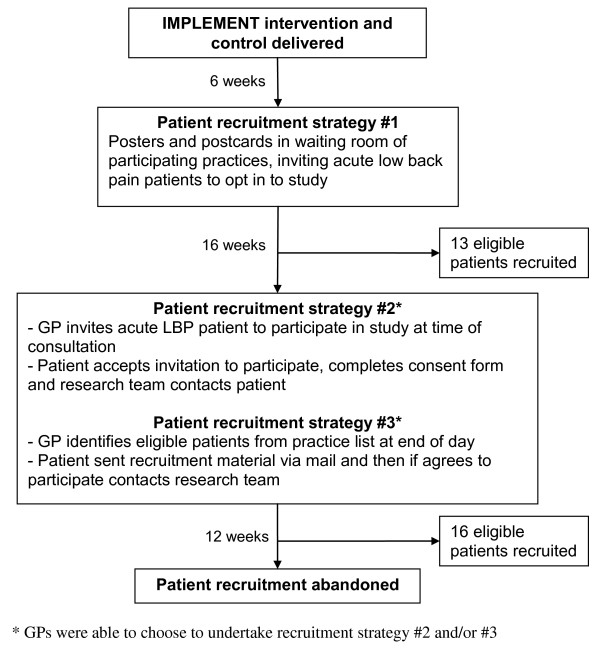
Recruitment of patients by health professionals is reported as one of the most challenging steps when undertaking studies in primary care settings. Numerous investigations of the barriers to patient recruitment in trials which recruit patients to receive an intervention have been published. However, we are not aware of any studies that have reported on the recruitment barriers as perceived by health professionals to recruiting patients into cluster randomised trials where patients do not directly receive an intervention. This particular subtype of cluster trial is commonly termed a professional-cluster trial. The aim of this study was to investigate factors that contributed to general practitioners recruitment of patients in a professional-cluster trial which evaluated the effectiveness of an intervention to increase general practitioners adherence to a clinical practice guideline for acute low-back pain.
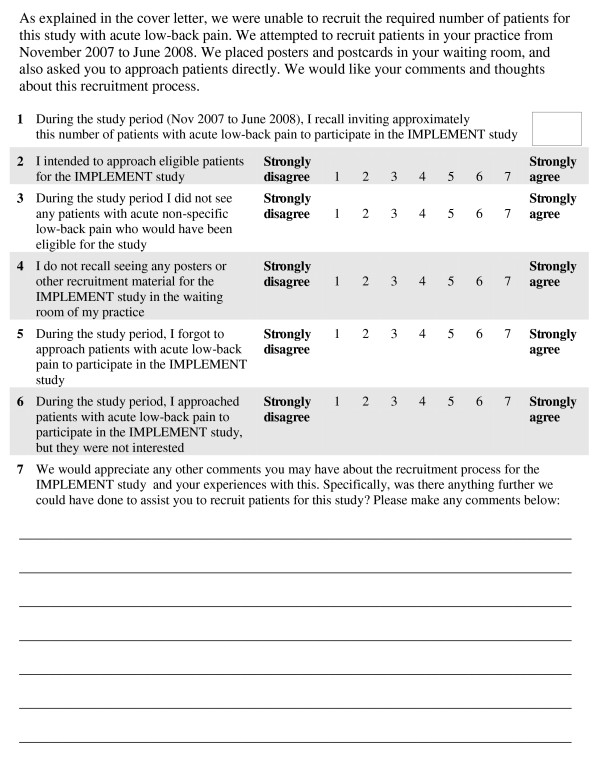
General practitioners enrolled in the study were posted a questionnaire, consisting of quantitative items and an open-ended question, to assess possible reasons for poor patient recruitment. Descriptive statistics were used to summarise quantitative items and responses to the open-ended question were coded into categories.
Seventy-nine general practitioners completed at least one item (79/94 = 84%), representing 68 practices (85% practice response rate), and 44 provided a response to the open-ended question. General practitioners recalled inviting a median of two patients with acute low-back pain to participate in the trial over a seven-month period; they reported that they intended to recruit patients, but forgot to approach patients to participate; and they did not perceive that patients had a strong interest or disinterest in participating. Additional open-ended comments were generally consistent with the quantitative data.
A number of barriers to the recruitment of patients with acute low-back pain by general practitioners in a professional-cluster trial were identified. These barriers were similar to those that have been identified in the literature surrounding the recruitment of patients in individual patient randomised trials. To advance the evidence base for patient recruitment strategies in primary care settings, trialists undertaking professional-cluster trials need to develop and evaluate patient recruitment strategies that minimise the efforts required by practice staff to recruit patients, while also meeting privacy and ethical responsibilities and minimising the risk of selection bias.
据报道,在基层医疗环境中开展研究时,招募患者是最具挑战性的步骤之一。已经发表了许多关于试验中招募患者接受干预时的患者招募障碍的调查研究。然而,我们不知道有任何研究报告过健康专业人员在招募患者参加不直接接受干预的集群随机试验时所感知到的招募障碍。这种特定类型的集群试验通常被称为专业集群试验。本研究的目的是调查导致全科医生在评估一项干预措施对增加全科医生对急性下背痛临床实践指南的依从性的有效性的专业集群试验中招募患者的因素。
参与研究的全科医生收到一份问卷,其中包括定量项目和一个开放式问题,以评估患者招募不佳的可能原因。使用描述性统计来总结定量项目,对开放式问题的回答进行编码分类。
79 名全科医生完成了至少一个项目(79/94=84%),代表 68 个实践(85%的实践回应率),44 名医生对开放式问题做出了回应。全科医生回忆在七个月的时间里平均邀请了两名急性下背痛患者参加试验;他们报告说他们打算招募患者,但忘记了邀请患者参与;他们认为患者对参与没有强烈的兴趣或不感兴趣。其他开放式评论通常与定量数据一致。
确定了在专业集群试验中招募急性下背痛患者的一些障碍。这些障碍与文献中报道的在个体患者随机试验中招募患者的障碍相似。为了推进基层医疗环境中患者招募策略的证据基础,从事专业集群试验的试验人员需要制定和评估患者招募策略,以最小化实践工作人员招募患者所需的努力,同时满足隐私和伦理责任,并最小化选择偏倚的风险。