Office for Disease Control and Emergency Response, Chinese Center for Disease Control and Prevention (China CDC), Beijing, People's Republicof China.
Influenza Other Respir Viruses. 2009 Sep;3(5):223-31. doi: 10.1111/j.1750-2659.2009.00093.x.
The next influenza pandemic will create a surge in demand for health resources in China, with its current population of >1·3 billion persons and under-developed medical care and public health system. However, few pandemic impact data are available for China.
We estimated the effects of a future influenza pandemic in China by examining pandemic scenarios of varying severity and described the time distribution of cases during a first wave.
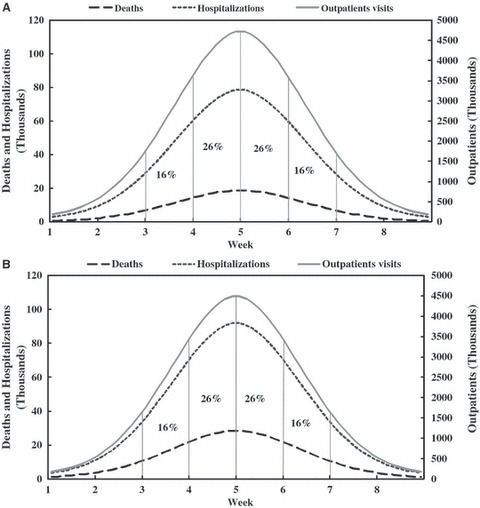
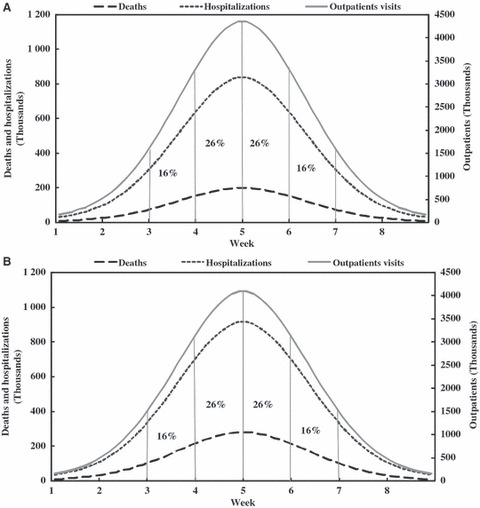
We used a Monte-Carlo simulation model and death rates, hospitalizations and outpatient visits for 1918- and 1968- like pandemic scenarios and data from the literature or experts' opinion to estimate four health outcomes: deaths, hospitalizations, outpatient medical visits and clinical illness for which medical care was not sought. For each of the two scenarios we estimated outcomes by week using a normal distribution.
We estimated that a 1968 scenario in China would result in 460,000-700,000 deaths, 1·94-2·27 million hospitalizations, 111-117 million outpatient visits and 192-197 million illnesses for which medical care was not sought. Fifty-two percent of hospitalizations occurred during the two-peak weeks of the first wave. We estimated that patients at high-risk of influenza complications (10-17% of the population) would account for 61-75% of all deaths. For a 1918 scenario, we estimated that 4·95-6·95 million deaths, 20·8-22·7 million hospitalizations and 101-108 million outpatient visits could occur.
Even a 1968 pandemic scenario will pose substantial challenges for the medical and public health system in China, and planning to manage these challenges is essential.
下一次流感大流行将给中国带来医疗资源需求的激增,中国目前人口超过 13 亿,医疗保健和公共卫生系统欠发达。然而,中国几乎没有大流行影响的数据。
通过检查不同严重程度的大流行情景,我们估计了未来在中国发生流感大流行的影响,并描述了第一波疫情期间病例的时间分布。
我们使用蒙特卡罗模拟模型和 1918 年和 1968 年类似大流行情景的死亡率、住院和门诊就诊数据,以及文献或专家意见,来估计四种健康结果:死亡、住院、门诊就诊和未寻求医疗的临床疾病。对于这两种情景中的每一种,我们使用正态分布按周估计结果。
我们估计,在中国,1968 年情景将导致 46 万至 70 万人死亡,194 万至 227 万人住院,1.11 亿至 1.17 亿门诊就诊和 1.92 亿至 1.97 亿未寻求医疗的疾病。52%的住院发生在第一波疫情的双峰周。我们估计,流感并发症高风险患者(占人口的 10-17%)将占所有死亡人数的 61-75%。对于 1918 年情景,我们估计可能会发生 495 万至 695 万人死亡,2080 万至 2270 万人住院和 1010 万至 1080 万人门诊就诊。
即使是 1968 年的大流行情景,也将给中国的医疗和公共卫生系统带来巨大挑战,规划应对这些挑战至关重要。