Department of Psychology, Northumbria University, Newcastle upon Tyne, United Kingdom.
Neuropsychology. 2011 Jul;25(4):442-53. doi: 10.1037/a0022436.
A prominent behavioral manifestation of impulsivity in children with attention-deficit/hyperactivity disorder (ADHD) is inappropriate language production, such as talking excessively, blurting out answers, and interrupting others.
In this study, we examined language production in ADHD and non-ADHD controls to determine whether these types of language production problems are apparent in adults with ADHD.
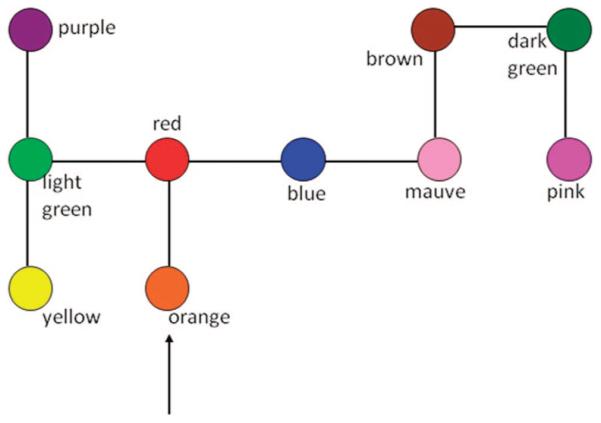
Participants (18-35 years old, 53.3% male) were asked to describe networks of colored dots that contained two branches that differed in length and complexity. According to the Minimal-Load Principle (Levelt, 1989), participants should prefer to describe a shorter and less complex branch first, in order to minimize planning and memory demands when formulating a description of the network. The dependent measures focused on which branch participants chose to describe first and the fluency of the descriptions. Four types of disfluency were examined: filled pauses, silent pauses, repetitions, and repairs.
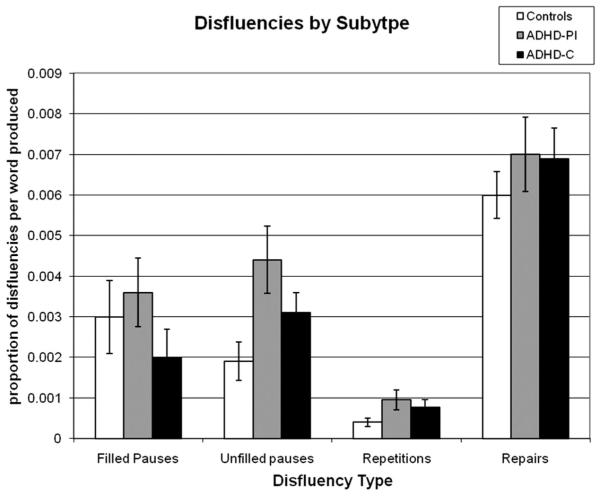
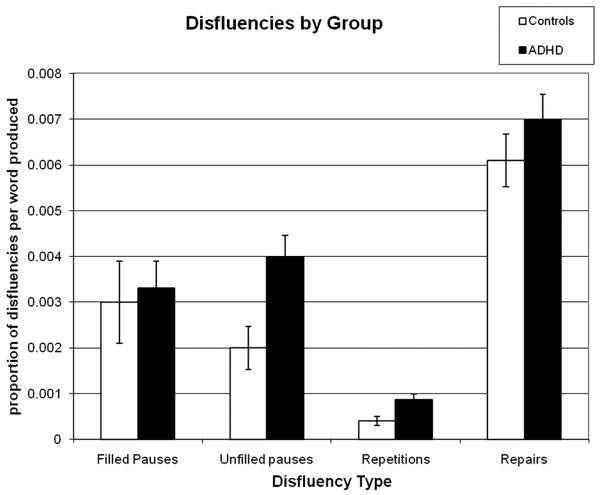
There was no difference between ADHD participants and controls in the decisions they made when describing the networks (p > .10, η² = .004). Participants in both groups preferred to describe a short branch before describing a long branch and decisions were unaffected by complexity. However, ADHD participants did produce more words overall, t(73) = -2.33, p < .05, η² = .07, and they also produced more disfluencies, F(4, 70) = 2.98, p < .05, η² = .15, even after adjusting for number of words produced.
These findings suggest less language efficiency and reduced fluency in ADHD, and that language production issues remain in adults with ADHD, similar to the issues commonly reported in children with ADHD.
注意力缺陷/多动障碍(ADHD)儿童的冲动行为的一个突出表现是不当的语言产生,例如过多地说话、脱口而出答案和打断他人。
在这项研究中,我们检查了 ADHD 和非 ADHD 对照组的语言产生情况,以确定这些类型的语言产生问题是否在 ADHD 成人中明显存在。
要求参与者(18-35 岁,53.3%为男性)描述包含两个分支的彩色点网络,这两个分支在长度和复杂性上有所不同。根据最小负载原则(Levelt,1989),参与者应该更喜欢首先描述较短和较不复杂的分支,以便在形成网络描述时最小化规划和记忆需求。依赖措施集中在参与者首先选择描述哪个分支以及描述的流畅性上。检查了四种类型的不流畅:填充停顿、沉默停顿、重复和修复。
在描述网络时,ADHD 参与者和对照组之间的决策没有差异(p >.10,η² =.004)。两组参与者都更喜欢先描述短分支,然后再描述长分支,而且决策不受复杂性的影响。然而,ADHD 参与者的总词汇量更多,t(73) = -2.33,p <.05,η² =.07,并且他们也产生了更多的不流畅,F(4, 70) = 2.98,p <.05,η² =.15,即使在调整了生成的单词数量后也是如此。
这些发现表明 ADHD 患者的语言效率较低,流畅性降低,并且 ADHD 成人中仍然存在语言产生问题,类似于常见于 ADHD 儿童的问题。