1Medical Sciences Graduate Program, McMaster University, Hamilton, ON,Canada.
Respir Res. 2011 Apr 7;12(1):39. doi: 10.1186/1465-9921-12-39.
While the presence of the chitinase-like molecule YKL40 has been reported in COPD and asthma, its relevance to inflammatory processes elicited by cigarette smoke and common environmental allergens, such as house dust mite (HDM), is not well understood. The objective of the current study was to assess expression and function of BRP-39, the murine equivalent of YKL40 in a murine model of cigarette smoke-induced inflammation and contrast expression and function to a model of HDM-induced allergic airway inflammation.
CD1, C57BL/6, and BALB/c mice were room air- or cigarette smoke-exposed for 4 days in a whole-body exposure system. In separate experiments, BALB/c mice were challenged with HDM extract once a day for 10 days. BRP-39 was assessed by ELISA and immunohistochemistry. IL-13, IL-1R1, IL-18, and BRP-39 knock out (KO) mice were utilized to assess the mechanism and relevance of BRP-39 in cigarette smoke- and HDM-induced airway inflammation.
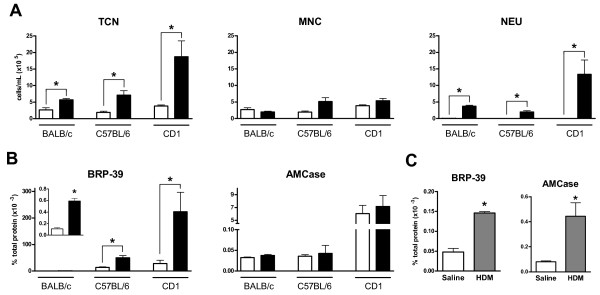
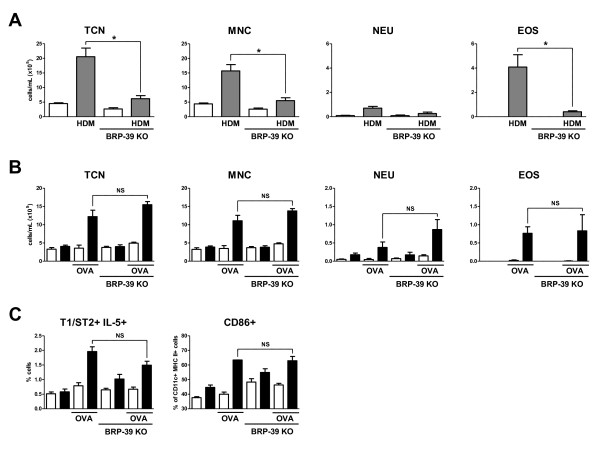
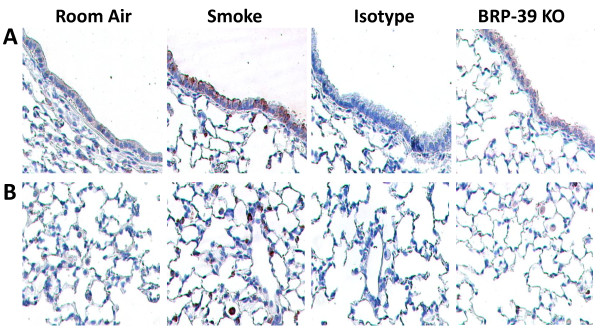
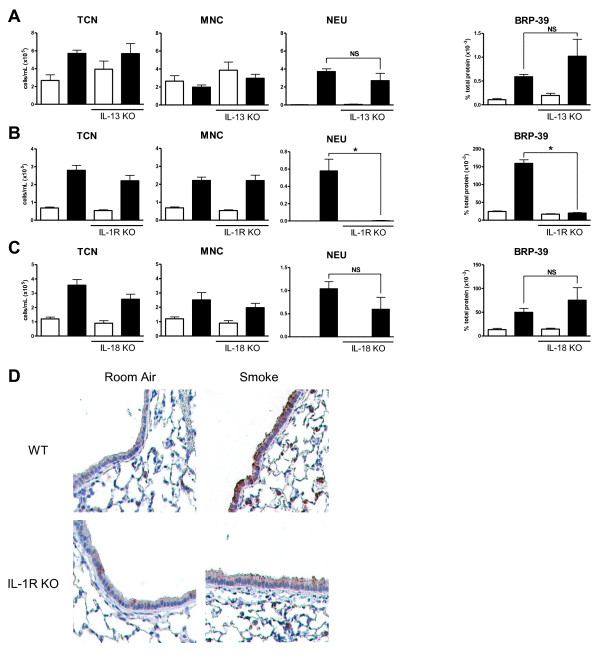
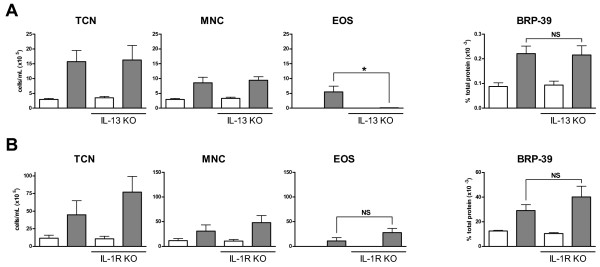
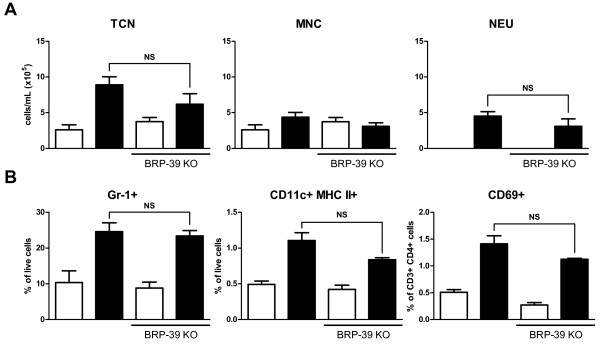
Cigarette smoke exposure elicited a robust induction of BRP-39 but not the catalytically active chitinase, AMCase, in lung epithelial cells and alveolar macrophages of all mouse strains tested. Both BRP-39 and AMCase were increased in lung tissue after HDM exposure. Examining smoke-exposed IL-1R1, IL-18, and IL-13 deficient mice, BRP-39 induction was found to be IL-1 and not IL-18 or IL-13 dependent, while induction of BRP-39 by HDM was independent of IL-1 and IL-13. Despite the importance of BRP-39 in cellular inflammation in HDM-induced airway inflammation, BRP-39 was found to be redundant for cigarette smoke-induced airway inflammation and the adjuvant properties of cigarette smoke.
These data highlight the contrast between the importance of BRP-39 in HDM- and cigarette smoke-induced inflammation. While functionally important in HDM-induced inflammation, BRP-39 is a biomarker of cigarette smoke induced inflammation which is the byproduct of an IL-1 inflammatory pathway.
虽然壳质酶样分子 YKL40 已在 COPD 和哮喘中被报道,但它与香烟烟雾和常见环境过敏原(如屋尘螨[HDM])引起的炎症过程的相关性尚不清楚。本研究的目的是评估 BRP-39(YKL40 的鼠等同物)在香烟烟雾诱导的炎症模型中的表达和功能,并将其与 HDM 诱导的过敏性气道炎症模型进行对比。
CD1、C57BL/6 和 BALB/c 小鼠在全身暴露系统中进行 4 天的空气或香烟烟雾暴露。在单独的实验中,BALB/c 小鼠每天接受 HDM 提取物挑战 10 天。通过 ELISA 和免疫组织化学评估 BRP-39。使用 IL-13、IL-1R1、IL-18 和 BRP-39 敲除(KO)小鼠来评估 BRP-39 在香烟烟雾和 HDM 诱导的气道炎症中的机制和相关性。
香烟烟雾暴露在所有测试的小鼠品系的肺上皮细胞和肺泡巨噬细胞中强烈诱导 BRP-39 但不诱导催化活性的壳聚糖酶 AMCase。在 HDM 暴露后,BRP-39 和 AMCase 均在肺组织中增加。在检查暴露于香烟烟雾的 IL-1R1、IL-18 和 IL-13 缺陷小鼠后,发现 BRP-39 的诱导依赖于 IL-1 而不是 IL-18 或 IL-13,而 HDM 诱导的 BRP-39 不依赖于 IL-1 和 IL-13。尽管 BRP-39 在 HDM 诱导的气道炎症中的细胞炎症中很重要,但 BRP-39 对于香烟烟雾诱导的气道炎症和香烟烟雾的佐剂特性是多余的。
这些数据突出了 BRP-39 在 HDM 和香烟烟雾诱导的炎症中的重要性之间的差异。虽然 BRP-39 在 HDM 诱导的炎症中具有功能重要性,但它是香烟烟雾诱导的炎症的生物标志物,是 IL-1 炎症途径的副产品。