Department of Pediatric Gastroenterology, Cleveland Clinic, 9500 Euclid Avenue, Cleveland, OH 44195, USA.
Expert Rev Gastroenterol Hepatol. 2011 Apr;5(2):201-12. doi: 10.1586/egh.11.6.
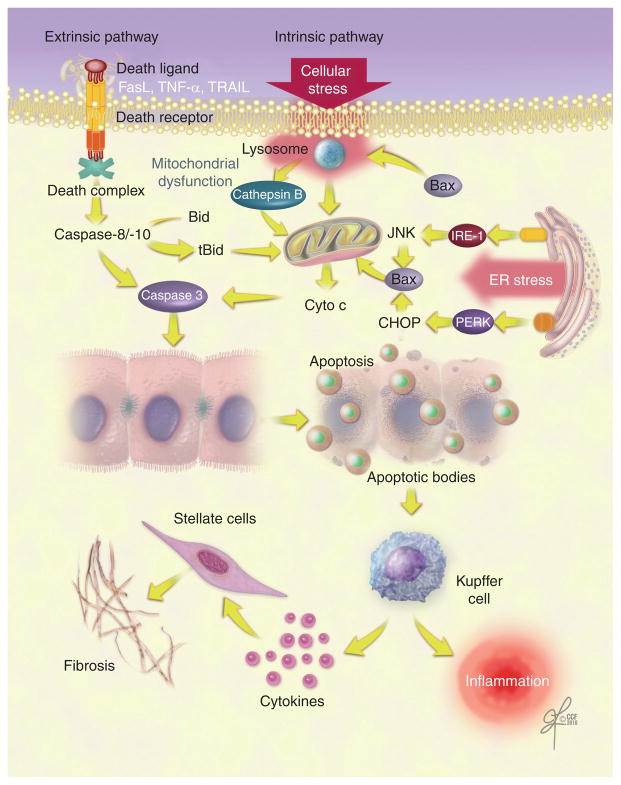
Pathological increases in cell death in the liver as well as in peripheral tissues has emerged as an important mechanism involved in the development and progression of nonalcoholic fatty liver disease (NAFLD). An increase in hepatocyte cell death by apoptosis is typically present in patients with NAFLD and in experimental models of steatohepatitis, while an increase in adipocyte cell death in visceral adipose tissue may be an important mechanism triggering insulin resistance and hepatic steatosis. The two fundamental pathways of apoptosis, the extrinsic (death receptor-mediated) and intrinsic (organelle-initiated) pathways, are both involved. This article summarizes the current knowledge related to the distinct molecular and biochemical pathways of cell death involved in NAFLD pathogenesis. In particular, it will highlight the efforts for the development of both novel diagnostic and therapeutic strategies based on this knowledge.
肝脏以及外周组织中细胞死亡的病理性增加,已成为非酒精性脂肪性肝病 (NAFLD) 发生和进展的一个重要机制。在非酒精性脂肪性肝病患者和脂肪性肝炎的实验模型中,肝细胞凋亡的增加通常存在,而内脏脂肪组织中脂肪细胞死亡的增加可能是触发胰岛素抵抗和肝脂肪变性的一个重要机制。凋亡的两条基本途径,即外在(死亡受体介导)和内在(细胞器起始)途径,都参与其中。本文总结了与 NAFLD 发病机制相关的细胞死亡的不同分子和生化途径的现有知识。特别是,它将强调基于这些知识开发新的诊断和治疗策略的努力。