Department of Neurology, UC Irvine Medical Centre, 101 The City Drive South, Bldg 53, Rm 203, Orange, CA 92868-4280, USA.
Brain. 2011 Jun;134(Pt 6):1591-609. doi: 10.1093/brain/awr039. Epub 2011 Apr 10.
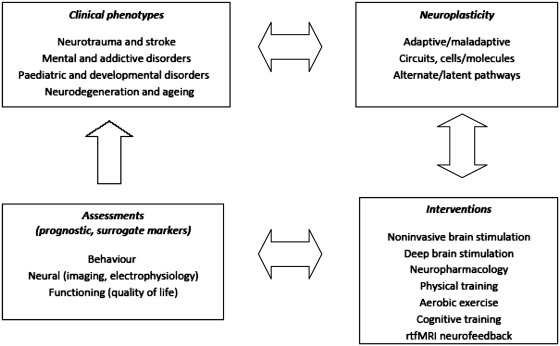
Neuroplasticity can be defined as the ability of the nervous system to respond to intrinsic or extrinsic stimuli by reorganizing its structure, function and connections. Major advances in the understanding of neuroplasticity have to date yielded few established interventions. To advance the translation of neuroplasticity research towards clinical applications, the National Institutes of Health Blueprint for Neuroscience Research sponsored a workshop in 2009. Basic and clinical researchers in disciplines from central nervous system injury/stroke, mental/addictive disorders, paediatric/developmental disorders and neurodegeneration/ageing identified cardinal examples of neuroplasticity, underlying mechanisms, therapeutic implications and common denominators. Promising therapies that may enhance training-induced cognitive and motor learning, such as brain stimulation and neuropharmacological interventions, were identified, along with questions of how best to use this body of information to reduce human disability. Improved understanding of adaptive mechanisms at every level, from molecules to synapses, to networks, to behaviour, can be gained from iterative collaborations between basic and clinical researchers. Lessons can be gleaned from studying fields related to plasticity, such as development, critical periods, learning and response to disease. Improved means of assessing neuroplasticity in humans, including biomarkers for predicting and monitoring treatment response, are needed. Neuroplasticity occurs with many variations, in many forms, and in many contexts. However, common themes in plasticity that emerge across diverse central nervous system conditions include experience dependence, time sensitivity and the importance of motivation and attention. Integration of information across disciplines should enhance opportunities for the translation of neuroplasticity and circuit retraining research into effective clinical therapies.
神经可塑性可以被定义为神经系统对外源性或内源性刺激做出反应的能力,通过重新组织其结构、功能和连接来实现。迄今为止,对神经可塑性的理解取得了重大进展,但很少有已确立的干预措施。为了将神经可塑性研究转化为临床应用,美国国立卫生研究院神经科学研究蓝图在 2009 年主办了一次研讨会。来自中枢神经系统损伤/中风、精神/成瘾障碍、儿科/发育障碍和神经退行性疾病/衰老等领域的基础和临床研究人员确定了神经可塑性的主要范例、潜在机制、治疗意义和共同特征。确定了一些有前途的治疗方法,如脑刺激和神经药理学干预,这些方法可能会增强训练引起的认知和运动学习,同时也提出了如何最好地利用这方面的信息来减少人类残疾的问题。通过基础和临床研究人员的迭代合作,可以从分子到突触,再到网络,再到行为,更深入地了解适应性机制。可以从与可塑性相关的领域(如发育、关键期、学习和对疾病的反应)中吸取经验教训。需要改进的方法来评估人类的神经可塑性,包括预测和监测治疗反应的生物标志物。神经可塑性具有多种变化形式,发生在许多不同的环境中。然而,在各种中枢神经系统疾病中出现的可塑性的共同主题包括经验依赖性、时间敏感性以及动机和注意力的重要性。跨学科整合信息应该会增加将神经可塑性和回路再训练研究转化为有效临床治疗的机会。