Departamento de Bioquímica e Biologia Molecular, BIOAGRO, Universidade Federal de Viçosa, Viçosa, MG, Brazil.
J Biol Chem. 2011 Jun 3;286(22):20020-30. doi: 10.1074/jbc.M111.233494. Epub 2011 Apr 11.
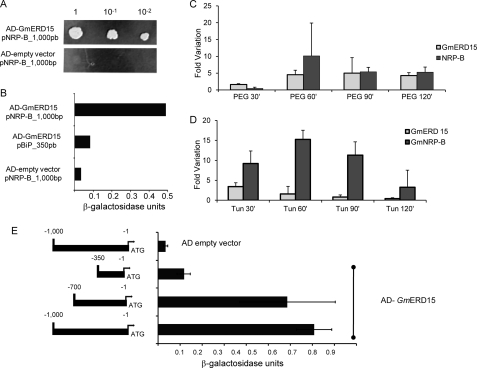
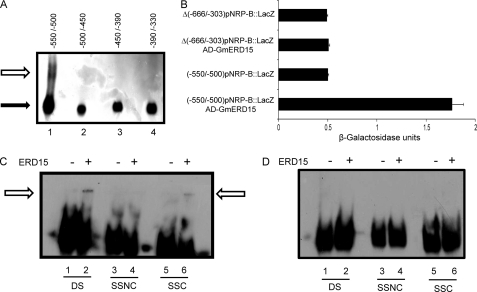
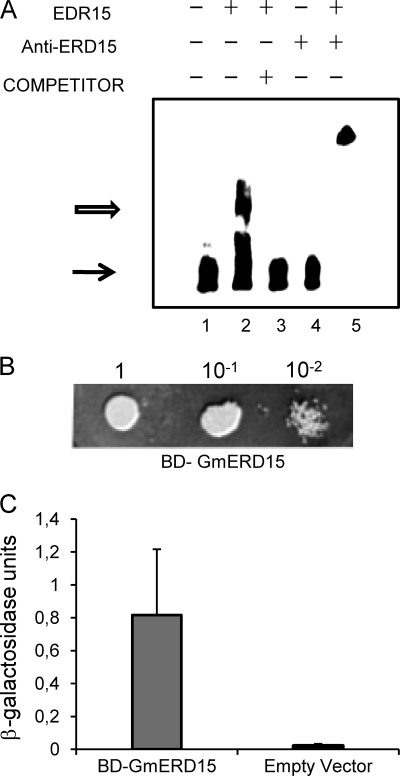
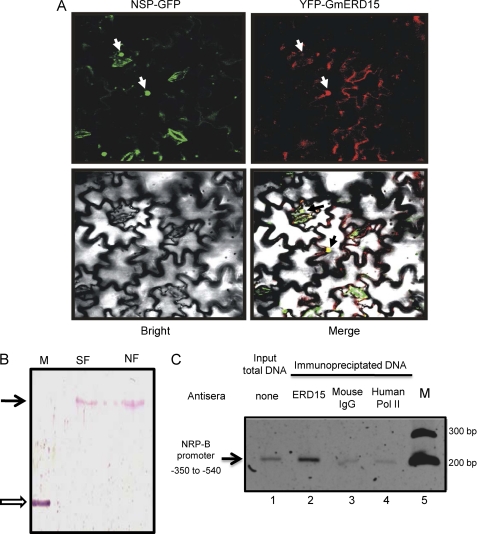
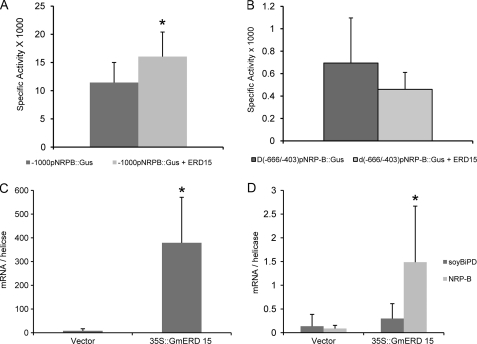
As in all other eukaryotic organisms, endoplasmic reticulum (ER) stress triggers the evolutionarily conserved unfolded protein response in soybean, but it also communicates with other adaptive signaling responses, such as osmotic stress-induced and ER stress-induced programmed cell death. These two signaling pathways converge at the level of gene transcription to activate an integrated cascade that is mediated by N-rich proteins (NRPs). Here, we describe a novel transcription factor, GmERD15 (Glycine max Early Responsive to Dehydration 15), which is induced by ER stress and osmotic stress to activate the expression of NRP genes. GmERD15 was isolated because of its capacity to stably associate with the NRP-B promoter in yeast. It specifically binds to a 187-bp fragment of the NRP-B promoter in vitro and activates the transcription of a reporter gene in yeast. Furthermore, GmERD15 was found in both the cytoplasm and the nucleus, and a ChIP assay revealed that it binds to the NRP-B promoter in vivo. Expression of GmERD15 in soybean protoplasts activated the NRP-B promoter and induced expression of the NRP-B gene. Collectively, these results support the interpretation that GmERD15 functions as an upstream component of stress-induced NRP-B-mediated signaling to connect stress in the ER to an osmotic stress-induced cell death signal.
与所有其他真核生物一样,内质网(ER)应激在大豆中引发进化上保守的未折叠蛋白反应,但它也与其他适应性信号反应(如渗透胁迫诱导和 ER 应激诱导的程序性细胞死亡)通讯。这两个信号通路在基因转录水平上汇聚,激活由富含 N 的蛋白质(NRP)介导的整合级联反应。在这里,我们描述了一种新型转录因子,GmERD15(Glycine max Early Responsive to Dehydration 15),它受 ER 应激和渗透胁迫诱导,激活 NRP 基因的表达。GmERD15 被分离出来是因为它能够在酵母中与 NRP-B 启动子稳定结合。它在体外特异性结合 NRP-B 启动子的 187bp 片段,并激活酵母中报告基因的转录。此外,GmERD15 存在于细胞质和细胞核中,ChIP 测定表明它在体内结合 NRP-B 启动子。GmERD15 在大豆原生质体中的表达激活了 NRP-B 启动子,并诱导了 NRP-B 基因的表达。总的来说,这些结果支持这样的解释,即 GmERD15 作为应激诱导的 NRP-B 介导的信号的上游成分,将 ER 中的应激与渗透胁迫诱导的细胞死亡信号联系起来。