Institut für Biologie, Fachgebiet Mikrobiologie, Universität Kassel, Kassel, Germany.
Roche Pharma Research & Early Development, Large Molecule Research, Roche Innovation Center München, Penzberg, Germany.
PLoS One. 2018 Oct 18;13(10):e0205870. doi: 10.1371/journal.pone.0205870. eCollection 2018.
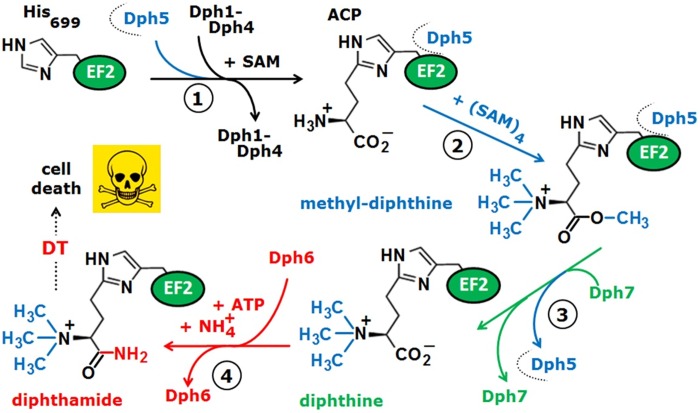
In eukaryotes, the modification of an invariant histidine (His-699 in yeast) residue in translation elongation factor 2 (EF2) with diphthamide involves a conserved pathway encoded by the DPH1-DPH7 gene network. Diphthamide is the target for diphtheria toxin and related lethal ADP ribosylases, which collectively kill cells by inactivating the essential translocase function of EF2 during mRNA translation and protein biosynthesis. Although this notion emphasizes the pathological importance of diphthamide, precisely why cells including our own require EF2 to carry it, is unclear. Mining the synthetic genetic array (SGA) landscape from the budding yeast Saccharomyces cerevisiae has revealed negative interactions between EF2 (EFT1-EFT2) and diphthamide (DPH1-DPH7) gene deletions. In line with these correlations, we confirm in here that loss of diphthamide modification (dphΔ) on EF2 combined with EF2 undersupply (eft2Δ) causes synthetic growth phenotypes in the composite mutant (dphΔ eft2Δ). These reflect negative interference with cell performance under standard as well as thermal and/or chemical stress conditions, cell growth rates and doubling times, competitive fitness, cell viability in the presence of TOR inhibitors (rapamycin, caffeine) and translation indicator drugs (hygromycin, anisomycin). Together with significantly suppressed tolerance towards EF2 inhibition by cytotoxic DPH5 overexpression and increased ribosomal -1 frame-shift errors in mutants lacking modifiable pools of EF2 (dphΔ, dphΔ eft2Δ), our data indicate that diphthamide is important for the fidelity of the EF2 translocation function during mRNA translation.
在真核生物中,翻译延伸因子 2 (EF2) 中一个不变组氨酸 (酵母中的 His-699) 残基的二氢喋呤修饰涉及由 DPH1-DPH7 基因网络编码的保守途径。二氢喋呤是白喉毒素和相关致死性 ADP 核糖基转移酶的靶标,这些毒素通过在 mRNA 翻译和蛋白质生物合成过程中使 EF2 的必需易位酶功能失活,共同杀死细胞。尽管这一概念强调了二氢喋呤的病理重要性,但细胞(包括我们自己的细胞)为什么需要 EF2 携带它还不清楚。从芽殖酵母酿酒酵母的合成遗传图谱 (SGA) 景观中挖掘发现,EF2 (EFT1-EFT2) 和二氢喋呤 (DPH1-DPH7) 基因缺失之间存在负相互作用。与这些相关性一致,我们在这里证实,EF2 上的二氢喋呤修饰缺失 (dphΔ) 与 EF2 供应不足 (eft2Δ) 相结合会导致复合突变体 (dphΔ eft2Δ) 出现合成生长表型。这些表型反映了在标准条件以及热和/或化学应激条件下、细胞生长速率和倍增时间、竞争适应性、TOR 抑制剂(雷帕霉素、咖啡因)存在下的细胞活力以及翻译指示剂药物( Hygromycin、anisomycin)存在下对细胞性能的负干扰。与通过细胞毒性 DPH5 过表达对 EF2 抑制的显著抑制以及缺乏可修饰 EF2 池的突变体中核糖体 -1 框移错误增加(dphΔ、dphΔ eft2Δ)一起,我们的数据表明二氢喋呤对 EF2 易位功能在 mRNA 翻译过程中的保真度很重要。