Department of Epidemiology and Population Health, Albert Einstein College of Medicine, USA.
Atherosclerosis. 2011 Jul;217(1):207-13. doi: 10.1016/j.atherosclerosis.2011.03.011. Epub 2011 Mar 15.
HIV disease is associated with increased arterial stiffness, which may be related to inflammation provoked by HIV-related immune perturbation. We assessed the association of T cell markers of immune activation and immunosenescence with carotid artery stiffness among HIV-infected women.
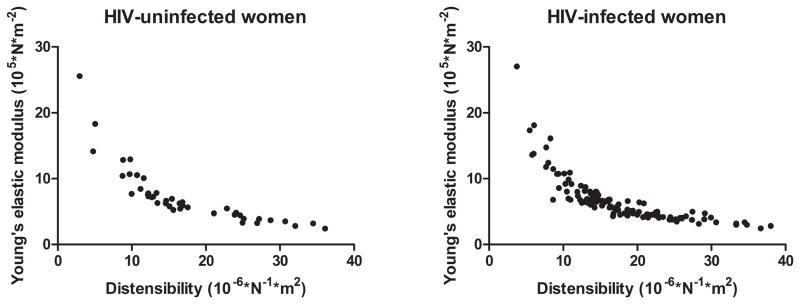
Among 114 HIV-infected and 43 HIV-uninfected women, we measured CD4+ and CD8+ T cell populations expressing activation (CD38+HLA-DR+) and senescence (CD28-CD57+) markers. We then related these measures of immune status with parameters of carotid artery stiffness, including decreased distensibility, and increased Young's elastic modulus, as assessed by B-mode ultrasound.
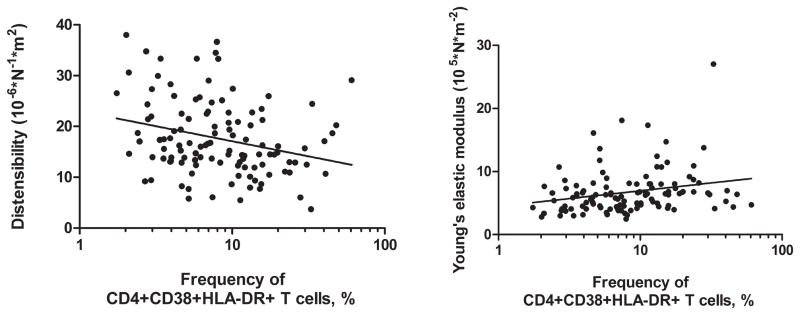
HIV infection was associated with increased CD4+ T cell activation, CD8+ T cell activation and CD8+ T cell senescence. Among HIV-infected women, adjusted for age, HIV medications, and vascular risk factors, higher CD4+CD38+HLA-DR+ T cell frequency was associated with decreased carotid artery distensibility (β=-2.00, 95% confidence interval [CI]=-3.86, -0.14, P=0.04) and increased Young's modulus (β=1.00, 95% CI=0.03, 1.97, P=0.04). These associations were affected little by further adjustment for CD4+ T cell count and viral load. Among HIV-infected women, higher frequencies of immunosenescent T cells, including CD4+CD28-CD57+ and CD8+CD28-CD57+ T cells, were also associated with decreased arterial distensibility. Among HIV-uninfected women, frequencies of activated or senescent T cells were not significantly associated with measures of carotid stiffness.
T cell activation and senescence are associated with arterial stiffness, suggesting that pro-inflammatory populations of T cells may produce functional or structural vascular changes in HIV-infected women.
HIV 疾病与动脉僵硬度增加有关,而这种增加可能与 HIV 相关免疫失调引起的炎症有关。我们评估了 HIV 感染女性的 T 细胞免疫激活和免疫衰老标志物与颈动脉僵硬之间的关联。
在 114 名 HIV 感染和 43 名 HIV 未感染的女性中,我们测量了表达激活(CD38+HLA-DR+)和衰老(CD28-CD57+)标志物的 CD4+和 CD8+T 细胞群体。然后,我们将这些免疫状态指标与颈动脉僵硬参数相关联,包括通过 B 型超声评估的可扩展性降低和杨氏弹性模量增加。
HIV 感染与 CD4+T 细胞激活、CD8+T 细胞激活和 CD8+T 细胞衰老增加有关。在 HIV 感染的女性中,在校正年龄、HIV 药物和血管危险因素后,较高的 CD4+CD38+HLA-DR+T 细胞频率与颈动脉可扩展性降低(β=-2.00,95%置信区间[CI]=-3.86,-0.14,P=0.04)和杨氏模量增加(β=1.00,95% CI=0.03,1.97,P=0.04)相关。这些关联在进一步调整 CD4+T 细胞计数和病毒载量后几乎没有受到影响。在 HIV 感染的女性中,包括 CD4+CD28-CD57+和 CD8+CD28-CD57+T 细胞在内的免疫衰老 T 细胞的较高频率也与动脉可扩展性降低相关。在 HIV 未感染的女性中,激活或衰老 T 细胞的频率与颈动脉僵硬的测量值没有显著相关。
T 细胞激活和衰老与动脉僵硬有关,这表明 HIV 感染女性的促炎 T 细胞群可能导致功能性或结构性血管变化。