Epidemiology Program, University of Hawaii Cancer Center, 1236 Lauhala Street, Honolulu, HI, 96813, USA.
Breast Cancer Res Treat. 2011 Sep;129(2):565-74. doi: 10.1007/s10549-011-1468-4. Epub 2011 Apr 16.
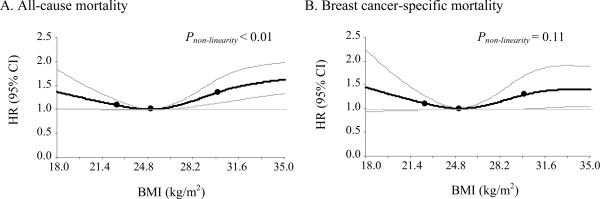
Breast cancer survival has been found to be lower in obese women, but few studies have evaluated ethnic variations in this association. This study examined all-cause and breast cancer-specific survival by body mass index (BMI) in the Multiethnic Cohort (MEC) study for African American, Native Hawaiian, Japanese American, Latino, and Caucasian women. Female MEC participants free of breast cancer, aged ≥50 years at cohort entry, and diagnosed with primary invasive breast cancer during follow-up were included in the analyses (n = 3,842). Cox proportional hazards regression was used to estimate the effect of pre-diagnostic adult BMI (<22.5, 22.5-24.9, 25.0-29.9, ≥30 kg/m(2)) on the risk of mortality. Mean age at diagnosis was 68.8 years (range 50-89 years). During a mean follow-up of 6.2 ± 3.8 years after diagnosis, there were 804 deaths that included 376 breast cancer-specific deaths. After adjustment for breast cancer characteristics, including hormone receptor status, stage at diagnosis, and treatment, obese women had a higher risk of all-cause [hazard ratio (HR) = 1.54; 95% confidence interval (CI): 1.23, 1.91] and breast cancer-specific (HR = 1.45; 95% CI: 1.05, 2.00) mortality compared to women with high-normal BMI; however, being overweight did not affect survival. There was no evidence of ethnic differences in the BMI effect on all-cause (P (interaction) = 0.87) or breast cancer-specific (P (interaction) = 0.63) mortality. Our findings are consistent with the literature that maintaining moderate weight throughout adult life may be beneficial for breast cancer survival in women and this appears to hold for all ethnic groups.
研究发现,肥胖女性的乳腺癌生存率较低,但很少有研究评估这种关联的种族差异。本研究在多民族队列(MEC)研究中,评估了身体质量指数(BMI)对非裔美国人、夏威夷原住民、日裔美国人、拉丁裔和白种人女性所有原因和乳腺癌特异性生存率的影响。在队列入组时年龄≥50 岁、无乳腺癌且在随访期间被诊断为原发性浸润性乳腺癌的女性 MEC 参与者被纳入分析(n=3842)。使用 Cox 比例风险回归估计诊断前成人 BMI(<22.5、22.5-24.9、25.0-29.9、≥30kg/m²)对死亡率风险的影响。诊断时的平均年龄为 68.8 岁(范围 50-89 岁)。在诊断后平均 6.2±3.8 年的随访期间,发生了 804 例死亡事件,其中包括 376 例乳腺癌特异性死亡。在调整了乳腺癌特征(包括激素受体状态、诊断时的分期和治疗)后,与高正常 BMI 的女性相比,肥胖女性的全因死亡风险更高(风险比 [HR] = 1.54;95%置信区间 [CI]:1.23,1.91)和乳腺癌特异性死亡风险(HR=1.45;95%CI:1.05,2.00);然而,超重并不影响生存率。在 BMI 对全因死亡率(P(交互作用)=0.87)或乳腺癌特异性死亡率(P(交互作用)=0.63)的影响方面,没有证据表明存在种族差异。我们的研究结果与文献一致,即保持成年期的适度体重可能对女性的乳腺癌生存有益,而且这种影响似乎适用于所有种族群体。