Seixas Daniela, Sá Maria José, Galhardo Vasco, Guimarães Joana, Lima Deolinda
Institute of Histology and Embryology, Faculty of Medicine of Porto University Porto, Portugal.
Front Neurol. 2011 Mar 31;2:20. doi: 10.3389/fneur.2011.00020. eCollection 2011.
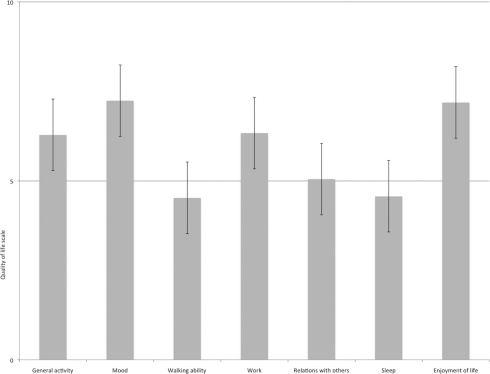
Early reports often ignored pain as an important symptom in multiple sclerosis (MS). Pain prevalence figures in MS from European countries other than Portugal range between 40 and 65%. To our knowledge there is no published data in English on pain in MS in Portugal. We describe the demographic and clinical characteristics, with an emphasis on pain, of 85 MS patients followed-up in a Portuguese hospital, contributing to pain epidemiology in MS. Patients were interviewed sequentially after their regular appointments at the MS clinic; patients with pain completed The Brief Pain Inventory and The McGill Pain Questionnaire (MPQ). The prevalence of pain found was 34%. Headache and back pain were the most common anatomical sites described, followed by upper and lower limbs. Intensity of pain in an 11-point scale was, for the maximum pain intensity 6.7 ± 1.8, for the minimum pain intensity 2.2 ± 2.0, for the mean pain intensity 4.5 ± 1.5, and for the actual pain intensity 2.4 ± 2.9. Pain interfered significantly with general activity, mood, work, social relations, and enjoyment of life. All MS patients with pain employed words from both the sensory and affective categories of the MPQ to describe it. Patient pain descriptions' included the word "hot-burning" in 59% of the cases, common in the report of central pain, but neuropathic pain medications were only used by 10% of them. Pain is an important symptom in Portuguese patients with MS, not only because of the high prevalence found, concordant with other European countries, but also because of its interference with quality-of-life.
早期报告常常忽视疼痛这一多发性硬化症(MS)的重要症状。除葡萄牙外,欧洲其他国家MS患者的疼痛患病率在40%至65%之间。据我们所知,尚无关于葡萄牙MS患者疼痛情况的英文发表数据。我们描述了在一家葡萄牙医院接受随访的85例MS患者的人口统计学和临床特征,重点关注疼痛情况,这有助于MS疼痛流行病学研究。患者在MS门诊定期就诊后依次接受访谈;有疼痛的患者完成了简明疼痛问卷和麦吉尔疼痛问卷(MPQ)。发现的疼痛患病率为34%。头痛和背痛是描述最多的解剖部位,其次是上肢和下肢。在11分制中,最大疼痛强度为6.7±1.8,最小疼痛强度为2.2±2.0,平均疼痛强度为4.5±1.5,实际疼痛强度为2.4±2.9。疼痛对一般活动、情绪、工作、社会关系和生活乐趣有显著干扰。所有有疼痛的MS患者都使用了MPQ感觉和情感类别中的词汇来描述疼痛。59%的患者疼痛描述中包含“热灼痛”一词,这在中枢性疼痛报告中很常见,但只有10%的患者使用了神经性疼痛药物。疼痛是葡萄牙MS患者的一个重要症状,不仅因为发现的患病率高,与其他欧洲国家一致,还因为它对生活质量有干扰。