Division of Clinical Nutrition, Shiga University of Medical Science, Seta-Tsukinowa, Otsu, Shiga 520-2192, Japan.
J Clin Biochem Nutr. 2011 May;48(3):183-6. doi: 10.3164/jcbn.10-83. Epub 2011 Apr 13.
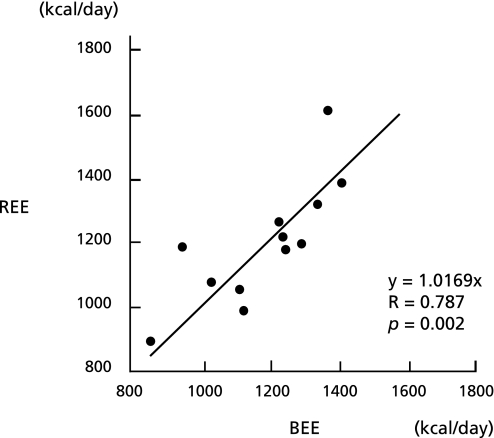
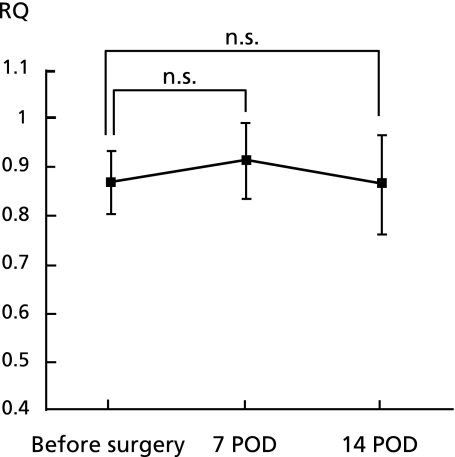
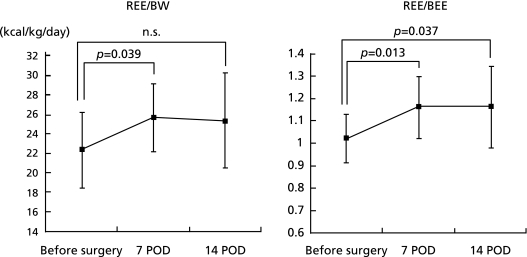
We measured the energy expenditure weekly in patients undergoing a pylorus preserving pancreatoduodenectomy for bile duct cancer or pancreatic tumors. Twelve patients (5 women and 7 men; mean age 70.1 years) were enrolled in this study, and their resting energy expenditure levels were determined by indirect calorimetry. In these patients, a significant correlation was observed between the measured resting energy expenditures and the predicted resting energy expenditures calculated by the Harris-Benedict equation. The resting energy expenditures measured before surgery were almost the same as the predicted resting energy expenditures (measured resting energy expenditure: 22.4 ± 3.9 kcal/kg/day vs predicted resting energy expenditure: 21.7 ± 2.0 kcal/kg/day). The measured resting energy expenditure/predicted resting energy expenditure ratio, which reflects the stress factor, was 1.02 ± 0.10. After the pylorus preserving pancreatoduodenectomy, a significant increase in energy expenditure was observed, and the measured resting energy expenditure was 25.7 ± 3.5 kcal/kg/day on postoperative day 7 and 25.4 ± 4.9 kcal/kg/day on postoperative day 14. The measured resting energy expenditure/predicted resting energy expenditure ratio was 1.16 ± 0.14 on postoperative day 7, and 1.16 ± 0.18 on postoperative day 14 respectively. In conclusion, patients undergoing a pylorus preserving pancreatoduodenectomy showed a hyper-metabolic status as evaluated by their measured resting energy expenditure/predicted resting energy expenditure ratio. From our observations, we recommend that nutritional management based on 30 kcal/body weight/day (calculated by the measured resting energy expenditure×activity factor 1.2-1.3) may be optimal for patients undergoing a pylorus preserving pancreatoduodenectomy.
我们每周测量行保留幽门胰十二指肠切除术的胆管癌或胰腺肿瘤患者的能量消耗。本研究纳入 12 例患者(5 例女性,7 例男性;平均年龄 70.1 岁),通过间接测热法测定其静息能量消耗水平。这些患者中,实测静息能量消耗与哈里斯-贝尼迪克特(Harris-Benedict)方程预测的静息能量消耗呈显著相关。术前实测静息能量消耗与预测静息能量消耗几乎相同(实测静息能量消耗:22.4±3.9 kcal/kg/天 vs 预测静息能量消耗:21.7±2.0 kcal/kg/天)。反映应激因素的实测静息能量消耗/预测静息能量消耗比值为 1.02±0.10。行保留幽门胰十二指肠切除术 7 天后,能量消耗显著增加,术后第 7 天实测静息能量消耗为 25.7±3.5 kcal/kg/天,术后第 14 天为 25.4±4.9 kcal/kg/天。术后第 7 天和第 14 天的实测静息能量消耗/预测静息能量消耗比值分别为 1.16±0.14 和 1.16±0.18。总之,行保留幽门胰十二指肠切除术的患者表现出高代谢状态,可通过实测静息能量消耗/预测静息能量消耗比值评估。根据我们的观察,我们建议基于 30 kcal/体重/天(由实测静息能量消耗×活动因子 1.2-1.3 计算)的营养管理可能是保留幽门胰十二指肠切除术患者的最佳选择。