Research Centre for Medical Genetics, Russian Academy of Medical Sciences, Moscow, Russia.
Mol Biol Evol. 2011 Oct;28(10):2905-20. doi: 10.1093/molbev/msr126. Epub 2011 May 13.
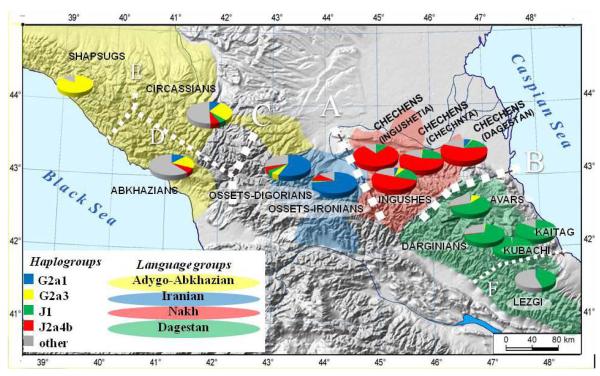
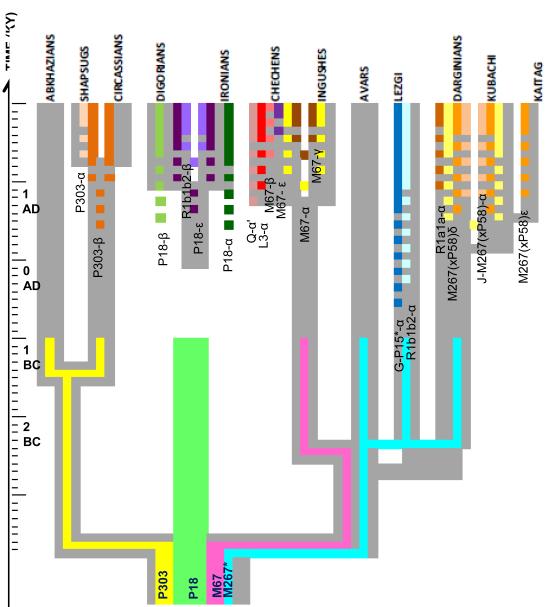
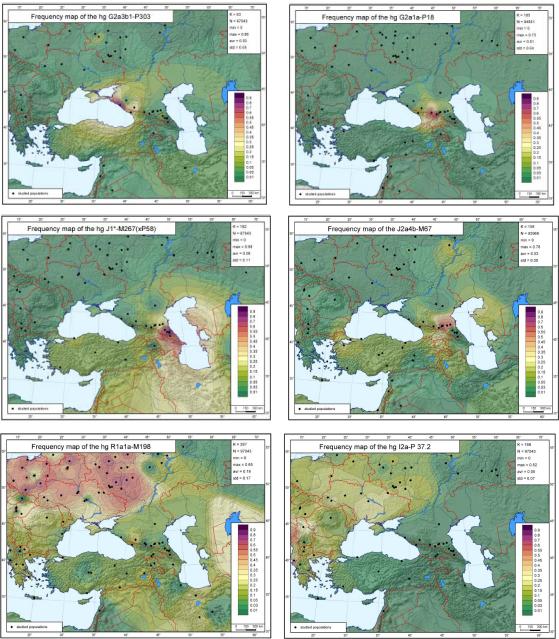
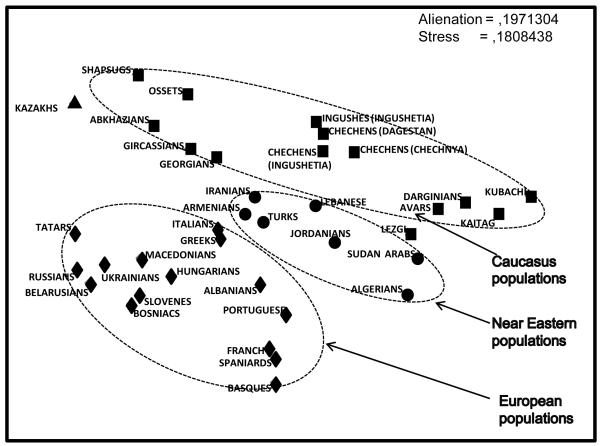
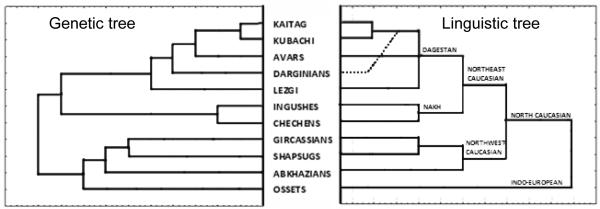
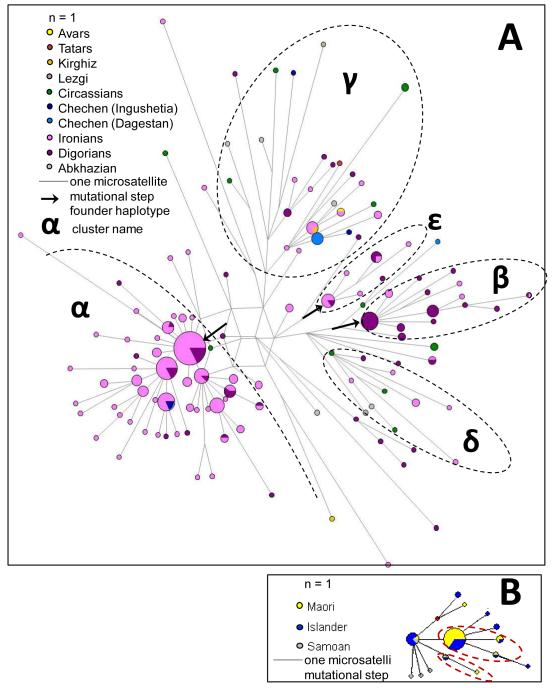
We analyzed 40 single nucleotide polymorphism and 19 short tandem repeat Y-chromosomal markers in a large sample of 1,525 indigenous individuals from 14 populations in the Caucasus and 254 additional individuals representing potential source populations. We also employed a lexicostatistical approach to reconstruct the history of the languages of the North Caucasian family spoken by the Caucasus populations. We found a different major haplogroup to be prevalent in each of four sets of populations that occupy distinct geographic regions and belong to different linguistic branches. The haplogroup frequencies correlated with geography and, even more strongly, with language. Within haplogroups, a number of haplotype clusters were shown to be specific to individual populations and languages. The data suggested a direct origin of Caucasus male lineages from the Near East, followed by high levels of isolation, differentiation, and genetic drift in situ. Comparison of genetic and linguistic reconstructions covering the last few millennia showed striking correspondences between the topology and dates of the respective gene and language trees and with documented historical events. Overall, in the Caucasus region, unmatched levels of gene-language coevolution occurred within geographically isolated populations, probably due to its mountainous terrain.
我们分析了来自高加索地区 14 个群体的 1525 名原住民和 254 名潜在来源群体的 40 个单核苷酸多态性和 19 个短串联重复 Y 染色体标记。我们还采用词汇统计学方法重建了高加索地区讲的北高加索语系语言的历史。我们发现,在四个分别占据不同地理区域并属于不同语言分支的人群中,每一组都有一个不同的主要单倍群占主导地位。单倍群频率与地理有关,与语言的相关性甚至更强。在单倍群内,一些单倍型簇被证明是特定于个别人群和语言的。这些数据表明,高加索男性谱系直接起源于近东,随后在当地经历了高度的隔离、分化和遗传漂变。对过去几千年的遗传和语言重建进行比较,发现各自基因和语言树的拓扑结构和日期与有记载的历史事件之间存在惊人的对应关系。总的来说,在高加索地区,由于其多山的地形,在地理上孤立的人群中发生了基因-语言不成比例的协同进化。