Mohandas Vinitha, Ballal Mamatha
Department of Microbiology, Dayanada Sagar Dental College, Bangalore; Kasturba Medical College International Center, Manipal, India.
J Glob Infect Dis. 2011 Jan;3(1):4-8. doi: 10.4103/0974-777X.77288.
Candida species are normal inhabitants of the skin and mucosa. The importance of epidemiological monitoring of yeasts involved in pathogenic processes is unquestionable due to the increase of these infections over the last decade;
The clinical samples from the respiratory tract (sputum, bronchial wash, tracheal secretions), saliva, blood, urine, middle ear discharge, vitreous fluid, corneal ulcer, and plastic devices (endotracheal tube, catheter tip, suction tip) were collected and cultured. The species of Candida isolated were identified.
A total of 111 isolates of Candida species were recovered from 250 diverse clinical sources. C. albicans (39.64%) was the most isolated species, although the Candida non albicans species with 60.36% showed the major prevalence. In blood cultures, C. krusei (38.23%) and C. albicans (20.58%) were isolated frequently. C. albicans (63.27%) was the predominant species in mucosal surface. Urinary tract infections caused by yeasts were more frequent in hospitalized patients, C. krusei (50.0%) being commonly isolated, followed by C. albicans (25.0%).
Several virulence factors like, biofilm, proteinase, phospholipase, etc. contribute to the pathogenecity. Early detection of virulence factors by Candida is useful in clinical decision making. We therefore have aimed at demonstrating the formation of biofilm using the method proposed by Branchini et al, (1994). The proteinase produced by Candida was estimated as per the method of Staib et al, (1965). Phospholipase assay was carried out as per the method of Samaranayake et al, (2005).
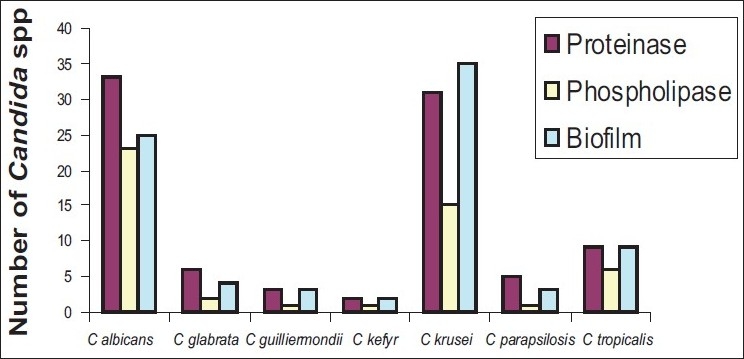
The data suggests that the capacity of Candida species to produce biofilm may be a reflection of the pathogenic potential of the isolates. C. krusei and C. tropicalis showed strong slime production. The non-Candida albicans produced more proteinase than C. albicans. C. albicans produced higher levels of phospholipase than non Candida albicans in this study.
念珠菌属是皮肤和黏膜的正常寄居菌。鉴于过去十年中这些感染的增加,对参与致病过程的酵母菌进行流行病学监测的重要性是毋庸置疑的;
收集来自呼吸道(痰液、支气管灌洗、气管分泌物)、唾液、血液、尿液、中耳分泌物、玻璃体液、角膜溃疡以及塑料装置(气管内导管、导管尖端、吸痰尖端)的临床样本并进行培养。对分离出的念珠菌种类进行鉴定。
从250个不同临床来源共分离出111株念珠菌。白色念珠菌(39.64%)是分离最多的菌种,不过非白色念珠菌占比60.36%,更为常见。在血培养中,克鲁斯念珠菌(38.23%)和白色念珠菌(20.58%)经常被分离出来。白色念珠菌(63.27%)是黏膜表面的主要菌种。住院患者中酵母菌引起的尿路感染更为常见,常见分离出的是克鲁斯念珠菌(50.0%),其次是白色念珠菌(25.0%)。
生物膜、蛋白酶、磷脂酶等多种毒力因子有助于致病性。念珠菌毒力因子的早期检测对临床决策有用。因此,我们旨在使用Branchini等人(1994年)提出的方法来证明生物膜的形成。念珠菌产生的蛋白酶按照Staib等人(1965年)的方法进行测定。磷脂酶测定按照Samaranayake等人(2005年)的方法进行。
数据表明念珠菌产生生物膜的能力可能反映了分离株的致病潜力。克鲁斯念珠菌和热带念珠菌显示出较强的黏液产生能力。非白色念珠菌产生的蛋白酶比白色念珠菌更多。在本研究中,白色念珠菌产生的磷脂酶水平高于非白色念珠菌。