Bisht Manisha, Bist S S, Dhasmana D C, Saini Sunil
Department of Pharmacology, Himalayan Institute of Medical Sciences, HIHT University, Jolly-grant, Dehradun - 248 140, Uttarakhand, India.
Indian J Med Paediatr Oncol. 2010 Oct;31(4):121-5. doi: 10.4103/0971-5851.76194.
Though well recognized in the West, palliative care and quality of life are relatively newer concepts in a developing country like India. The aim of this study was to assess the effect of palliative care on pain and quality of life and to identify the association between the two.
Observational prospective study.
Patients with advanced cancer, receiving palliative drug therapy, were recruited from a tertiary care hospital. City of Hope Medical Center Quality of Life Survey and visual analog scale (VAS) were used to assess the quality of life and cancer pain severity, respectively.
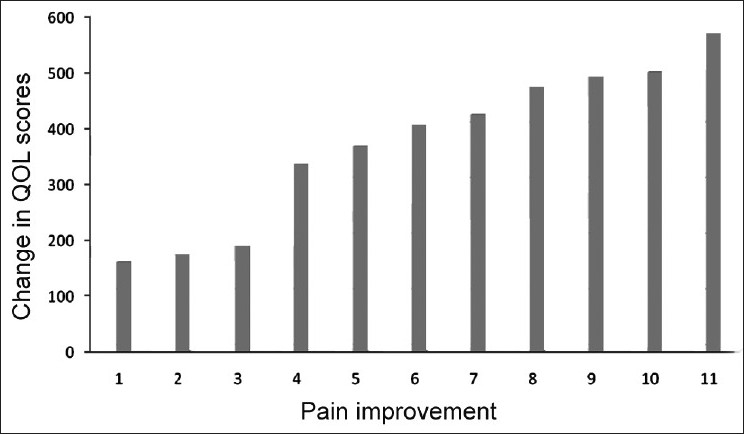
A total of 100 patients were included in the study. Palliative drug therapy produced a significant reduction in pain scores expressed as mean ± SD in VAS [7.13 ± 2.2 vs. 2.62 ± 2.1 (P<0.001) after 1 month in 93 patients; 7.06 ± 2.1 vs. 2.47 ± 2.1 (P<0.001) after 1 month and 2.02 ± 1.9 (P<0.001) after 2 months in 51 patients]. Also, significant improvement in the quality of life scores [919.78 ± 271.3 vs. 1280.65 ± 306.8 (P<0.01) after 1 month in 93 patients; 950.39 ± 238.2 vs. 1336.67 ± 291 (P<0.01) after 1 month and 1405.49 ± 368.3 (P<0.01) after 2 months in 51 patients] was obtained. There was a high correlation between the average change of pain intensity and quality of life scores (r= -0.53, P<0.02). Overall, a reduction in pain resulted in significant improvement in the quality of life (P<0.001).
This study emphasizes the role of palliative care and, more importantly, pain management in improving the quality of life of advanced cancer patients.
尽管姑息治疗和生活质量在西方已得到广泛认可,但在印度这样的发展中国家,它们仍是相对较新的概念。本研究的目的是评估姑息治疗对疼痛和生活质量的影响,并确定两者之间的关联。
观察性前瞻性研究。
从一家三级护理医院招募接受姑息药物治疗的晚期癌症患者。分别使用希望之城医疗中心生活质量调查问卷和视觉模拟量表(VAS)评估生活质量和癌症疼痛严重程度。
本研究共纳入100例患者。姑息药物治疗使VAS中以均值±标准差表示的疼痛评分显著降低[93例患者在1个月后为7.13±2.2 vs. 2.62±2.1(P<0.001);51例患者在1个月后为7.06±2.1 vs. 2.47±2.1(P<0.001),在2个月后为2.02±1.9(P<0.001)]。生活质量评分也有显著改善[93例患者在1个月后为919.78±271.3 vs. 1280.65±306.8(P<0.01);51例患者在1个月后为9�0.39±238.2 vs. 1336.67±291(P<),在2个月后为1405.49±368.3(P<0.01)]。疼痛强度的平均变化与生活质量评分之间存在高度相关性(r = -㵘3,P<0.02)。总体而言,疼痛减轻导致生活质量显著改善(P<0.001)。
本研究强调了姑息治疗的作用,更重要的是,疼痛管理对改善晚期癌症患者生活质量的作用。