Ecological Genetics Research Unit, Department of Biosciences, University of Helsinki, Helsinki, Finland.
PLoS One. 2011 May 11;6(5):e19476. doi: 10.1371/journal.pone.0019476.
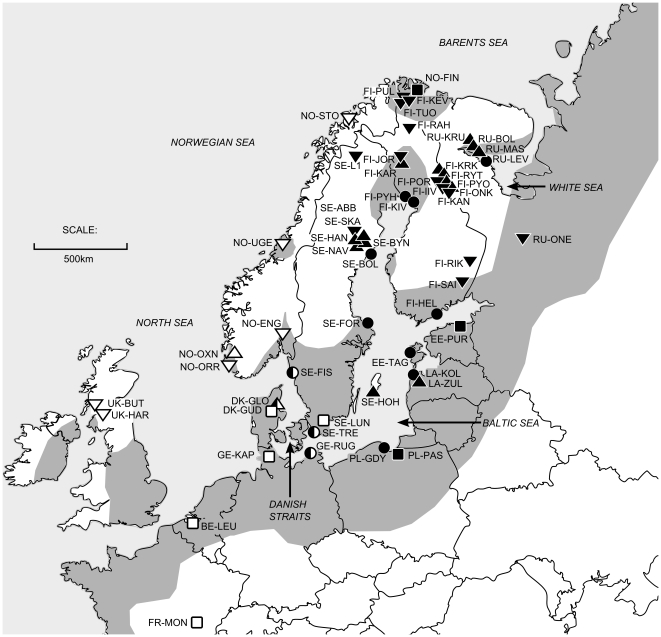
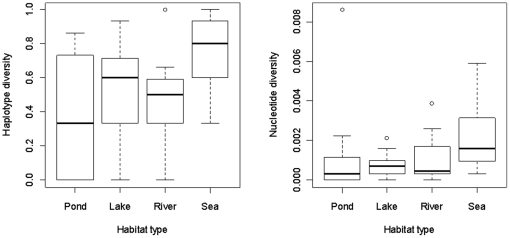
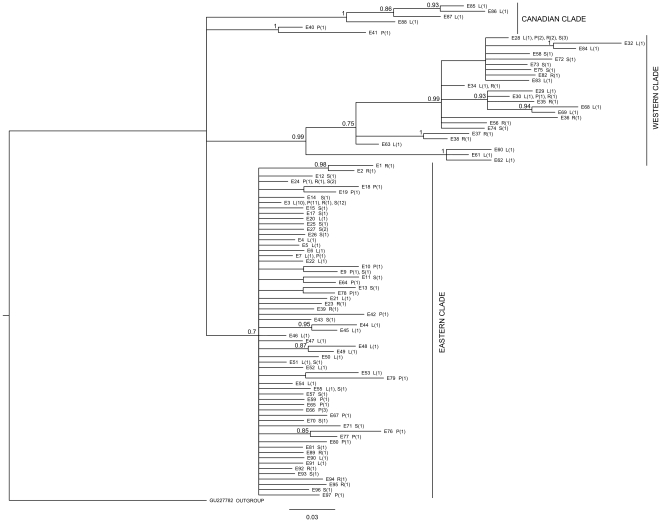
As a consequence of colonisation from different glacial refugia, many northern European taxa are split into distinct western and eastern lineages. However, as for the nine-spined stickleback (Pungitius pungitius), the exact location of the contact zone between lineages often remains poorly known. We assessed the genetic differentiation and diversity in the nine-spined stickleback within Europe using 1037 base pairs of cytochrome b sequence for 320 individuals from 57 locations, including pond, lake, river, and coastal habitats. Our main aims were (i) to locate the contact zone between the previously recognized western and eastern lineages, (ii) investigate latitudinal patterns in genetic diversity, (iii) compare genetic diversity among different habitat types, and (iv) date the known split between eastern and western lineages. The data revealed the split between eastern and western to be located across the Danish Straits and roughly following the Norway/Sweden border to the North. Reference sites from Canada form their own clades, and one of the Canadian sites was found to have a haplotype common to the Eastern European lineage, possibly representing an ancestral polymorphism. The split between the two European clades was dated to approximately 1.48 million years ago (Mya), and between Canada and Europe to approximately 1.62 Mya. After controlling for habitat effects, nucleotide (but not haplotype) diversity across populations decreased with increasing latitude. Coastal populations showed significantly higher haplotype diversity (but not nucleotide diversity) than pond populations, but there were no detectable differences in haplotype diversity among different freshwater habitat types (viz. river, lake and pond populations), or between coastal and lake/river populations. Sequences were found to cluster according to their geographic proximity, rather than by habitat type, and all habitat types were found within each major clade, implying that colonisation and adaptation between the coastal and freshwater environments in different regions must have occurred in parallel.
由于来自不同冰川避难所的殖民化,许多北欧分类单元分为明显的西部和东部谱系。然而,对于九刺鱼(Pungitius pungitius),谱系之间的接触带的确切位置通常仍然知之甚少。我们使用来自 57 个地点的 320 个个体的 1037 个碱基对细胞色素 b 序列评估了欧洲九刺鱼的遗传分化和多样性,这些地点包括池塘、湖泊、河流和沿海栖息地。我们的主要目的是:(i)确定先前识别的西部和东部谱系之间的接触带;(ii)研究遗传多样性的纬度模式;(iii)比较不同栖息地类型的遗传多样性;(iv)确定东部和西部谱系之间的已知分裂时间。数据显示,东部和西部的分裂位于丹麦海峡,并大致沿着挪威/瑞典边界向北。来自加拿大的参考地点形成了自己的分支,其中一个加拿大地点的单倍型与东欧谱系共有,可能代表了一个祖先多态性。两个欧洲谱系之间的分裂大约发生在 148 万年前(Mya),而加拿大和欧洲之间的分裂大约发生在 162 万年前。在控制了栖息地效应后,种群的核苷酸(而非单倍型)多样性随着纬度的增加而降低。沿海种群的单倍型多样性(而非核苷酸多样性)明显高于池塘种群,但不同淡水栖息地类型(即河流、湖泊和池塘种群)之间或沿海和湖泊/河流种群之间的单倍型多样性没有差异。序列根据其地理接近程度而不是根据栖息地类型聚类,并且所有栖息地类型都存在于每个主要分支中,这意味着在不同地区的沿海和淡水环境之间必须已经发生了殖民化和适应。