Department of Psychiatry, College of Medicine, Korea University, Seoul, Republic of Korea.
J Affect Disord. 2011 Oct;133(3):573-9. doi: 10.1016/j.jad.2011.04.046. Epub 2011 May 20.
Both delayed sleep phase syndrome (DSPS) and seasonal affective disorder (SAD) may manifest similar delayed circadian phase problems. However, the relationships and co-morbidity between the two conditions have not been fully studied. The authors examined the comorbidity between DSPS and SAD.
We recruited a case series of 327 DSPS and 331 controls with normal sleep, roughly matched for age, gender, and ancestry. Both DSPS and controls completed extensive questionnaires about sleep, the morningness-eveningness trait, depression, mania, seasonality of symptoms, etc.
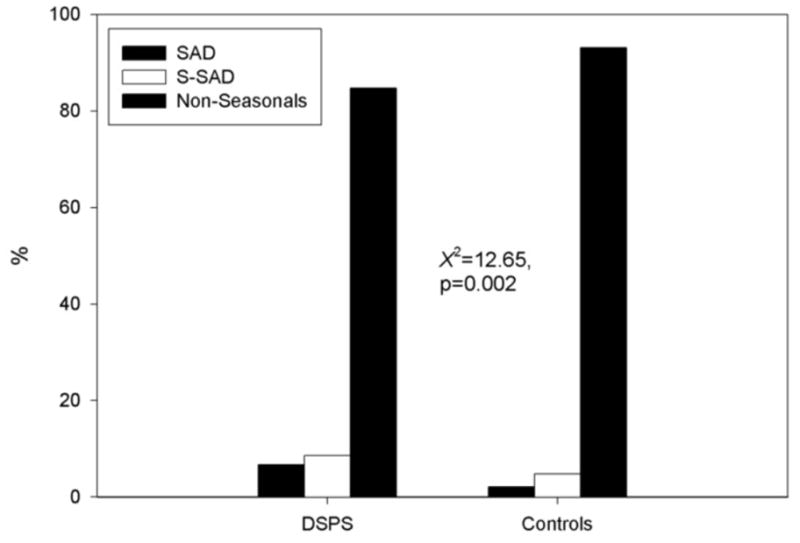
The prevalences of SAD and subsyndromal SAD (S-SAD) were higher in DSPS compared to controls (χ(2)=12.65, p=0.002). DSPS were 3.3 times more likely to report SAD (odds ratio, 3.34; 95% CI, 1.41-7.93) compared to controls as defined by the Seasonal Pattern Assessment Questionnaire (SPAQ). Correspondingly, DSPS showed significantly higher seasonality scores compared to controls in mood, appetite, and energy level subscores and the global seasonality score (t=3.12, t=0.002; t=2.04, p=0.041; t=2.64, p=0.008; and t=2.15, p=0.032, respectively). Weight fluctuation during seasons and winter-summer sleep length differences were also significantly higher in DSPS than controls (t=5.16, p<0.001 and t=2.64, p=0.009, respectively). SAD and S-SAD reported significantly higher eveningness, higher depression self-ratings, and more previous mania symptoms compared to non-seasonal subjects regardless of whether they were DSPS or controls.
These cases suggested that DSPS is partially comorbid with SAD. These data support the hypothesis that DSPS and SAD may share a pathophysiological mechanism causing delayed circadian phase.
延迟睡眠期综合征(DSPS)和季节性情感障碍(SAD)都可能表现出相似的昼夜节律相位问题。然而,这两种情况之间的关系和共病尚未得到充分研究。作者研究了 DSPS 与 SAD 的共病关系。
我们招募了一组 327 名 DSPS 和 331 名正常睡眠的对照组,年龄、性别和种族大致匹配。DSPS 和对照组都完成了关于睡眠、早晨/晚上倾向、抑郁、躁狂、症状季节性等的广泛问卷。
与对照组相比,DSPS 中 SAD 和亚综合征 SAD(S-SAD)的患病率更高(χ²=12.65,p=0.002)。与对照组相比,DSPS 报告 SAD 的可能性高 3.3 倍(优势比,3.34;95%置信区间,1.41-7.93),根据季节性模式评估问卷(SPAQ)进行定义。相应地,与对照组相比,DSPS 在情绪、食欲和能量水平子评分以及总体季节性评分方面表现出显著更高的季节性(t=3.12,p=0.002;t=0.002;t=2.04,p=0.041;t=2.64,p=0.008;t=2.15,p=0.032,分别)。DSPS 中季节期间的体重波动和冬夏睡眠时长差异也明显高于对照组(t=5.16,p<0.001;t=2.64,p=0.009,分别)。SAD 和 S-SAD 报告的晚上倾向更高,自我抑郁评分更高,以及更多的先前躁狂症状,无论他们是 DSPS 还是对照组。
这些病例表明 DSPS 与 SAD 部分共病。这些数据支持 DSPS 和 SAD 可能具有导致昼夜节律相位延迟的共同病理生理机制的假说。