Center for Microbial Pathogenesis, The Research Institute at Nationwide Children's Hospital, OH 43205, USA.
The Ohio State University College of Medicine, Columbus, OH 43210, USA.
Microbiology (Reading). 2011 Aug;157(Pt 8):2369-2381. doi: 10.1099/mic.0.045609-0. Epub 2011 May 20.
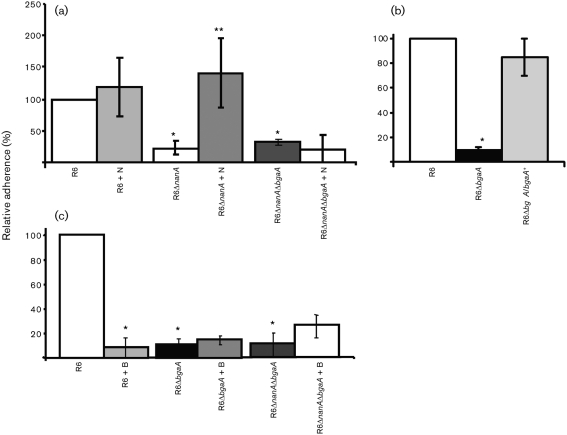
Streptococcus pneumoniae colonization of the respiratory tract is an essential precursor for pneumococcal disease. To colonize efficiently, bacteria must adhere to the epithelial-cell surface. S. pneumoniae possesses surface-associated exoglycosidases that are capable of sequentially deglycosylating human glycans. Two exoglycosidases, neuraminidase (NanA) and β-galactosidase (BgaA), have previously been shown to contribute to S. pneumoniae adherence to human epithelial cells, as deletion of either of these genes results in reduced adherence. It has been suggested that these enzymes may modulate adherence by cleaving sugars to reveal a receptor on host cells. Pretreatment of epithelial cells with exogenous neuraminidase restores the adherence of a nanA mutant, whereas pretreatment with β-galactosidase does not restore the adherence of a bgaA mutant. These data suggest that BgaA may not function to reveal a receptor, and implicate an alternative role for BgaA in adherence. Here we demonstrate that β-galactosidase activity is not required for BgaA-mediated adherence. Addition of recombinant BgaA (rBgaA) to adherence assays and pretreatment of epithelial cells with rBgaA both significantly reduced the level of adherence of the parental strain, but not the BgaA mutant. One possible explanation of these data is that BgaA is acting as an adhesin and that rBgaA is binding to the receptor, preventing bacterial binding. A bead-binding assay demonstrated that BgaA can bind directly to human epithelial cells, supporting the hypothesis that BgaA is an adhesin. Preliminary characterization of the epithelial-cell receptor suggests that it is a glycan in the context of a glycosphingolipid. To further establish the relevance of this adherence mechanism, we demonstrated that BgaA-mediated adherence contributed to adherence of a recent clinical isolate to primary human epithelial cells. Together, these data suggest a novel role for BgaA as an adhesin and suggest that this mechanism could contribute to adherence of at least some pneumococcal strains in vivo.
肺炎链球菌对呼吸道的定植是肺炎球菌病的必要前提。为了有效地定植,细菌必须附着在上皮细胞表面。肺炎链球菌具有表面相关的外糖苷酶,能够依次对人糖进行去糖基化。先前已经表明,两种外糖苷酶,神经氨酸酶(NanA)和β-半乳糖苷酶(BgaA)有助于肺炎链球菌与人类上皮细胞的附着,因为这些基因中的任何一个缺失都会导致附着减少。有人认为这些酶可能通过切割糖来揭示宿主细胞上的受体,从而调节附着。用外源性神经氨酸酶预处理上皮细胞可恢复纳米 A 突变体的粘附性,而用β-半乳糖苷酶预处理则不能恢复 bgaA 突变体的粘附性。这些数据表明 BgaA 可能不起揭示受体的作用,并暗示 BgaA 在粘附中的作用可能不同。在这里,我们证明β-半乳糖苷酶活性不是 BgaA 介导的粘附所必需的。在粘附试验中添加重组 BgaA(rBgaA)并预先用 rBgaA 处理上皮细胞,都显著降低了亲本菌株的粘附水平,但不能降低 BgaA 突变体的粘附水平。对这些数据的一种可能解释是,BgaA 作为一种黏附素起作用,rBgaA 与受体结合,阻止细菌结合。珠结合试验表明 BgaA 可以直接与人类上皮细胞结合,支持 BgaA 是一种黏附素的假说。对上皮细胞受体的初步特征分析表明,它是糖脂中的一种糖。为了进一步确定这种粘附机制的相关性,我们证明了 BgaA 介导的粘附有助于最近的临床分离株对原代人上皮细胞的粘附。这些数据共同表明 BgaA 作为一种黏附素的新作用,并表明这种机制可能有助于至少一些肺炎球菌菌株在体内的粘附。