Center for Infectious Diseases and Vaccine Immunology, Research Institute, Rochester General Hospital, Rochester, NY 14621, USA.
Microbes Infect. 2012 Oct;14(12):1102-10. doi: 10.1016/j.micinf.2012.06.007. Epub 2012 Jul 14.
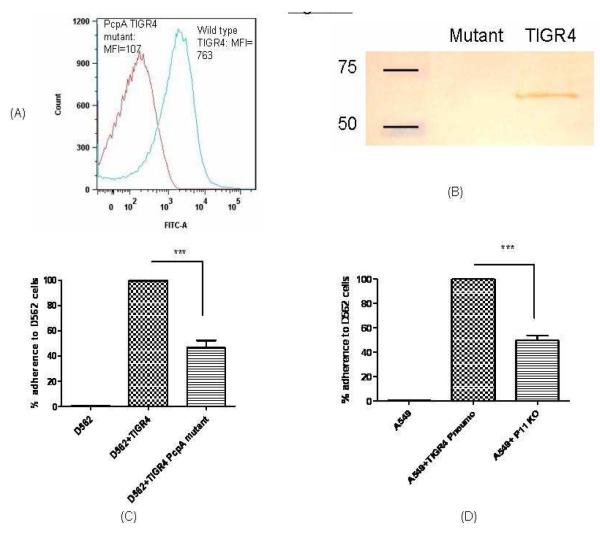
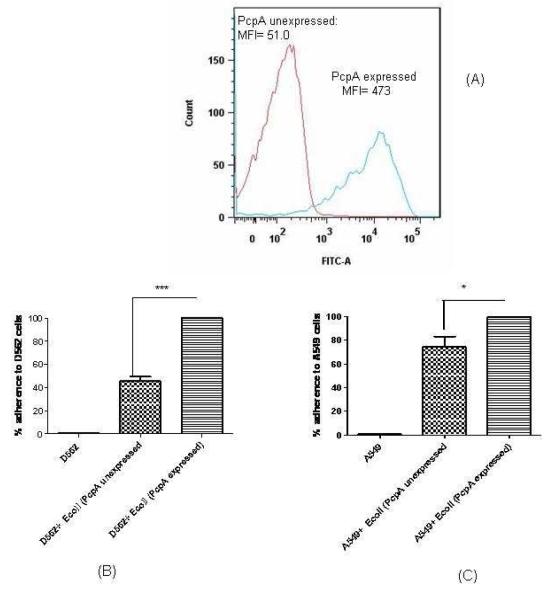
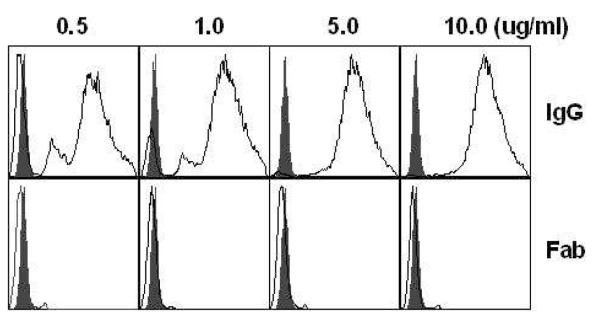
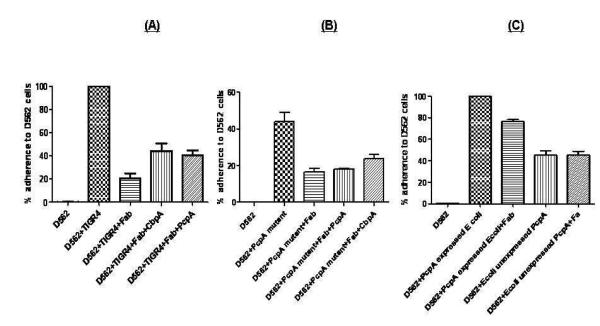
Streptococcus pneumoniae (pneumococci) adhere to human nasopharyngeal (NP) epithelial cells as a first step in colonization and adherence of pneumococci to lung epithelia may be required to establish pneumonia. We sought to determine if PcpA can serve as an adhesin to human NP (D562) and lung (A549) epithelial cells and whether PcpA mediated adherence can be inhibited by human anti-PcpA antibodies. A PcpA isogenic mutant was constructed in a pneumococcal TIGR4 background. When the mutant and wild type strains were compared for their adherence to D562 and A549 cell lines, a reduction in adherence by the mutant was observed (p = 0.0001 for both cell types). PcpA was ectopically expressed on the surface of minimally-adherent heterologous host Escherichia coli resulting in augmented adherence to D562 (p = 0.002) and A549 (p = 0.015) cells. Total IgG was purified from a pool of 6 human sera having high IgG titers of anti-pneumococcal proteins. The purified IgG reduced TIGR4 adherence to D562 cells but we determined that this effect was largely due to bacterial cell aggregation as determined by flow cytometry and confocal microscopy. Fab fragments were prepared from pooled IgG sera. Inhibition of TIGR4 adherence to D562 cells was observed using the Fab fragments without causing bacterial aggregation (p = 0.0001). Depletion of PcpA-specific Fab fragments resulted in an increase in adherence of TIGR4 to D562 cells (p = 0.028). We conclude that PcpA can mediate adherence of pneumococci to human NP and lung epithelial cells and PcpA mediated adherence can be inhibited by human anti-PcpA antibodies.
肺炎链球菌(肺炎球菌)首先黏附于人鼻咽(NP)上皮细胞,然后肺炎球菌黏附于肺上皮细胞可能是建立肺炎的必要条件。我们试图确定 PcpA 是否可以作为黏附素黏附于人 NP(D562)和肺(A549)上皮细胞,以及人抗 PcpA 抗体是否可以抑制 PcpA 介导的黏附。在肺炎链球菌 TIGR4 背景中构建了 PcpA 同工酶突变体。当比较突变体和野生型菌株对 D562 和 A549 细胞系的黏附时,观察到突变体的黏附减少(两种细胞类型的 p = 0.0001)。PcpA 在最小黏附异源宿主大肠杆菌表面异位表达,导致对 D562(p = 0.002)和 A549(p = 0.015)细胞的黏附增加。从具有高抗肺炎球菌蛋白 IgG 滴度的 6 个人血清池中纯化总 IgG。纯化的 IgG 降低了 TIGR4 对 D562 细胞的黏附,但我们通过流式细胞术和共聚焦显微镜确定,这种效应主要是由于细菌细胞聚集。从混合 IgG 血清中制备 Fab 片段。使用 Fab 片段观察到 TIGR4 对 D562 细胞的黏附被抑制,而不会引起细菌聚集(p = 0.0001)。耗尽 PcpA 特异性 Fab 片段会导致 TIGR4 对 D562 细胞的黏附增加(p = 0.028)。我们得出结论,PcpA 可以介导肺炎球菌与人 NP 和肺上皮细胞的黏附,人抗 PcpA 抗体可以抑制 PcpA 介导的黏附。