Prevention of Metabolic Disorders Research Center, Research Institute for Endocrine Sciences, Shahid Beheshti University of Medical Sciences, Tehran, Iran.
BMC Public Health. 2011 May 25;11:383. doi: 10.1186/1471-2458-11-383.
Metabolic syndrome (MetS) and body mass index (BMI, kg.m(-2)) are established independent risk factors in the development of diabetes; we prospectively examined their relative contributions and joint relationship with incident diabetes in a Middle Eastern cohort.
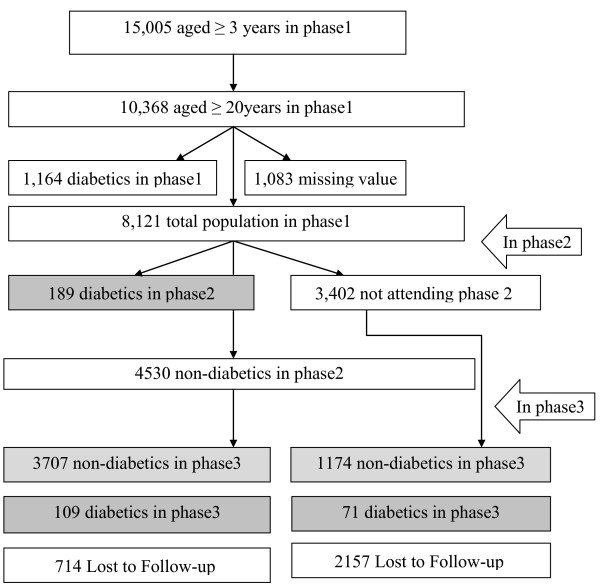
participants of the ongoing Tehran lipid and glucose study are followed on a triennial basis. Among non-diabetic participants aged≥ 20 years at baseline (8,121) those with at least one follow-up examination (5,250) were included for the current study. Multivariate logistic regression models were used to estimate sex-specific adjusted odd ratios (ORs) and 95% confidence intervals (CIs) of baseline BMI-MetS categories (normal weight without MetS as reference group) for incident diabetes among 2186 men and 3064 women, aged ≥ 20 years, free of diabetes at baseline.
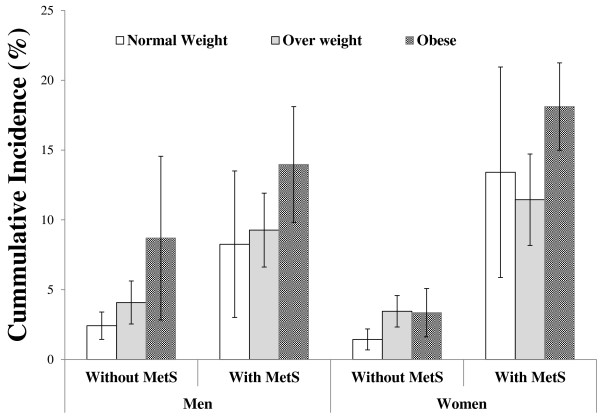
During follow up (median 6.5 years); there were 369 incident diabetes (147 in men). In women without MetS, the multivariate adjusted ORs (95% CIs) for overweight (BMI 25-30 kg/m(2)) and obese (BMI≥30) participants were 2.3 (1.2-4.3) and 2.2 (1.0-4.7), respectively. The corresponding ORs for men without MetS were 1.6 (0.9-2.9) and 3.6 (1.5-8.4) respectively. As compared to the normal-weight/without MetS, normal-weight women and men with MetS, had a multivariate-adjusted ORs for incident diabetes of 8.8 (3.7-21.2) and 3.1 (1.3-7.0), respectively. The corresponding ORs for overweight and obese women with MetS reached to 7.7 (4.0-14.9) and 12.6 (6.9-23.2) and for men reached to 3.4(2.0-5.8) and 5.7(3.9-9.9), respectively.
This study highlights the importance of screening for MetS in normal weight individuals. Obesity increases diabetes risk in the absence of MetS, underscores the need for more stringent criteria to define healthy metabolic state among obese individuals. Weight reduction measures, thus, should be encouraged in conjunction with achieving metabolic targets not addressed by current definition of MetS, both in every day encounter and public health setting.
代谢综合征(MetS)和体重指数(BMI,kg.m(-2))是糖尿病发展的独立危险因素;我们前瞻性地研究了它们在中东队列中与糖尿病发病的相对贡献和共同关系。
正在进行的德黑兰脂质和血糖研究的参与者每三年接受一次随访。在基线时年龄≥20 岁的非糖尿病参与者(8121 人)中,至少有一次随访检查(5250 人)被纳入本研究。使用多变量逻辑回归模型,估计基线 BMI-MetS 类别(正常体重且无 MetS 作为参考组)的性别特异性调整比值比(OR)和 95%置信区间(CI),以评估 2186 名男性和 3064 名女性在基线时无糖尿病的情况下,发生糖尿病的情况。
在随访期间(中位 6.5 年),有 369 例发生糖尿病(147 例为男性)。在没有 MetS 的女性中,超重(BMI25-30kg/m(2))和肥胖(BMI≥30)参与者的多变量调整 OR(95%CI)分别为 2.3(1.2-4.3)和 2.2(1.0-4.7)。对于没有 MetS 的男性,相应的 OR 分别为 1.6(0.9-2.9)和 3.6(1.5-8.4)。与正常体重/无 MetS 相比,正常体重的女性和男性伴 MetS 的发生糖尿病的多变量调整 OR 分别为 8.8(3.7-21.2)和 3.1(1.3-7.0)。对于超重和肥胖且伴有 MetS 的女性,其发生糖尿病的 OR 分别达到 7.7(4.0-14.9)和 12.6(6.9-23.2),对于男性,OR 分别达到 3.4(2.0-5.8)和 5.7(3.9-9.9)。
本研究强调了在正常体重个体中筛查 MetS 的重要性。肥胖增加了无 MetS 个体的糖尿病风险,突出了需要更严格的标准来定义肥胖个体的健康代谢状态。因此,应鼓励采取减肥措施,同时实现当前 MetS 定义中未涉及的代谢目标,无论是在日常实践中还是在公共卫生环境中。