Takekawa Mutsuhiro, Kubota Yuji, Nakamura Takanori, Ichikawa Kenji
Department of Cell Signaling and Molecular Medicine, Research Institute of Environmental Medicine, Nagoya University, Japan.
Nagoya J Med Sci. 2011 Feb;73(1-2):1-14.
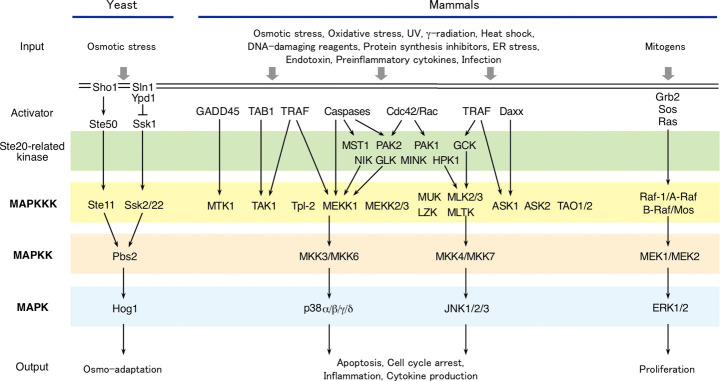
Mammalian cells are frequently exposed to a variety of environmental stresses, such as ultraviolet rays, ionizing radiation, genotoxins, heat shock, and oxidative stress. In coping with the barrage of these and other stresses, multi-cellular eukaryotic organisms have developed a strategy as to how damaged cells will respond to stresses. In general, if the intensity of the damage is moderate, the cell will seek to repair the damage. If, however, the damage to a cell is too severe to be repaired, the affected cells are eliminated by apoptosis. This cell death reduces the risk to the organism as a whole, such as development of a cancer. Such a crucial decision between survival and death is, at least in part, mediated by the stress-activated MAP kinase (SAPK) pathways. SAPKs are a group of serine/threonine protein kinases that convert extracellular stress stimuli into diverse cellular responses, including cell cycle arrest, apoptotic cell death, and cytokine production, through phosphorylation of specific target proteins. Recent progress in the identification of molecules that participate in the SAPK pathways, such as GADD45 proteins and Wipl, has provided new insights, not only into the molecular basis of the cellular response to environmental stress, but also into the etiology of human diseases including cancer.
哺乳动物细胞经常受到各种环境压力的影响,如紫外线、电离辐射、基因毒素、热休克和氧化应激。在应对这些及其他压力的冲击时,多细胞真核生物已经形成了一种关于受损细胞如何应对压力的策略。一般来说,如果损伤强度适中,细胞会试图修复损伤。然而,如果细胞损伤过于严重而无法修复,受影响的细胞就会通过凋亡被清除。这种细胞死亡降低了对整个生物体的风险,比如癌症的发生。生存与死亡之间的这种关键决定至少部分是由应激激活的丝裂原活化蛋白激酶(SAPK)途径介导的。SAPK是一组丝氨酸/苏氨酸蛋白激酶,通过特定靶蛋白的磷酸化,将细胞外应激刺激转化为多种细胞反应,包括细胞周期停滞、凋亡性细胞死亡和细胞因子产生。在参与SAPK途径的分子(如GADD45蛋白和Wipl)的鉴定方面的最新进展,不仅为细胞对环境应激反应的分子基础提供了新的见解,也为包括癌症在内的人类疾病的病因学提供了新的见解。