GenHotel, Département de Biologie, Univ. èvry, Université Paris-Saclay, Genopole, èvry 91025, France.
Département de Biologie, Institut de Biologie de l'Ecole Normale Supérieure (IBENS), ècole Normale Supérieure, CNRS, INSERM, Université PSL, Paris 75005, France.
Bioinformatics. 2020 Aug 15;36(16):4473-4482. doi: 10.1093/bioinformatics/btaa484.
Molecular interaction maps have emerged as a meaningful way of representing biological mechanisms in a comprehensive and systematic manner. However, their static nature provides limited insights to the emerging behaviour of the described biological system under different conditions. Computational modelling provides the means to study dynamic properties through in silico simulations and perturbations. We aim to bridge the gap between static and dynamic representations of biological systems with CaSQ, a software tool that infers Boolean rules based on the topology and semantics of molecular interaction maps built with CellDesigner.
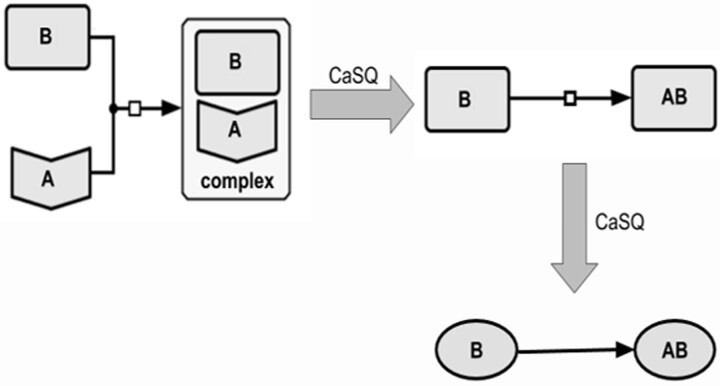
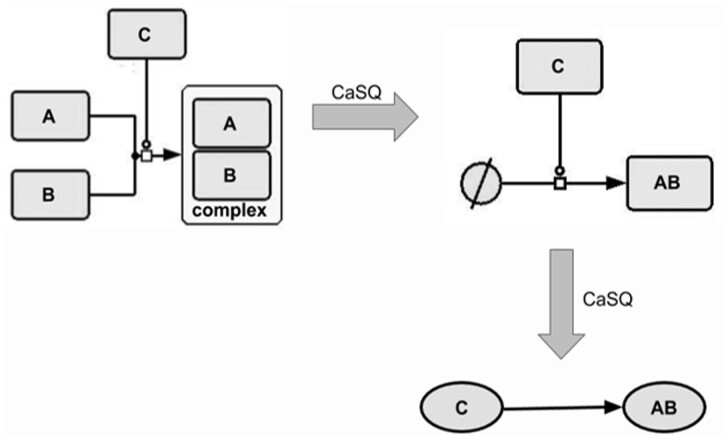
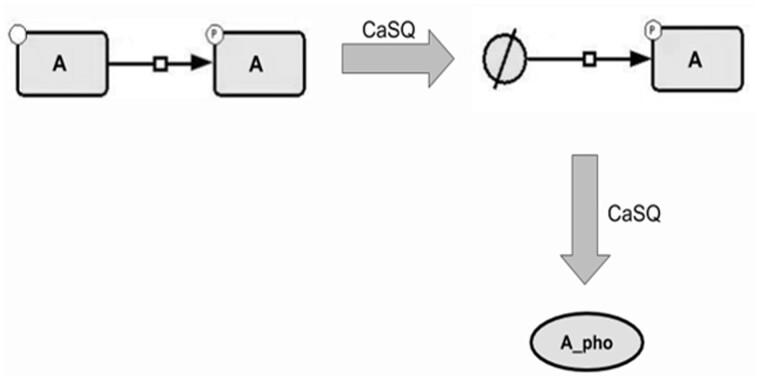
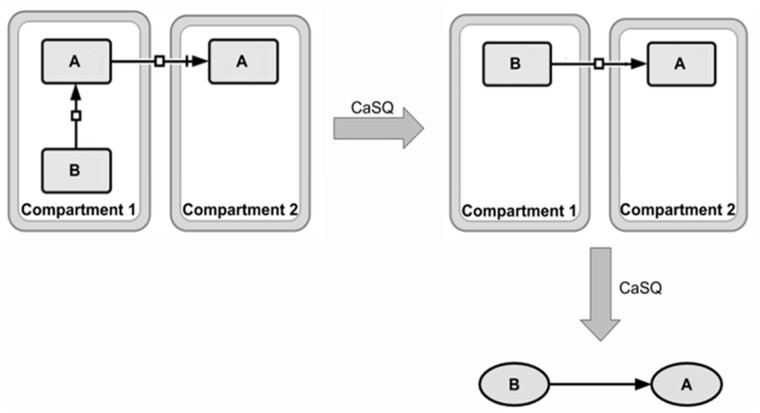
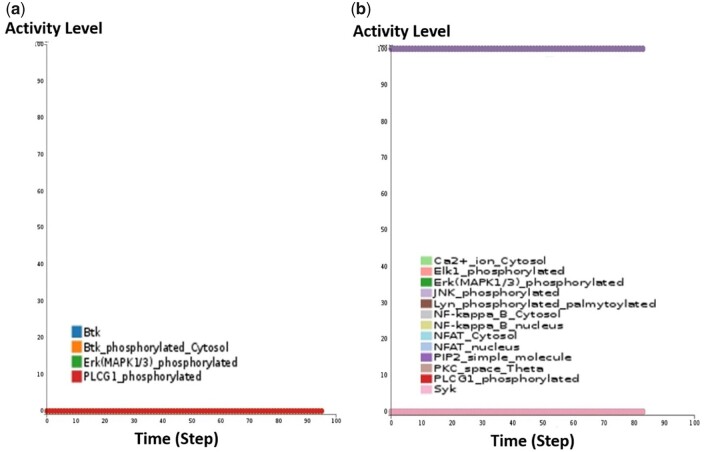
We developed CaSQ by defining conversion rules and logical formulas for inferred Boolean models according to the topology and the annotations of the starting molecular interaction maps. We used CaSQ to produce executable files of existing molecular maps that differ in size, complexity and the use of Systems Biology Graphical Notation (SBGN) standards. We also compared, where possible, the manually built logical models corresponding to a molecular map to the ones inferred by CaSQ. The tool is able to process large and complex maps built with CellDesigner (either following SBGN standards or not) and produce Boolean models in a standard output format, Systems Biology Marked Up Language-qualitative (SBML-qual), that can be further analyzed using popular modelling tools. References, annotations and layout of the CellDesigner molecular map are retained in the obtained model, facilitating interoperability and model reusability.
The present tool is available online: https://lifeware.inria.fr/∼soliman/post/casq/ and distributed as a Python package under the GNU GPLv3 license. The code can be accessed here: https://gitlab.inria.fr/soliman/casq.
Supplementary data are available at Bioinformatics online.
分子相互作用图已成为一种以全面和系统的方式表示生物学机制的有意义的方式。然而,它们的静态性质为描述的生物系统在不同条件下的新兴行为提供了有限的见解。计算建模通过计算机模拟和干扰提供了研究动态特性的手段。我们旨在通过 CaSQ 弥合生物系统静态和动态表示之间的差距,CaSQ 是一种根据使用 CellDesigner 构建的分子相互作用图的拓扑结构和语义推断布尔规则的软件工具。
我们通过定义转换规则和根据起始分子相互作用图的拓扑结构和注释推断布尔模型的逻辑公式来开发 CaSQ。我们使用 CaSQ 为大小、复杂性和系统生物学图形表示法 (SBGN) 标准不同的现有分子图生成可执行文件。我们还比较了 CaSQ 推断的逻辑模型与对应于分子图的手动构建的逻辑模型,只要有可能。该工具能够处理 CellDesigner 构建的大型和复杂地图(无论是遵循 SBGN 标准还是不遵循),并以标准输出格式生成布尔模型,系统生物学标记语言定性(SBML-qual),可以使用流行的建模工具进一步分析。所获得的模型保留了 CellDesigner 分子图的参考文献、注释和布局,促进了互操作性和模型可重用性。
该工具可在线获得:https://lifeware.inria.fr/∼soliman/post/casq/,并作为 GNU GPLv3 许可证下的 Python 包分发。代码可在此处访问:https://gitlab.inria.fr/soliman/casq。
补充数据可在生物信息学在线获得。