Center for Statistics and Quantitative Infectious Diseases, Vaccine and Infectious Diseases Division, Fred Hutchinson Cancer Research Center, Seattle, Washington 98109-1024, USA.
J Infect Dis. 2010 Sep 15;202(6):877-80. doi: 10.1086/655810.
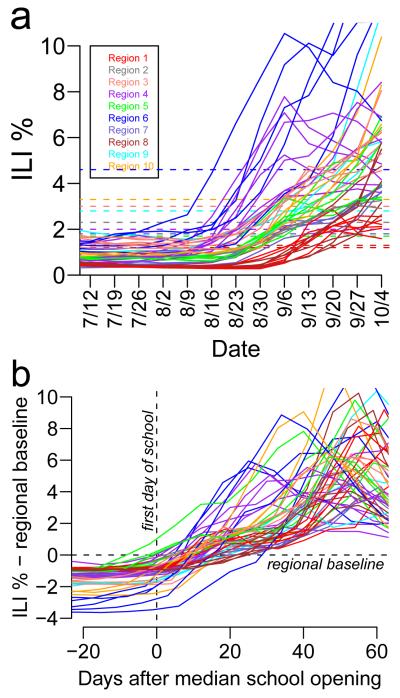
The opening of schools in the late summer of 2009 may have triggered the fall wave of pandemic influenza A(H1N1) in the United States. We found that an elevated percentage of outpatient visits for influenza-like illness occurred an average of 14 days after schools opened in the fall of 2009. The timing of these events was highly correlated (Spearman correlation coefficient, 0.62; P<.001). This result provides evidence that transmission in schools catalyzes community-wide transmission. School opening dates can be useful for future pandemic planning, and influenza mitigation strategies should be targeted at school populations before the influenza season.
2009 年夏末开学可能引发了美国秋季甲型 H1N1 流感大流行。我们发现,2009 年秋季开学后,流感样疾病的门诊就诊比例平均升高了 14 天。这些事件的时间高度相关(Spearman 相关系数,0.62;P<.001)。这一结果提供了证据表明学校内的传播促进了社区范围内的传播。开学日期可用于未来的大流行规划,流感缓解策略应在流感季节之前针对学校人群。