Laboratório de Genética e Biologia Molecular, Instituto de Estudos Costeiros Universidade Federal do Pará, Campus de Bragança, Bragança, PA, Brazil.
Genet Mol Biol. 2011 Jan;34(1):142-51. doi: 10.1590/S1415-47572010005000115. Epub 2011 Mar 1.
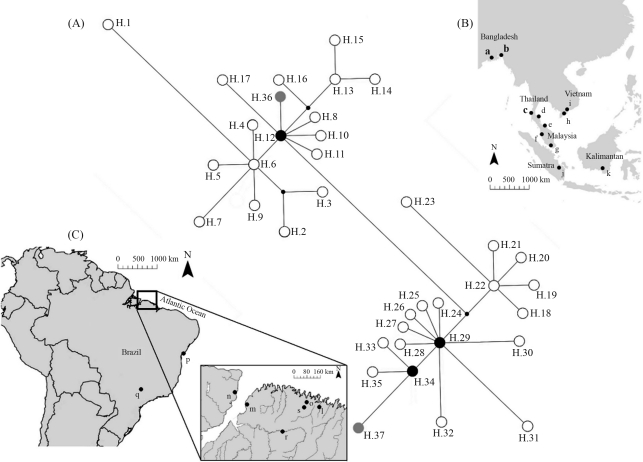
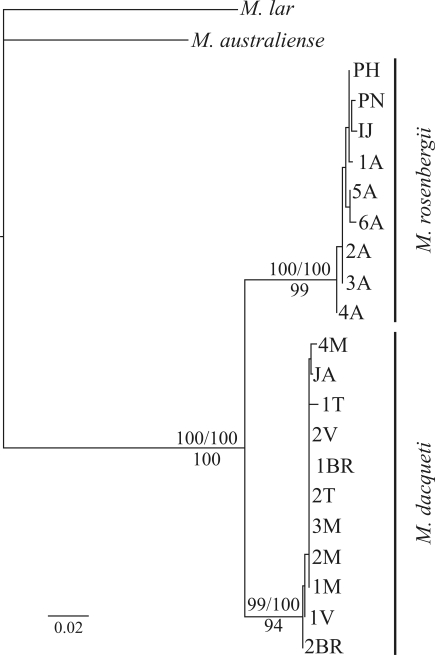
The giant river prawn, Macrobrachium cf. rosenbergii, is one of the most cultivated freshwater prawns in the world and has been introduced into more than 40 countries. In some countries, this prawn is considered an invasive species that requires close monitoring. Recent changes in the taxonomy of this species (separation of M. rosenbergii and M. dacqueti) require a re-evaluation of introduced taxa. In this work, molecular analyses were used to determine which of these two species was introduced into Brazil and to establish the geographic origin of the introduced populations that have invaded Amazonian coastal waters. The species introduced into Brazil was M. dacqueti through two introduction events involving prawns originating from Vietnam and either Bangladesh or Thailand. These origins differ from historical reports of the introductions and underline the need to confirm the origin of other exotic populations around the world. The invading populations in Amazonia require monitoring not only because the biodiversity of this region may be affected by the introduction, but also because admixture of different native haplotypes can increase the genetic variability and the likelihood of persistence of the invading species in new habitats.
罗氏沼虾,Macrobrachium cf. rosenbergii,是世界上养殖最广泛的淡水虾之一,已被引入 40 多个国家。在一些国家,这种虾被认为是入侵物种,需要密切监测。该物种的分类学最近发生了变化(罗氏沼虾和达氏沼虾的分离),这需要重新评估引入的分类单元。在这项工作中,利用分子分析确定了引入巴西的是哪种虾,并确定了入侵亚马逊沿海水域的引入种群的地理起源。通过涉及源自越南的虾的两次引种事件,引入巴西的是达氏沼虾,这些虾的起源分别来自孟加拉国或泰国。这些起源与引种的历史报告不同,强调了需要确认世界各地其他外来种群的起源。亚马逊地区的入侵种群需要监测,不仅因为该地区的生物多样性可能会受到引入的影响,还因为不同本地单倍型的混合可以增加入侵物种在新栖息地中的遗传变异性和持续存在的可能性。