UKK Institute for Health Promotion Research, Tampere, Finland.
Ann Med. 2012 Sep;44(6):616-26. doi: 10.3109/07853890.2011.583674. Epub 2011 Jun 3.
To estimate whether aerobic training has an effect on frequency of hot flushes or quality of life.
A randomized controlled trial.
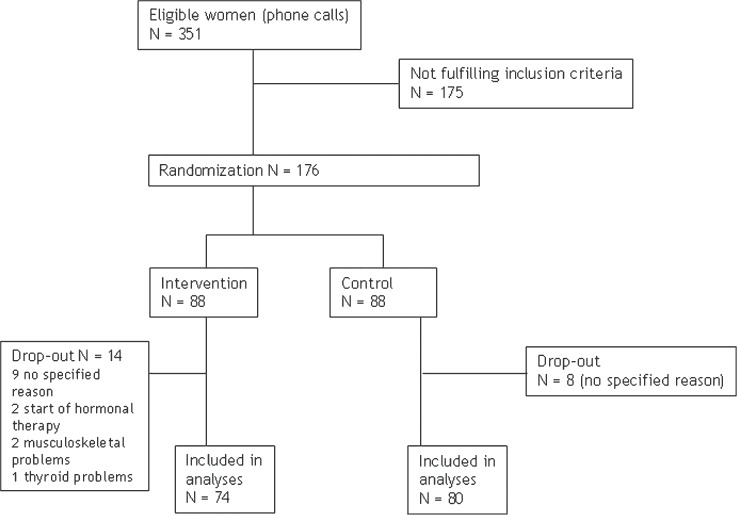
Symptomatic, sedentary women (n = 176), 43-63 years, no current use of hormone therapy.
Unsupervised aerobic training for 50 minutes four times per week during 6 months.
Hot flushes as measured with Women's Health Questionnaire (WHQ) and Health-Related Quality of Life (HRQoL, SF-36), daily reported hot flushes on phone-based diary, cardiorespiratory fitness (CRF), and body composition.
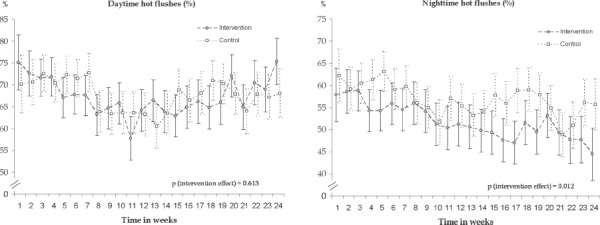
Intervention group had larger decrease in the frequency of night-time hot flushes based on phone diary (P for month × group = 0.012), but not on WHQ scale. Intervention group had less depressed mood (P = 0.01) than control women according to change in WHQ score. Changes in WHQ score in depressed mood (P = 0.03) and menstrual symptoms (P = 0.01) in the intervention group were significantly dependent on frequency of training sessions. HRQoL was improved among the intervention group women in physical functioning (P = 0.049) and physical role limitation (P = 0.017). CRF improved (P = 0.008), and lean muscle mass increased (P = 0.046) significantly in the intervention group as compared to controls.
Aerobic training may decrease the frequency of hot flushes and improve quality of life among slightly overweight women.
评估有氧运动是否对热潮频率或生活质量有影响。
随机对照试验。
有症状、久坐的女性(n=176),年龄 43-63 岁,当前未使用激素治疗。
6 个月内每周 4 次,每次 50 分钟,进行监督下的有氧运动。
采用妇女健康问卷(WHQ)和健康相关生活质量(SF-36)评估热潮,电话日记记录每日报告的热潮,心肺功能(CRF)和身体成分。
根据电话日记,干预组夜间热潮频率的下降幅度更大(P 月×组=0.012),但 WHQ 量表上没有差异。根据 WHQ 评分变化,干预组女性的情绪低落(P=0.01)较对照组女性减少。WHQ 评分中情绪低落(P=0.03)和月经症状(P=0.01)的变化与训练次数的变化显著相关。干预组女性的生理功能(P=0.049)和身体角色受限(P=0.017)的 HRQoL 得到改善。与对照组相比,干预组的 CRF 提高(P=0.008),瘦肌肉质量增加(P=0.046)。
有氧运动可能会减少超重女性热潮的频率并改善其生活质量。