VAMC/Cardiology, University of California-San Diego, 3350 La Jolla Village Dr., San Diego, CA 92161, USA.
Circulation. 2011 Jun 28;123(25):2922-30. doi: 10.1161/CIRCULATIONAHA.110.977827. Epub 2011 Jun 6.
The substrates for human atrial fibrillation (AF) are poorly understood, but involve abnormal repolarization (action potential duration [APD]). We hypothesized that beat-to-beat oscillations in APD may explain AF substrates, and why vulnerability to AF forms a spectrum from control subjects without AF to patients with paroxysmal then persistent AF.
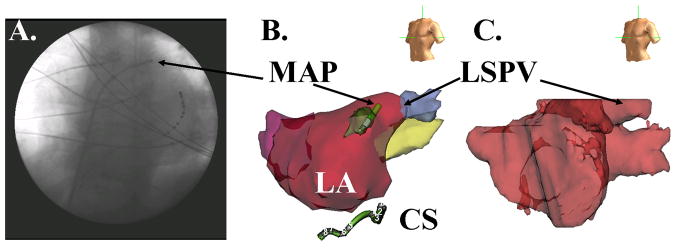
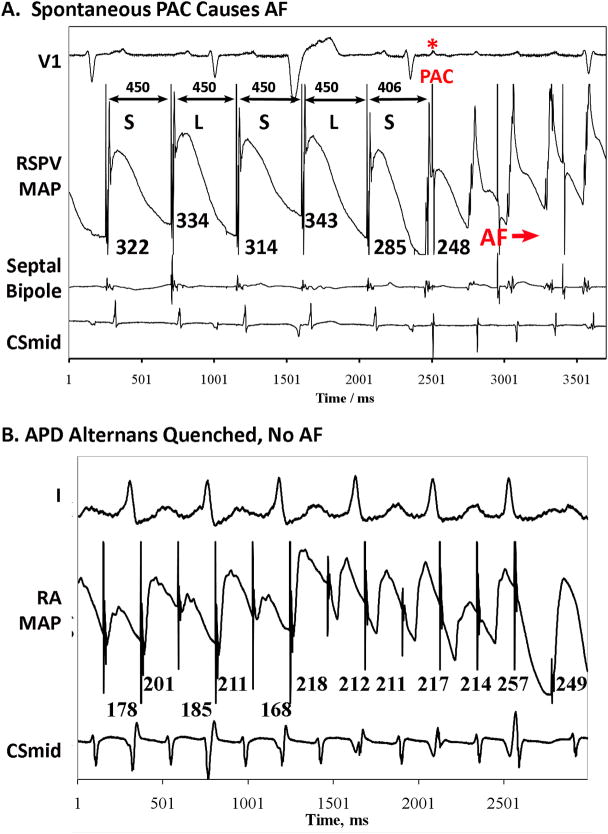
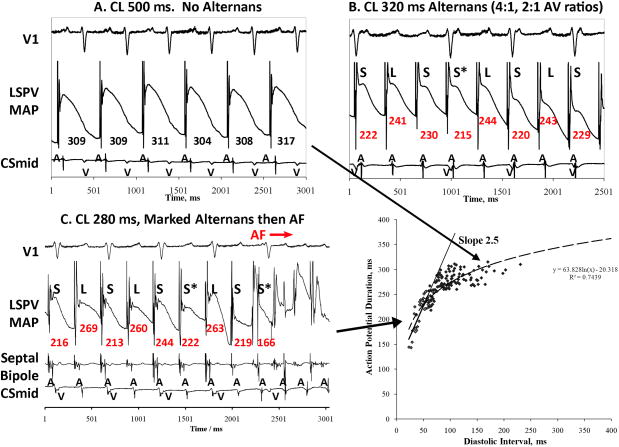
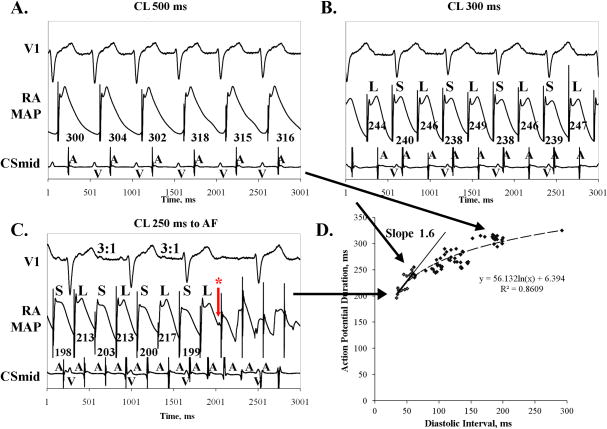
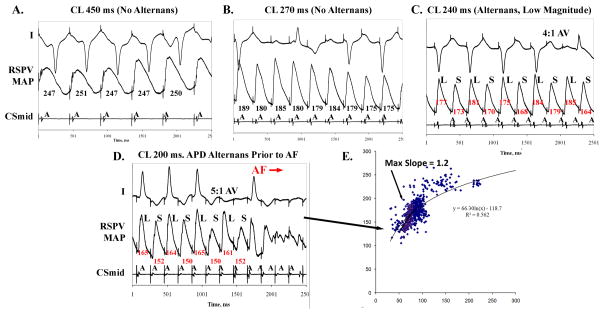
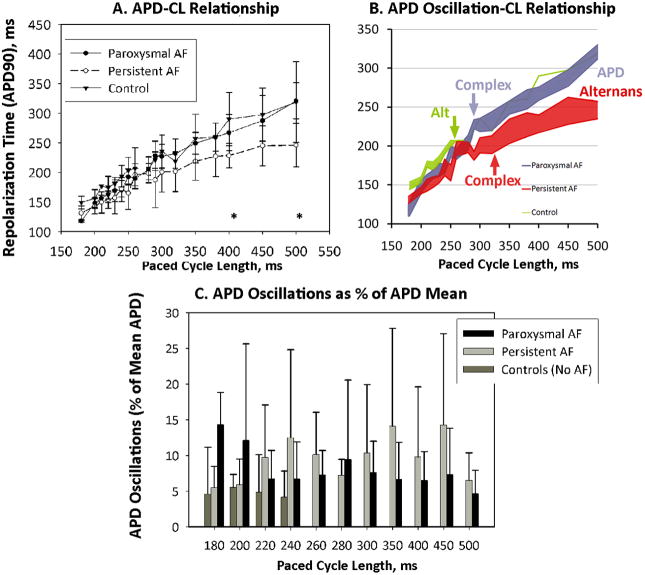
In 33 subjects (12 with persistent AF, 13 with paroxysmal AF, and 8 controls without AF), we recorded left (n=33) and right (n=6) atrial APD on pacing from cycle lengths 600 to 500 ms (100 to 120 bpm) up to the point where AF initiated. Action potential duration alternans required progressively faster rates for patients with persistent AF, patients with paroxysmal AF, and controls (cycle length 411±94 versus 372±72 versus 218±33 ms; P<0.01). In AF patients, APD alternans occurred at rates as slow as 100 to 120 bpm, unrelated to APD restitution (P>0.10). In this milieu, spontaneous ectopy initiated AF. At fast rates, APD alternans disorganized to complex oscillations en route to AF. Complex oscillations also arose at progressively faster rates for persistent AF, paroxysmal AF, and controls (cycle length: 316±99 versus 266±19 versus 177±16 ms; P=0.02). In paroxysmal AF, APD oscillations amplified before AF (P<0.001). In controls, APD alternans arose only at very fast rates (cycle length <250 ms; P<0.001 versus AF groups) just preceding AF. In 4 AF patients in whom rapid pacing did not initiate AF, APD alternans arose transiently then extinguished.
Atrial APD alternans reveals dynamic substrates for AF, arising most readily (at lower rates and higher magnitudes) in persistent AF then paroxysmal AF, and least readily in controls. APD alternans preceded all AF episodes and was absent when AF did not initiate. The cellular mechanisms for APD alternans near resting heart rates require definition.
人类心房颤动(AF)的底物知之甚少,但涉及异常复极(动作电位持续时间[APD])。我们假设 APD 的逐搏波动可能解释 AF 的底物,以及为什么易发生 AF 的范围从无 AF 的对照受试者到阵发性然后持续性 AF 的患者。
在 33 名受试者(12 名持续性 AF、13 名阵发性 AF 和 8 名无 AF 的对照)中,我们记录了左心房(n=33)和右心房(n=6)的 APD,起搏从周长 600 到 500 ms(100 到 120 bpm),直到 AF 开始。对于持续性 AF、阵发性 AF 和对照患者,APD 交替需要更快的起搏频率(周长 411±94 与 372±72 与 218±33 ms;P<0.01)。在 AF 患者中,APD 交替发生在 100 到 120 bpm 的缓慢速率,与 APD restitution 无关(P>0.10)。在这种环境下,自发性异位搏动引发 AF。在快速起搏时,APD 交替变得混乱,导致 AF 途中出现复杂的振荡。对于持续性 AF、阵发性 AF 和对照患者,复杂的振荡也以逐渐更快的速率出现(周长:316±99 与 266±19 与 177±16 ms;P=0.02)。在阵发性 AF 中,APD 振荡在 AF 之前放大(P<0.001)。在对照患者中,APD 交替仅在非常快的速率(周长<250 ms;P<0.001 与 AF 组)下出现,就在 AF 之前出现。在 4 名快速起搏不能引发 AF 的 AF 患者中,APD 交替短暂出现然后消失。
心房 APD 交替揭示了 AF 的动态底物,在持续性 AF 中最容易(在较低的速率和较高的幅度下)出现,然后是阵发性 AF,在对照患者中最不容易出现。APD 交替先于所有 AF 发作,当 AF 不发作时不存在。需要确定接近静息心率的 APD 交替的细胞机制。