Cell Biology and Biochemistry, Pacific Northwest National Laboratory, Richland, Washington 99354, USA.
Environ Health Perspect. 2011 Sep;119(9):1314-20. doi: 10.1289/ehp.1103745. Epub 2011 Jun 6.
Nitric oxide is a physiological regulator of endothelial function and hemodynamics. Oxidized products of nitric oxide can form nitrotyrosine, which is a marker of nitrative stress. Cigarette smoking decreases exhaled nitric oxide, and the underlying mechanism may be important in the cardiovascular toxicity of smoking. Even so, it is unclear if this effect results from decreased nitric oxide production or increased oxidative degradation of nitric oxide to reactive nitrating species. These two processes would be expected to have opposite effects on nitrotyrosine levels, a marker of nitrative stress.
In this study, we evaluated associations of cigarette smoking and chronic obstructive pulmonary disease (COPD) with nitrotyrosine modifications of specific plasma proteins to gain insight into the processes regulating nitrotyrosine formation.
A custom antibody microarray platform was developed to analyze the levels of 3-nitrotyrosine modifications on 24 proteins in plasma. In a cross-sectional study, plasma samples from 458 individuals were analyzed.
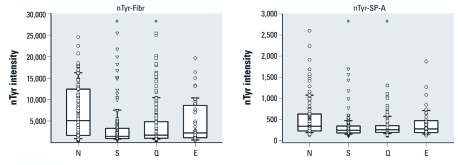
Average nitrotyrosine levels in plasma proteins were consistently lower in smokers and former smokers than in never smokers but increased in smokers with COPD compared with smokers who had normal lung-function tests.
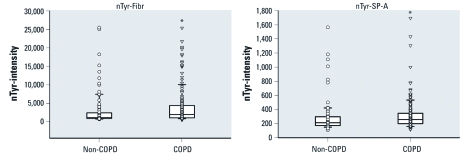
Smoking is associated with a broad decrease in 3-nitrotyrosine levels of plasma proteins, consistent with an inhibitory effect of cigarette smoke on endothelial nitric oxide production. In contrast, we observed higher nitrotyrosine levels in smokers with COPD than in smokers without COPD. This finding is consistent with increased nitration associated with inflammatory processes. This study provides insight into a mechanism through which smoking could induce endothelial dysfunction and increase the risk of cardiovascular disease.
一氧化氮是内皮功能和血液动力学的生理调节剂。一氧化氮的氧化产物可以形成硝基酪氨酸,这是硝化应激的标志物。吸烟会降低呼出的一氧化氮,其潜在机制可能在吸烟的心血管毒性中起重要作用。即便如此,目前尚不清楚这种效应是由于一氧化氮生成减少还是由于一氧化氮的氧化降解为反应性硝化物种而增加。这两个过程预计会对硝化应激的标志物硝基酪氨酸水平产生相反的影响。
在这项研究中,我们评估了吸烟和慢性阻塞性肺疾病(COPD)与特定血浆蛋白的硝基酪氨酸修饰之间的关联,以深入了解调节硝基酪氨酸形成的过程。
开发了一种定制的抗体微阵列平台,用于分析血浆中 24 种蛋白质上 3-硝基酪氨酸修饰的水平。在一项横断面研究中,分析了 458 个人的血浆样本。
与从不吸烟者相比,吸烟者和前吸烟者的血浆蛋白中硝基酪氨酸水平普遍较低,但与肺功能正常的吸烟者相比,COPD 吸烟者的硝基酪氨酸水平升高。
吸烟与血浆蛋白中 3-硝基酪氨酸水平的广泛降低有关,这与香烟烟雾对内皮一氧化氮生成的抑制作用一致。相比之下,我们观察到 COPD 吸烟者的硝基酪氨酸水平高于非 COPD 吸烟者。这一发现与与炎症过程相关的增加的硝化作用一致。这项研究提供了一种机制的见解,即吸烟如何导致内皮功能障碍并增加心血管疾病的风险。