Computational Neurobiology Laboratory, The Salk Institute for Biological Studies, La Jolla, California, United States of America.
PLoS One. 2011;6(5):e20572. doi: 10.1371/journal.pone.0020572. Epub 2011 May 31.
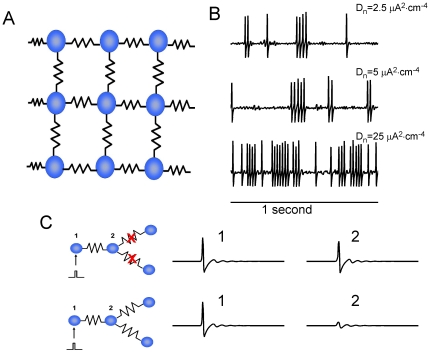
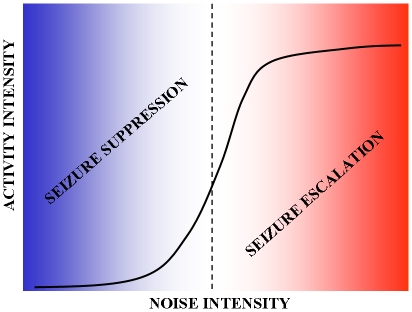
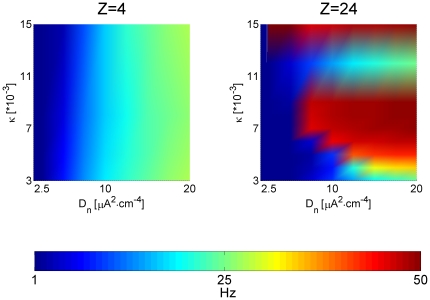
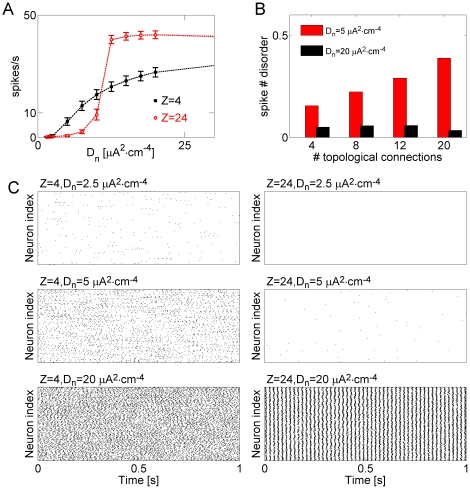
Electrical synapses (gap junctions) play a pivotal role in the synchronization of neuronal ensembles which also makes them likely agonists of pathological brain activity. Although large body of experimental data and theoretical considerations indicate that coupling neurons by electrical synapses promotes synchronous activity (and thus is potentially epileptogenic), some recent evidence questions the hypothesis of gap junctions being among purely epileptogenic factors. In particular, an expression of inter-neuronal gap junctions is often found to be higher after the experimentally induced seizures than before. Here we used a computational modeling approach to address the role of neuronal gap junctions in shaping the stability of a network to perturbations that are often associated with the onset of epileptic seizures. We show that under some circumstances, the addition of gap junctions can increase the dynamical stability of a network and thus suppress the collective electrical activity associated with seizures. This implies that the experimentally observed post-seizure additions of gap junctions could serve to prevent further escalations, suggesting furthermore that they are a consequence of an adaptive response of the neuronal network to the pathological activity. However, if the seizures are strong and persistent, our model predicts the existence of a critical tipping point after which additional gap junctions no longer suppress but strongly facilitate the escalation of epileptic seizures. Our results thus reveal a complex role of electrical coupling in relation to epileptiform events. Which dynamic scenario (seizure suppression or seizure escalation) is ultimately adopted by the network depends critically on the strength and duration of seizures, in turn emphasizing the importance of temporal and causal aspects when linking gap junctions with epilepsy.
电突触(缝隙连接)在神经元集合的同步中起着关键作用,这也使它们成为病理性脑活动的可能激动剂。尽管大量的实验数据和理论考虑表明,通过电突触耦合神经元会促进同步活动(因此可能具有致痫性),但一些最近的证据质疑缝隙连接是纯粹的致痫因素的假设。特别是,在实验诱导的癫痫发作后,神经元之间的缝隙连接的表达通常比发作前更高。在这里,我们使用计算建模方法来解决神经元缝隙连接在塑造网络对与癫痫发作起始相关的扰动的稳定性方面的作用。我们表明,在某些情况下,添加缝隙连接可以增加网络的动力学稳定性,从而抑制与癫痫发作相关的集体电活动。这意味着实验中观察到的癫痫发作后缝隙连接的增加可能有助于防止进一步恶化,并进一步表明它们是神经元网络对病理性活动的适应性反应的结果。然而,如果癫痫发作强烈且持续,我们的模型预测存在一个关键的临界点,超过这个临界点后,额外的缝隙连接不再抑制而是强烈促进癫痫发作的升级。因此,我们的研究结果揭示了电耦合与癫痫样事件之间的复杂关系。网络最终采用哪种动态场景(癫痫发作抑制或癫痫发作升级)取决于癫痫发作的强度和持续时间,这反过来强调了在将缝隙连接与癫痫联系起来时考虑时间和因果关系的重要性。