School of Physics and Astronomy, Tel Aviv University, Ramat Aviv, Israel.
PLoS Comput Biol. 2010 Aug 26;6(8):e1000909. doi: 10.1371/journal.pcbi.1000909.
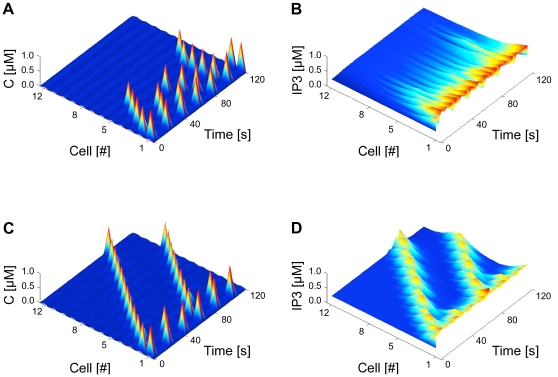
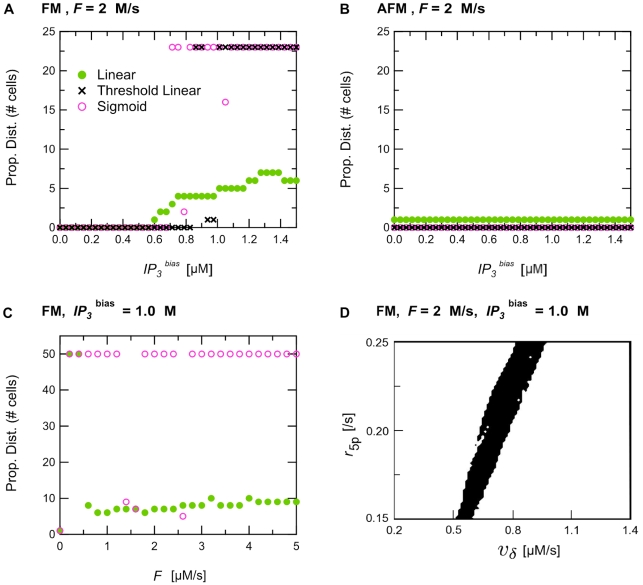
A new paradigm has recently emerged in brain science whereby communications between glial cells and neuron-glia interactions should be considered together with neurons and their networks to understand higher brain functions. In particular, astrocytes, the main type of glial cells in the cortex, have been shown to communicate with neurons and with each other. They are thought to form a gap-junction-coupled syncytium supporting cell-cell communication via propagating Ca(2+) waves. An identified mode of propagation is based on cytoplasm-to-cytoplasm transport of inositol trisphosphate (IP(3)) through gap junctions that locally trigger Ca(2+) pulses via IP(3)-dependent Ca(2+)-induced Ca(2+) release. It is, however, currently unknown whether this intracellular route is able to support the propagation of long-distance regenerative Ca(2+) waves or is restricted to short-distance signaling. Furthermore, the influence of the intracellular signaling dynamics on intercellular propagation remains to be understood. In this work, we propose a model of the gap-junctional route for intercellular Ca(2+) wave propagation in astrocytes. Our model yields two major predictions. First, we show that long-distance regenerative signaling requires nonlinear coupling in the gap junctions. Second, we show that even with nonlinear gap junctions, long-distance regenerative signaling is favored when the internal Ca(2+) dynamics implements frequency modulation-encoding oscillations with pulsating dynamics, while amplitude modulation-encoding dynamics tends to restrict the propagation range. As a result, spatially heterogeneous molecular properties and/or weak couplings are shown to give rise to rich spatiotemporal dynamics that support complex propagation behaviors. These results shed new light on the mechanisms implicated in the propagation of Ca(2+) waves across astrocytes and the precise conditions under which glial cells may participate in information processing in the brain.
一种新的范式最近在脑科学中出现,即应该将神经胶质细胞之间的通讯以及神经元-神经胶质相互作用与神经元及其网络一起考虑,以理解大脑的高级功能。特别是,星形胶质细胞,皮层中的主要胶质细胞类型,已经被证明与神经元和彼此之间进行通讯。它们被认为形成了一个缝隙连接偶联的合胞体,通过传播 Ca(2+)波来支持细胞间通讯。一种已确定的传播模式是基于通过缝隙连接进行细胞质到细胞质的三磷酸肌醇 (IP(3)) 转运,该转运通过 IP(3)依赖性 Ca(2+)诱导的 Ca(2+)释放在局部引发 Ca(2+)脉冲。然而,目前尚不清楚这种细胞内途径是否能够支持长距离再生 Ca(2+)波的传播,或者是否仅限于短距离信号传递。此外,细胞内信号动力学对细胞间传播的影响仍有待理解。在这项工作中,我们提出了一种星形胶质细胞中细胞间 Ca(2+)波传播的缝隙连接途径模型。我们的模型产生了两个主要预测。首先,我们表明长距离再生信号需要缝隙连接中的非线性耦合。其次,我们表明,即使存在非线性缝隙连接,当内部 Ca(2+)动力学实现具有脉动动力学的频率调制编码振荡时,长距离再生信号也有利于支持复杂的传播行为。而幅度调制编码动力学往往会限制传播范围。结果表明,空间异质的分子特性和/或弱耦合会导致丰富的时空动力学,从而支持复杂的传播行为。这些结果为 Ca(2+)波在星形胶质细胞中的传播所涉及的机制以及胶质细胞在大脑信息处理中可能参与的精确条件提供了新的见解。