Kawashima Motoko, Kawakita Tetsuya, Maida Yoshiko, Kamoi Mizuka, Ogawa Yoko, Shimmura Shigeto, Masutomi Kenkichi, Tsubota Kazuo
Department of Ophthalmology, Keio University School of Medicine, Tokyo, Japan.
Mol Vis. 2011;17:1397-404. Epub 2011 May 27.
Indicators of aging such as disruption of telomeric function due to shortening may be more frequent in dysfunctional lacrimal gland. The aims of this study were to 1) determine the viability of quantitative fluorescence in situ hybridization of telomeres (telo-FISH) for the assessment of telomere length in lacrimal gland in Sjögren and non- Sjögren syndrome patients; and 2) investigate the relationship between progenitor cell markers and telomere length in both groups.
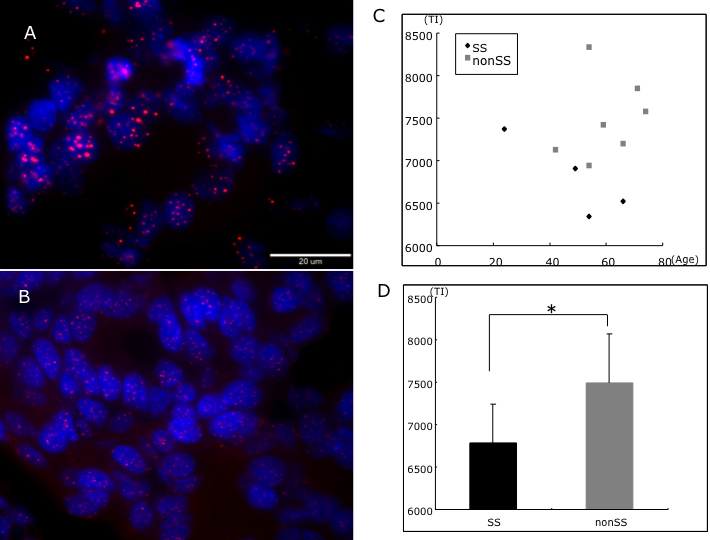
Quantitative fluorescence in situ hybridization with a peptide nucleic acid probe complementary to the telomere repeat sequence was performed on frozen sections from human lacrimal gland tissues. The mean fluorescence intensity of telomere spots was automatically quantified by image analysis as relative telomere length in lacrimal gland epithelial cells. Immunostaining for p63, nucleostemin, ATP-binding cassette, sub-family G, member 2 (ABCG2), and nestin was also performed.
Telomere intensity in the Sjögren syndrome group (6,785.0±455) was significantly lower than that in the non-Sjögren syndrome group (7,494.7±477; p=0.02). Among the samples from the non-Sjögren syndrome group, immunostaining revealed that p63 was expressed in 1-3 acinar cells in each acinar unit and continuously in the basal layer of duct cells. In contrast, in the Sjögren syndrome group, p63 and nucleostemin showed a lower level of expression. ABCG2 was expressed in acinar cells in both sjogren and non-Sjogren syndrome.
The results of this study indicate that 1) telo-FISH is a viable method of assessing telomere length in lacrimal gland, and 2) telomere length in Sjögren syndrome is shorter and associated with lower levels of expression of p63 and nucleostemin than in non-Sjögren syndrome.
由于端粒缩短导致的端粒功能破坏等衰老指标在功能失调的泪腺中可能更为常见。本研究的目的是:1)确定用于评估干燥综合征和非干燥综合征患者泪腺中端粒长度的端粒定量荧光原位杂交(telo-FISH)的可行性;2)研究两组中祖细胞标志物与端粒长度之间的关系。
使用与端粒重复序列互补的肽核酸探针进行定量荧光原位杂交,对人泪腺组织的冰冻切片进行检测。通过图像分析自动定量端粒斑点的平均荧光强度,作为泪腺上皮细胞中的相对端粒长度。还进行了p63、核仁素、ATP结合盒亚家族G成员2(ABCG2)和巢蛋白的免疫染色。
干燥综合征组的端粒强度(6,785.0±455)显著低于非干燥综合征组(7,494.7±477;p = 0.02)。在非干燥综合征组的样本中,免疫染色显示p63在每个腺泡单位的1 - 3个腺泡细胞中表达,并在导管细胞的基底层持续表达。相比之下,在干燥综合征组中,p63和核仁素的表达水平较低。ABCG2在干燥综合征和非干燥综合征的腺泡细胞中均有表达。
本研究结果表明:1)telo-FISH是评估泪腺中端粒长度的可行方法;2)干燥综合征中的端粒长度比非干燥综合征中的端粒长度短,且与p63和核仁素的低表达水平相关。