Pediatric Pain Program, Department of Pediatrics, David Geffen School of Medicine, University of California, Los Angeles, USA.
Evid Based Complement Alternat Med. 2011;2011:250708. doi: 10.1093/ecam/neq072. Epub 2011 Feb 13.
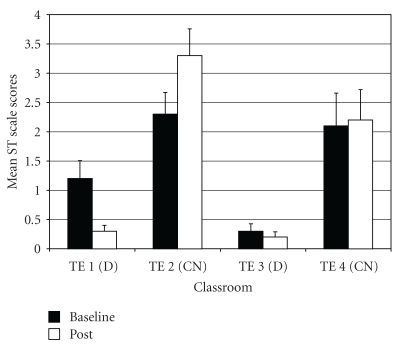
Low-income youth experience social-emotional problems linked to chronic stress that are exacerbated by lack of access to care. Drumming is a non-verbal, universal activity that builds upon a collectivistic aspect of diverse cultures and does not bear the stigma of therapy. A pretest-post-test non-equivalent control group design was used to assess the effects of 12 weeks of school counselor-led drumming on social-emotional behavior in two fifth-grade intervention classrooms versus two standard education control classrooms. The weekly intervention integrated rhythmic and group counseling activities to build skills, such as emotion management, focus and listening. The Teacher's Report Form was used to assess each of 101 participants (n = 54 experimental, n = 47 control, 90% Latino, 53.5% female, mean age 10.5 years, range 10-12 years). There was 100% retention. ANOVA testing showed that intervention classrooms improved significantly compared to the control group in broad-band scales (total problems (P < .01), internalizing problems (P < .02)), narrow-band syndrome scales (withdrawn/depression (P < .02), attention problems (P < .01), inattention subscale (P < .001)), Diagnostic and Statistical Manual of Mental Disorders-oriented scales (anxiety problems (P < .01), attention deficit/hyperactivity problems (P < .01), inattention subscale (P < .001), oppositional defiant problems (P < .03)), and other scales (post-traumatic stress problems (P < .01), sluggish cognitive tempo (P < .001)). Participation in group drumming led to significant improvements in multiple domains of social-emotional behavior. This sustainable intervention can foster positive youth development and increase student-counselor interaction. These findings underscore the potential value of the arts as a therapeutic tool.
低收入青年面临与慢性压力相关的社会情感问题,由于无法获得护理,这些问题更加严重。打鼓是一种非言语的、普遍的活动,它建立在多元文化的集体主义方面,没有治疗的污名。采用前测后测非等效对照组设计,评估了学校辅导员主导的 12 周击鼓对两个五年级干预班(共 54 名实验组和 47 名对照组)与两个标准教育对照组的社会情感行为的影响。每周的干预整合了节奏和团体咨询活动,以培养情绪管理、专注和倾听等技能。教师报告表用于评估 101 名参与者中的每一位(n = 54 名实验组,n = 47 名对照组,90%拉丁裔,53.5%女性,平均年龄 10.5 岁,范围 10-12 岁)。保留率为 100%。方差分析显示,与对照组相比,实验组在宽带量表(总问题(P <.01),内化问题(P <.02))、窄带综合征量表(退缩/抑郁(P <.02),注意力问题(P <.01),注意力不集中亚量表(P <.001))、精神障碍诊断与统计手册导向量表(焦虑问题(P <.01),注意力缺陷/多动障碍问题(P <.01),注意力不集中亚量表(P <.001),对立违抗性问题(P <.03))和其他量表(创伤后应激问题(P <.01),认知迟钝(P <.001))方面均有显著改善。参与团体击鼓导致社会情感行为的多个领域显著改善。这种可持续的干预措施可以促进积极的青年发展和增加学生与辅导员的互动。这些发现突显了艺术作为一种治疗工具的潜在价值。