Centro de Estudios Fotosintéticos y Bioquímicos, Facultad de Ciencias Bioquímicas y Farmacéuticas, Universidad Nacional de Rosario, Suipacha 531, 2000 Rosario, Argentina.
BMC Genomics. 2011 Jun 16;12:321. doi: 10.1186/1471-2164-12-321.
Under normal solar fluence, UV-B damages macromolecules, but it also elicits physiological acclimation and developmental changes in plants. Excess UV-B decreases crop yield. Using a treatment twice solar fluence, we focus on discovering signals produced in UV-B-irradiated maize leaves that translate to systemic changes in shielded leaves and immature ears.
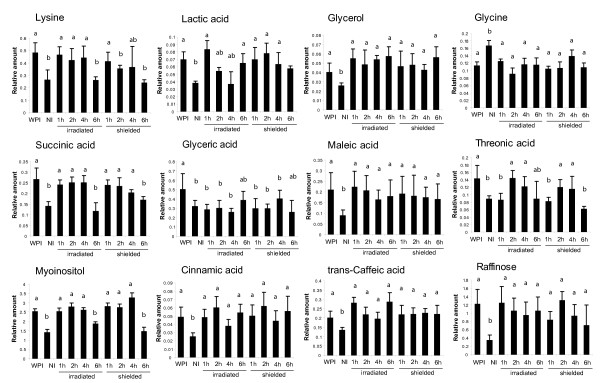
Using transcriptome and proteomic profiling, we tracked the kinetics of transcript and protein alterations in exposed and shielded organs over 6 h. In parallel, metabolic profiling identified candidate signaling molecules based on rapid increase in irradiated leaves and increased levels in shielded organs; pathways associated with the synthesis, sequestration, or degradation of some of these potential signal molecules were UV-B-responsive. Exposure of just the top leaf substantially alters the transcriptomes of both irradiated and shielded organs, with greater changes as additional leaves are irradiated. Some phenylpropanoid pathway genes are expressed only in irradiated leaves, reflected in accumulation of pathway sunscreen molecules. Most protein changes detected occur quickly: approximately 92% of the proteins in leaves and 73% in immature ears changed after 4 h UV-B were altered by a 1 h UV-B treatment.
There were significant transcriptome, proteomic, and metabolomic changes under all conditions studied in both shielded and irradiated organs. A dramatic decrease in transcript diversity in irradiated and shielded leaves occurs between 0 h and 1 h, demonstrating the susceptibility of plants to short term UV-B spikes as during ozone depletion. Immature maize ears are highly responsive to canopy leaf exposure to UV-B.
在正常的太阳辐照度下,UV-B 会破坏大分子,但它也会引起植物的生理适应和发育变化。过量的 UV-B 会降低作物产量。我们使用两倍于太阳辐照度的处理方法,专注于发现 UV-B 照射玉米叶片中产生的信号,这些信号会转化为受屏蔽叶片和未成熟耳的系统变化。
使用转录组和蛋白质组谱分析,我们在 6 小时内跟踪了暴露和屏蔽器官中转录物和蛋白质变化的动力学。同时,代谢谱分析根据照射叶片中快速增加的候选信号分子和屏蔽器官中增加的水平,确定了候选信号分子;与这些潜在信号分子的合成、隔离或降解相关的途径与 UV-B 反应。仅暴露顶部叶片就会极大地改变受照射和屏蔽器官的转录组,随着更多叶片被照射,变化更大。一些苯丙烷途径基因仅在照射叶片中表达,这反映了途径防晒分子的积累。检测到的大多数蛋白质变化发生得很快:在 1 小时的 UV-B 处理后,叶片中约 92%和未成熟耳中 73%的蛋白质在 4 小时的 UV-B 照射后发生了改变。
在受屏蔽和照射器官的所有研究条件下,均发生了显著的转录组、蛋白质组和代谢组变化。在 0 小时到 1 小时之间,受照射和屏蔽叶片中转录物多样性急剧下降,这表明植物对臭氧消耗期间短期 UV-B 峰值的敏感性。未成熟的玉米穗对冠层叶片暴露于 UV-B 非常敏感。