Division of Infectious Diseases, Johns Hopkins University, Baltimore, MD 21205, USA.
Ann Emerg Med. 2011 Jul;58(1 Suppl 1):S74-8. doi: 10.1016/j.annemergmed.2011.03.029.
We evaluate the feasibility and accuracy of existing point-of-care HIV tests performed by an untrained patient compared with the routinely used HIV point-of-care test offered to patients in 2 urban emergency departments (EDs).
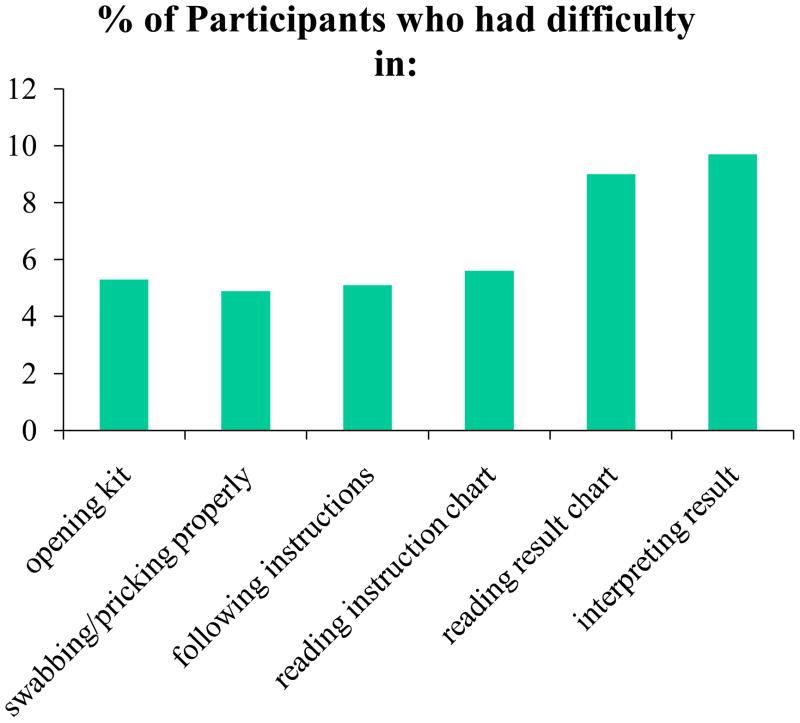
From April 2008 through December 2009, patients who had completed a standard HIV oral fluid test performed by a trained health care professional and who were unaware of their results were recruited to perform a rapid point-of-care HIV test. Patients were given a choice of the oral fluid or the fingerstick blood point-of-care test. Evaluation of acceptability to perform the mechanics of the test was accessed by questionnaire. For the "self-test," the participant obtained his or her own sample and performed the test. The patient's results were compared with standard oral fluid results obtained by the health care professional.
Overall, 478 of 564 (85%) patients receiving a standard oral fluid HIV test volunteered, with a mean age of 38 to 39 years. Ninety-one percent of participants chose oral fluid and 9% chose blood (P<.05). Self-test results were 99.6% concordant with health care professionals' test results. For the self-testers, 94% of oral fluid testers and 84.4% of blood testers reported trusting the self-administered test result "very much." Furthermore, 95.6% of the oral fluid group and 93.3% of the blood group would "probably" or "definitely" perform a test at home, if available.
This study demonstrated that a significant proportion of patients offered a self-HIV point-of-care test volunteered and preferred using oral fluid. Patients' results agreed with standard HIV point-of-care results. The majority of participants trusted their results and would perform a point-of-care HIV test at home, given the opportunity.
我们评估未经培训的患者进行即时检测(point-of-care HIV test)的可行性和准确性,与在 2 家城市急诊科常规提供给患者的即时 HIV 检测方法进行比较。
从 2008 年 4 月至 2009 年 12 月,招募了完成标准 HIV 口腔液检测的患者,这些患者由经过培训的医护人员进行检测,并且不知道自己的检测结果。患者可以选择口腔液或指尖血即时检测方法。通过问卷评估患者进行检测的可接受性。对于“自我检测”,参与者自行获取样本并进行检测。将患者的检测结果与医护人员获得的标准口腔液结果进行比较。
总体而言,在接受标准口腔液 HIV 检测的 564 名患者中,有 478 名(85%)患者自愿参与,平均年龄为 38 至 39 岁。91%的参与者选择口腔液,9%选择血液(P<.05)。自我检测结果与医护人员的检测结果 99.6%一致。对于自我检测者,94%的口腔液检测者和 84.4%的血液检测者报告非常信任自我检测的结果。此外,95.6%的口腔液组和 93.3%的血液组如果有家用即时检测方法,“很可能”或“肯定”会在家中进行检测。
本研究表明,提供自我 HIV 即时检测的患者中有很大一部分愿意参与并更倾向于使用口腔液。患者的检测结果与标准即时 HIV 检测结果一致。大多数参与者信任自己的检测结果,并愿意在有机会的情况下在家中进行即时 HIV 检测。