Ktsoyan Zhanna A, Beloborodova Natalia V, Sedrakyan Anahit M, Osipov George A, Khachatryan Zaruhi A, Kelly Denise, Manukyan Gayane P, Arakelova Karine A, Hovhannisyan Alvard I, Olenin Andrey Y, Arakelyan Arsen A, Ghazaryan Karine A, Aminov Rustam I
Institute of Molecular Biology, National Academy of Sciences of Republic of Armenia Yerevan, Republic of Armenia.
Front Microbiol. 2011 Jan 20;1:148. doi: 10.3389/fmicb.2010.00148. eCollection 2010.
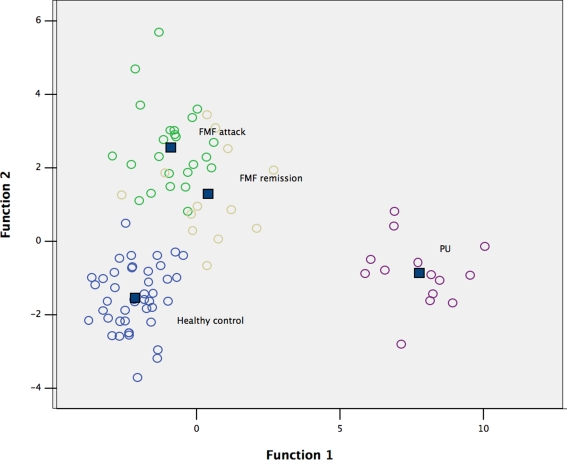
The human gastrointestinal tract is inhabited by a diverse and dense symbiotic microbiota, the composition of which is the result of host-microbe co-evolution and co-adaptation. This tight integration creates intense cross-talk and signaling between the host and microbiota at the cellular and metabolic levels. In many genetic or infectious diseases the balance between host and microbiota may be compromised resulting in erroneous communication. Consequently, the composition of the human metabolome, which includes the gut metabolome, may be different in health and disease states in terms of microbial products and metabolites entering systemic circulation. To test this hypothesis, we measured the level of hydroxy, branched, cyclopropyl and unsaturated fatty acids, aldehydes, and phenyl derivatives in blood of patients with a hereditary autoinflammatory disorder, familial Mediterranean fever (FMF), and in patients with peptic ulceration (PU) resulting from Helicobacter pylori infection. Discriminant function analysis of a data matrix consisting of 94 cases as statistical units (37 FMF patients, 14 PU patients, and 43 healthy controls) and the concentration of 35 microbial products in the blood as statistical variables revealed a high accuracy of the proposed model (all cases were correctly classified). This suggests that the profile of microbial products and metabolites in the human metabolome is specific for a given disease and may potentially serve as a biomarker for disease.
人类胃肠道中栖息着种类繁多且密集的共生微生物群,其组成是宿主与微生物共同进化和共同适应的结果。这种紧密的整合在细胞和代谢水平上造成了宿主与微生物群之间强烈的相互作用和信号传递。在许多遗传或感染性疾病中,宿主与微生物群之间的平衡可能会受到破坏,从而导致错误的交流。因此,就进入体循环的微生物产物和代谢物而言,包括肠道代谢组在内的人类代谢组的组成在健康和疾病状态下可能会有所不同。为了验证这一假设,我们测量了患有遗传性自身炎症性疾病——家族性地中海热(FMF)的患者以及因幽门螺杆菌感染导致消化性溃疡(PU)的患者血液中羟基、支链、环丙基和不饱和脂肪酸、醛类和苯基衍生物的水平。以94个病例作为统计单位(37名FMF患者、14名PU患者和43名健康对照)组成的数据矩阵以及血液中35种微生物产物的浓度作为统计变量进行判别函数分析,结果显示所提出的模型具有很高的准确性(所有病例均被正确分类)。这表明人类代谢组中微生物产物和代谢物的特征对于特定疾病具有特异性,并且可能潜在地用作疾病的生物标志物。