Marshall Catherine A, Larkey Linda K, Curran Melissa A, Weihs Karen L, Badger Terry A, Armin Julie, García Francisco
Center of Excellence in Women's Health and Frances McClelland Institute for Children, Youth, & Families, Norton School of Family & Consumer Sciences, University of Arizona, Tucson, AZ 85721-0078, USA.
Fam Syst Health. 2011 Jun;29(2):81-94. doi: 10.1037/a0023975.
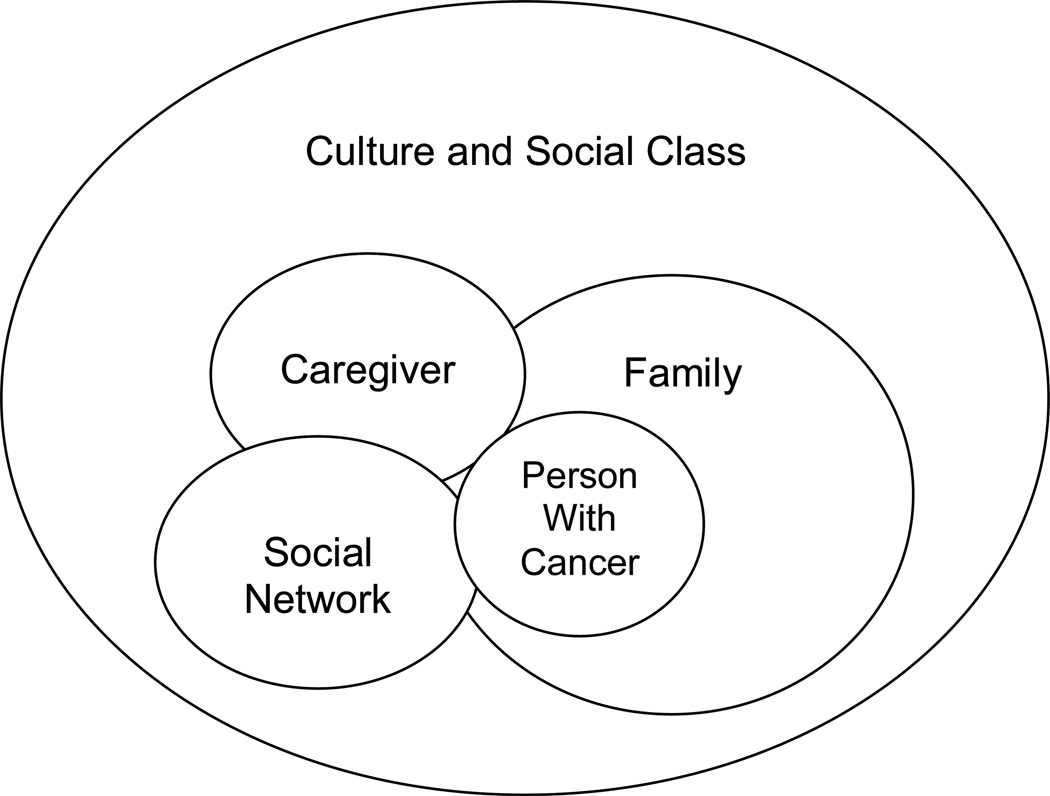
Cancer is a family experience, and family members often have as much, or more, difficulty in coping with cancer as does the person diagnosed with cancer. Using both family systems and sociocultural frameworks, we call for a new model of health promotion and psychosocial intervention that builds on the current understanding that family members, as well as the individuals diagnosed with cancer, are themselves survivors of cancer. We argue that considering culture, or the values, beliefs, and customs of the family, including their choice of language, is necessary to understand fully a family's response to cancer. Likewise, acknowledging social class is necessary to understand how access to, and understanding of, otherwise available interventions for families facing cancer can be limited. Components of the model as conceptualized are discussed and provide guidance for psychosocial cancer health disparities research and the development of family-focused, strength-based, interventions.
癌症是一种涉及整个家庭的经历,家庭成员在应对癌症时往往会遇到与被诊断患有癌症的人同样多甚至更多的困难。运用家庭系统和社会文化框架,我们倡导一种新的健康促进和心理社会干预模式,该模式基于当前的认识,即家庭成员以及被诊断患有癌症的个体本身都是癌症幸存者。我们认为,考虑文化,即家庭的价值观、信仰和习俗,包括他们对语言的选择,对于全面理解家庭对癌症的反应是必要的。同样,认识到社会阶层对于理解面临癌症的家庭获得以及理解其他可用干预措施的机会如何可能受到限制也是必要的。文中所构想的该模式的组成部分将被讨论,并为心理社会癌症健康差异研究以及以家庭为重点、基于优势的干预措施的开发提供指导。