Cellular Neuroscience, Neurodegeneration and Repair Program, Department of Neurology, Yale School of Medicine, New Haven, CT 06536-0812, USA.
Exp Neurol. 2012 May;235(1):43-52. doi: 10.1016/j.expneurol.2011.06.006. Epub 2011 Jun 15.
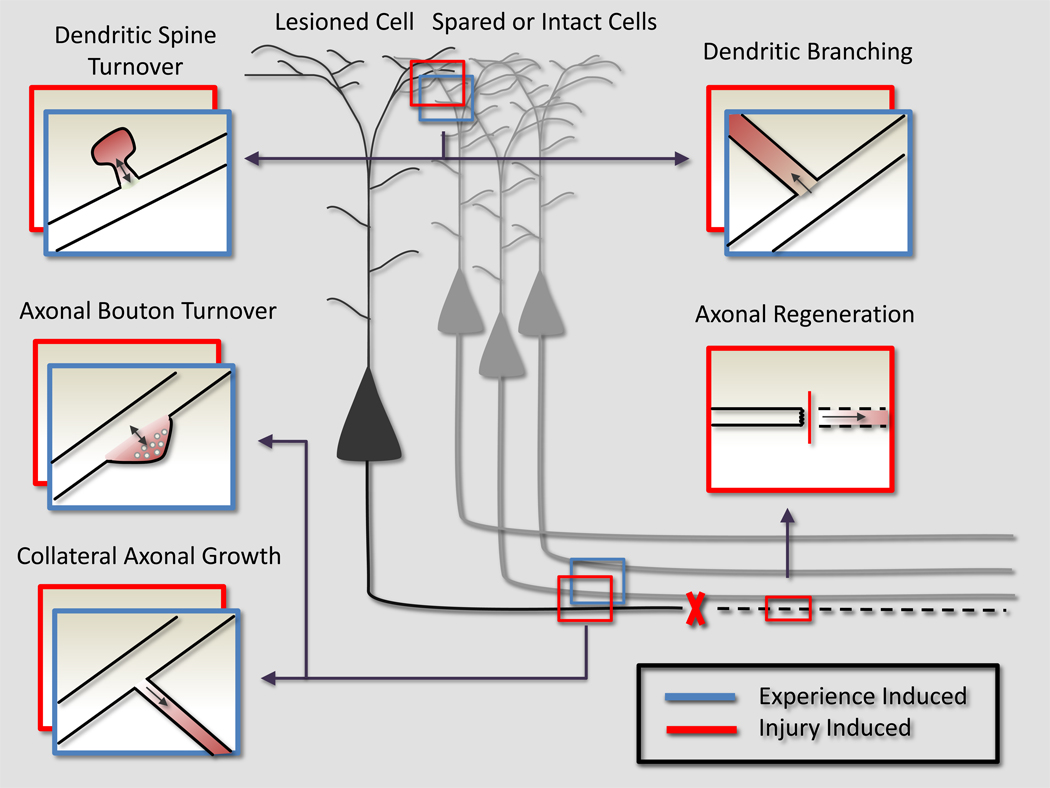
In the adult, both neurologic recovery and anatomical growth after a CNS injury are limited. Two classes of growth inhibitors, myelin associated inhibitors (MAIs) and extracellular matrix associated inhibitors, limit both functional recovery and anatomical rearrangements in animal models of spinal cord injury. Here we focus on how MAIs limit a wide spectrum of growth that includes regeneration, sprouting, and plasticity in both the intact and lesioned CNS. Three classic myelin associated inhibitors, Nogo-A, MAG, and OMgp, signal through their common receptors, Nogo-66 Receptor-1 (NgR1) and Paired-Immunoglobulin-like-Receptor-B (PirB), to regulate cytoskeletal dynamics and inhibit growth. Initially described as inhibitors of axonal regeneration, subsequent work has demonstrated that MAIs also limit activity and experience-dependent plasticity in the intact, adult CNS. MAIs therefore represent a point of convergence for plasticity that limits anatomical rearrangements regardless of the inciting stimulus, blurring the distinction between injury studies and more "basic" plasticity studies.
在成年人中,中枢神经系统损伤后的神经恢复和解剖生长都受到限制。有两类生长抑制剂,髓鞘相关抑制剂(MAIs)和细胞外基质相关抑制剂,它们限制了脊髓损伤动物模型中的功能恢复和解剖重排。在这里,我们重点关注 MAIs 如何限制广泛的生长,包括未受损和受损中枢神经系统中的再生、发芽和可塑性。三种经典的髓鞘相关抑制剂,Nogo-A、MAG 和 OMgp,通过其共同的受体 Nogo-66 受体-1(NgR1)和配对免疫球蛋白样受体-B(PirB)信号转导,调节细胞骨架动力学并抑制生长。最初被描述为轴突再生的抑制剂,随后的研究表明,MAIs 也限制了未受损的成年中枢神经系统中的活动和经验依赖性可塑性。因此,MAIs 代表了一个可塑性的汇聚点,它限制了无论刺激因素如何,解剖重排的发生,模糊了损伤研究和更“基础”的可塑性研究之间的区别。